You have 0 items in your cart
Key takeaways
- Structured business development separates growing agencies from stagnant ones as firms that treat BD as a discipline see predictable revenue instead of relying on sporadic referrals and cold calls.
- Multi-channel outreach works better than cold calling alone because decision-makers respond to coordinated sequences across email, LinkedIn, and phone that build familiarity before the ask.
- Client retention drives more revenue than new client acquisition since expanding existing accounts costs less and closes faster than constantly chasing new logos.
- Integrated ATS and CRM platforms give business development teams the visibility they need to track every touchpoint, forecast accurately, and focus on conversations that actually close business.
Many staffing firms work hard on outreach but still see uneven results. Recent data shows that 23% of staffing agencies now identify finding new clients as their biggest hurdle, up 7 percentage points year-over-year.
Structured business development for staffing agencies makes the difference between occasional wins and steady revenue.
This article walks through eight practical strategies to build a stronger pipeline, deepen client partnerships, and support long-term staffing agency growth.
What is business development for staffing agencies?
Business development for staffing agencies is a strategic process for winning new clients, strengthening relationships, and expanding services that build long-term revenue. It goes beyond one-off sales efforts.
Effective business development starts with identifying high-potential clients using CRM data, past placements, and market research. Teams plan targeted outreach through email, social platforms, and calls, while making sure the agency’s online presence attracts inbound leads.
1. Define your ideal client profile and market niche
Business development becomes easier when your team knows exactly which organisations you want to serve. A clear ideal client profile keeps staffing business development focused on prospects most likely to convert and stay.
Your ideal client profile should include:
- Company size and team structure
- Typical hiring volume and frequency
- Budget range and decision-making process
- Culture and attitude toward recruitment partners
Review your historical data to see which clients are most profitable. The Bureau of Labor Statistics projects that healthcare and social assistance will grow 8.4% through 2034, making it the fastest-growing sector. Professional services follow at 7.5%, fueled by AI and cybersecurity demand.
Once you choose a niche, refine your messaging to match that sector’s hiring challenges. A tighter niche means clearer positioning and shorter sales cycles.
2. Build a predictable sales pipeline
A predictable pipeline keeps opportunities moving even when individual deals slow down. Sales strategies for staffing agencies work best when outreach and follow-ups happen on a consistent schedule.
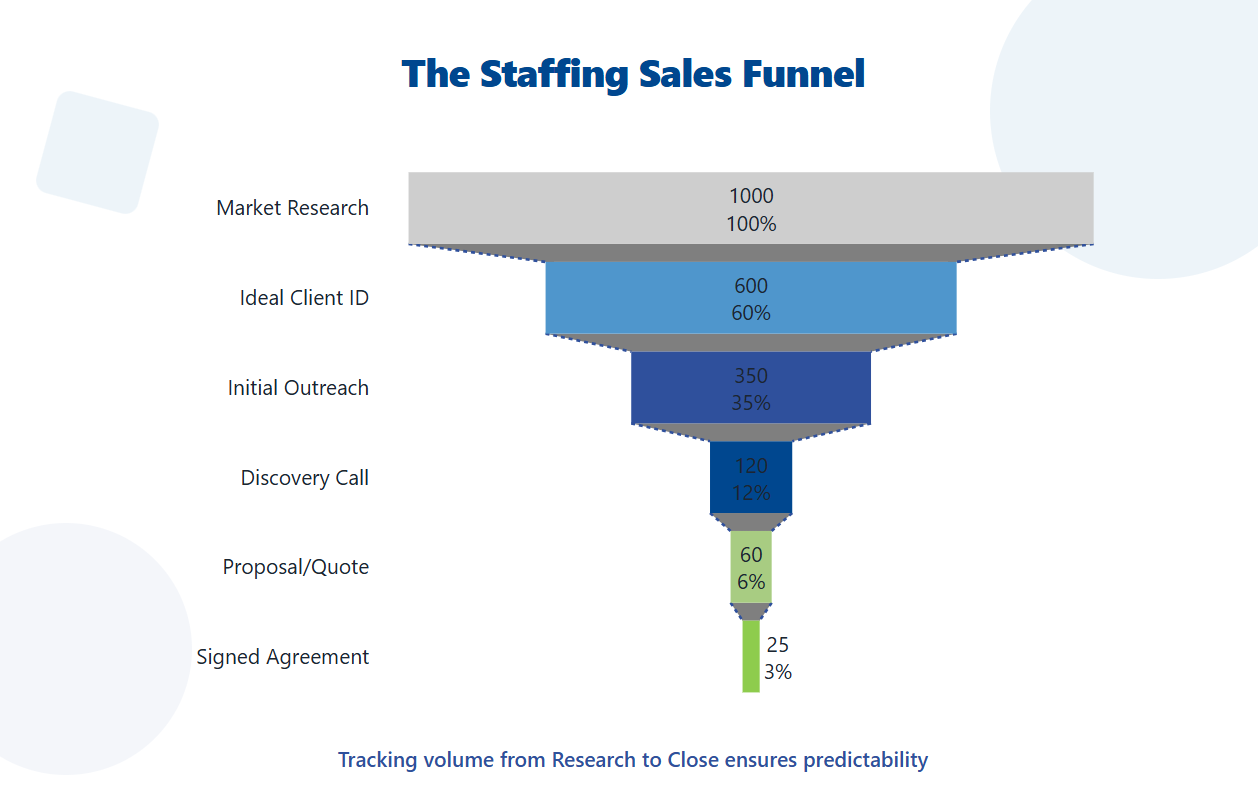
Treat your pipeline as clear stages, from early research through signed agreement. For each stage, define:
- What actions move a prospect forward
- Who owns those actions on your team
- How and when you follow up
Use your ATS + CRM to record every touchpoint and schedule next steps. Simple habits like updating deal stages and logging calls create visibility into where each opportunity stands.
3. Develop multi-channel outreach campaigns
Modern business development for staffing agencies depends on reaching prospects in more than one way. Decision-makers receive countless messages daily, so relying on cold calls alone makes it easy to get ignored.

Design outreach sequences that combine several channels:
- Personalized email campaigns that reference specific roles, skills, or hiring goals
- LinkedIn connection requests and follow-up messages that show market understanding
- Warm calls that build on earlier digital touchpoints
- Referral requests from existing clients who fit a similar profile
Use automation to schedule and track outreach, then refine campaigns based on response patterns.
4. Strengthen your agency’s brand and market visibility
A strong brand makes every outreach attempt more familiar and less intrusive. When prospects already know who you are, they are more likely to open your email or respond on LinkedIn. That is why staffing agency marketing and business development should support each other.

Useful content plays a major role. Examples include:
- Short hiring trend summaries for your niche
- Salary or rate snapshots by role and region
- Practical guides on building effective job specs or interview processes
Businesses with blogs generate 67% more leads than those without, and branded video convinces 88% of viewers to make a purchase decision. When you publish material that solves real problems for hiring managers, you build familiarity and trust long before your first direct conversation.
5. Use data and technology to scale outreach
Integrated platforms make it easier to track activity, personalise outreach, and see what works. An ATS + CRM built for agencies supports staffing agency growth in a sustainable way.
Your core system should:
- Centralise contact, account, and opportunity data
- Record emails, calls, and meetings in one place
- Allow you to build and run simple outreach sequences
- Provide dashboards that show key pipeline and revenue metrics
Automation handles repetitive tasks like follow-up reminders and status updates, freeing your team to focus on higher-value conversations. End-to-end staffing management software gives your business development team clear context before each interaction and a straightforward way to track results.

6. Focus on relationship management and client retention
Winning new business is important, but building client relationships that last often brings a higher return.
Strong relationship management includes:
- Regular check-ins after placements to review performance and candidate fit
- Scheduled calls or emails to share market insights and talent trends
- Proactive outreach before renewal dates or known hiring cycles

Quarterly business reviews help structure these conversations. Use them to review outcomes, discuss upcoming projects, and surface any gaps in coverage. The shift toward strategic talent advisor roles reflects what clients expect in 2025. They want recruiters who understand hiring patterns, anticipate future needs, and provide market intelligence that validates their decisions.
7. Expand existing accounts through upselling and cross-selling
Growing revenue within existing clients is often faster and more cost-effective than continually finding new ones. By understanding how a client’s organisation is structured, your team can identify areas where your services are not yet in use but would add value.
Examples include:
- Adding permanent search alongside existing contract staffing
- Supporting additional departments or locations under the same parent company
- Introducing new service tiers, such as retained search or project-based hiring support
Use your staffing agency’s performance data to support these conversations. Metrics like fill rates, time to present, or hiring manager satisfaction give you concrete proof of value.
8. Track KPIs and continuously improve business development performance
Without clear metrics, business development activity quickly becomes guesswork. To turn outreach into predictable revenue, staffing firms need a simple set of KPIs and a regular rhythm for reviewing them.

Useful metrics for business development include:
- New client acquisition rate
- Conversion rate from first meeting to signed agreement
- Client retention and churn
- Revenue per client or account
Track both leading indicators, like outreach volume and meetings booked, and lagging indicators, like placements and revenue. Review these metrics as a team and adjust your playbook based on what you see. Over time, this cycle of measurement and refinement supports more effective business development for staffing agencies and more confident growth planning.
Powering business development efficiency with Tracker
Tracker brings your recruiting ATS, sales CRM, and marketing tools into one platform so business development work is easier to plan, track, and improve. Teams see the full picture of clients, candidates, and open jobs in a single workspace.
Core Tracker features that support business development for staffing agencies include:
- Recruitment ATS and CRM: Centralised job, client, and candidate records with resume parsing, skills profiling, and auto-match

- Sales workflows and automation: Task tracking, email and SMS templates, and configurable sequences that keep outreach consistent across the team

- Marketing and automation tools: Email campaigns, telesales tools, and website and job board integrations that send new leads directly into Tracker
- Reporting and collaboration: Custom dashboards, Big Screens, and collaboration tools that show real-time KPIs

Palmer Group transformed their operations by implementing Tracker to accommodate various workflow configurations across different staffing types. The platform automated essential emails, marketing, tracking, and reporting, making their recruiters and sales teams significantly more effective.
To review the full range of tools for sales, recruiting, marketing, and reporting, explore the Tracker feature roundup.
Turning business development strategies into measurable growth
Sustainable success in staffing comes from repeatable systems, data visibility, and relationships that grow stronger with every interaction. When you treat business development for staffing agencies as a structured discipline rather than an ad-hoc activity, your pipeline becomes easier to manage and forecast.
Start by clarifying your ideal clients, designing consistent outreach, and using technology to keep every interaction organised. Then focus on deepening existing relationships and expanding accounts that trust your work. As you put these eight strategies into practice, tools like Tracker can act as a central hub for your sales, recruiting, and account teams.
Strengthen client relationships and grow your agency with confidence. Tracker’s all-in-one ATS + CRM helps your team automate outreach, track performance, and win more business. Schedule a personalized demo to see how Tracker supports growth for staffing agencies.
FAQs
How would a new staffing company typically go about finding clients?
New staffing firms often begin by defining a clear niche, building a targeted prospect list, and reaching out through email, LinkedIn, and warm introductions. Early wins usually come from focused outreach, strong referrals, and quick follow-through on every opportunity.
What are the key steps involved in business development for a staffing firm?
Key steps include researching target markets, defining an ideal client profile, planning outreach campaigns, holding discovery calls, presenting tailored solutions, and keeping a regular follow-up rhythm. Ongoing account management and review conversations keep relationships active.
How can staffing agencies effectively implement business development strategies?
Agencies see the best results when they document a simple playbook, train both sales and recruiting teams on shared goals, and use an ATS + CRM to track every activity. Regular KPI reviews help teams refine what works and drop tactics that do not deliver.