You have 0 items in your cart
Key Takeaways
- The best job posts start with clear basics so candidates know right away if the role fits.
- Stating the salary range and job location early saves time for both recruiters and applicants.
- A job description reads better when it names must have skills and skips vague filler.
- A straightforward application form keeps qualified people from walking away for no good reason.
- If the applicant flow looks off, small edits to the job title and requirements can change what comes in.
A job posting that brings in 200 applications might sound successful until you realize only 10 are qualified. The problem isn’t volume, it’s clarity. When candidates can’t assess fit quickly, they either skip the role or apply without understanding it, clogging your funnel with mismatched applicants.
A strong job posting sets expectations, builds trust, and moves the right candidates from view to apply.
The shifts in the job posting process
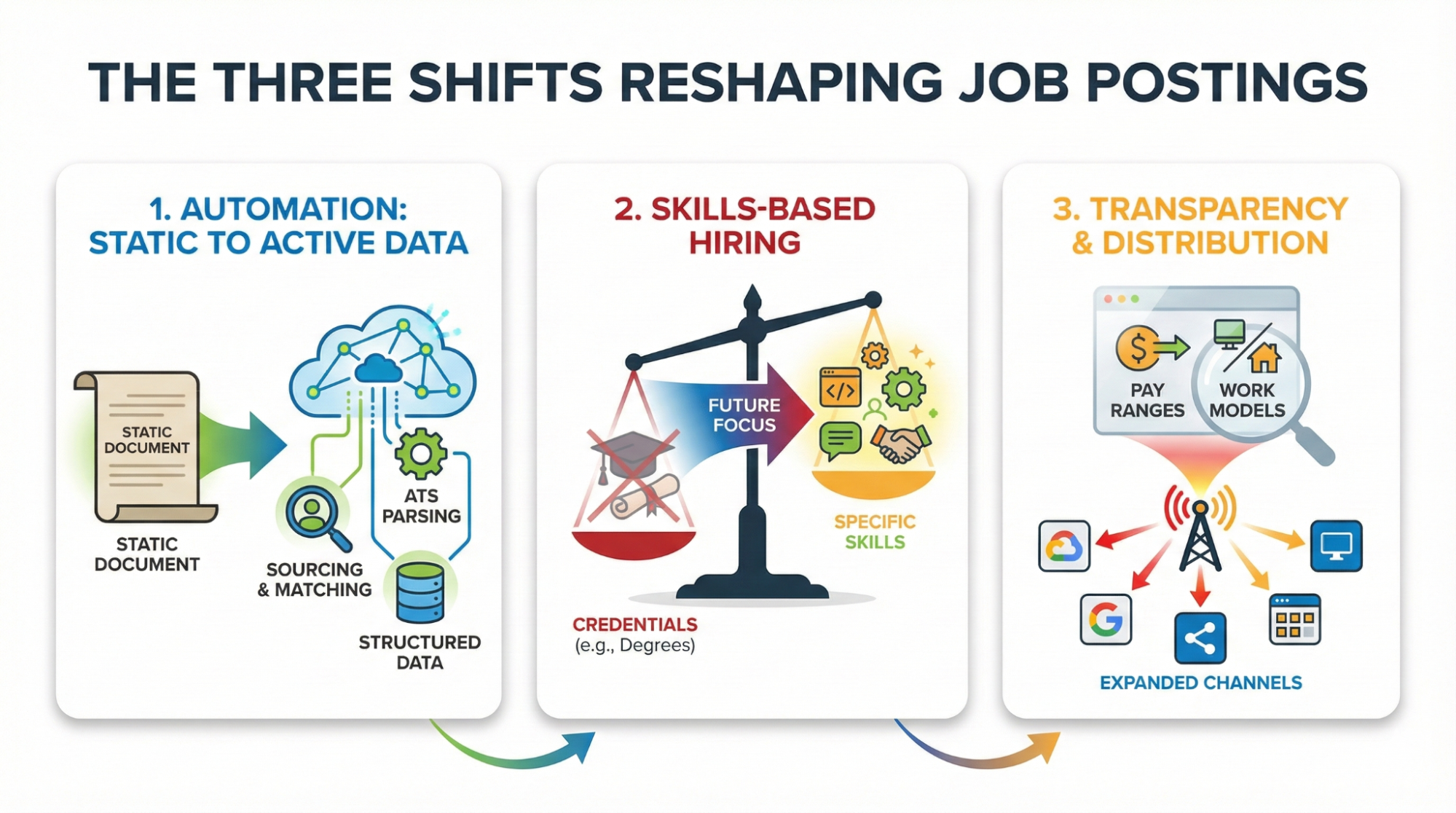
Three major shifts are reshaping how job posts work.
First, automation has moved job postings from static documents to active data sources. Applicant tracking systems parse postings to power sourcing, screening, and candidate matching. Clean, structured job details directly affect system performance.
Second, skills-based hiring is replacing credential filters. The World Economic Forum projects that a substantial proportion of core skills for the existing job market will change by 2030. Job posts now need to articulate specific skills rather than rely on proxies like “Bachelor’s degree required.”
Third, transparency has become non-negotiable. Candidates expect pay ranges, work models, and clear next steps before applying. Distribution has expanded beyond job boards to social channels and aggregators like Google for Jobs, requiring tighter quality control across platforms.
How to write a job posting that attracts more candidates
A high-performing job post is easier to scan, easier to trust, and easier to act on.
This checklist focuses on what candidates filter on first and what recruiting teams need to keep the funnel moving.
1. Use job titles that candidates search for
The job title drives relevance and search visibility. Titles should match how candidates search, not how internal teams label roles.

If qualifiers are needed, keep them practical: seniority level, shift, or region. “Senior Software Engineer – Python” works. “Senior Full Stack Software Engineer Expert in Python, Django, React, PostgreSQL, AWS” doesn’t.
Match the title to real search results.
2. Put pay, location, and work model up front
Candidates decide whether to keep reading based on salary range, location, and work model. Pay transparency cuts guesswork and builds trust. Research shows 72% of candidates are more likely to apply for a job if the salary is listed.
State remote job or work from home, hybrid, or on-site location and facilities up front, including travel and flexible working hours.
If the role spans multiple locations, list them. This clarifies eligibility requirements.
3. Open with a short role summary that clarifies impact
Job listing should explain what the role supports and what success looks like. Keep the job description to two sentences: one defines the core purpose, the next describes a clear outcome.
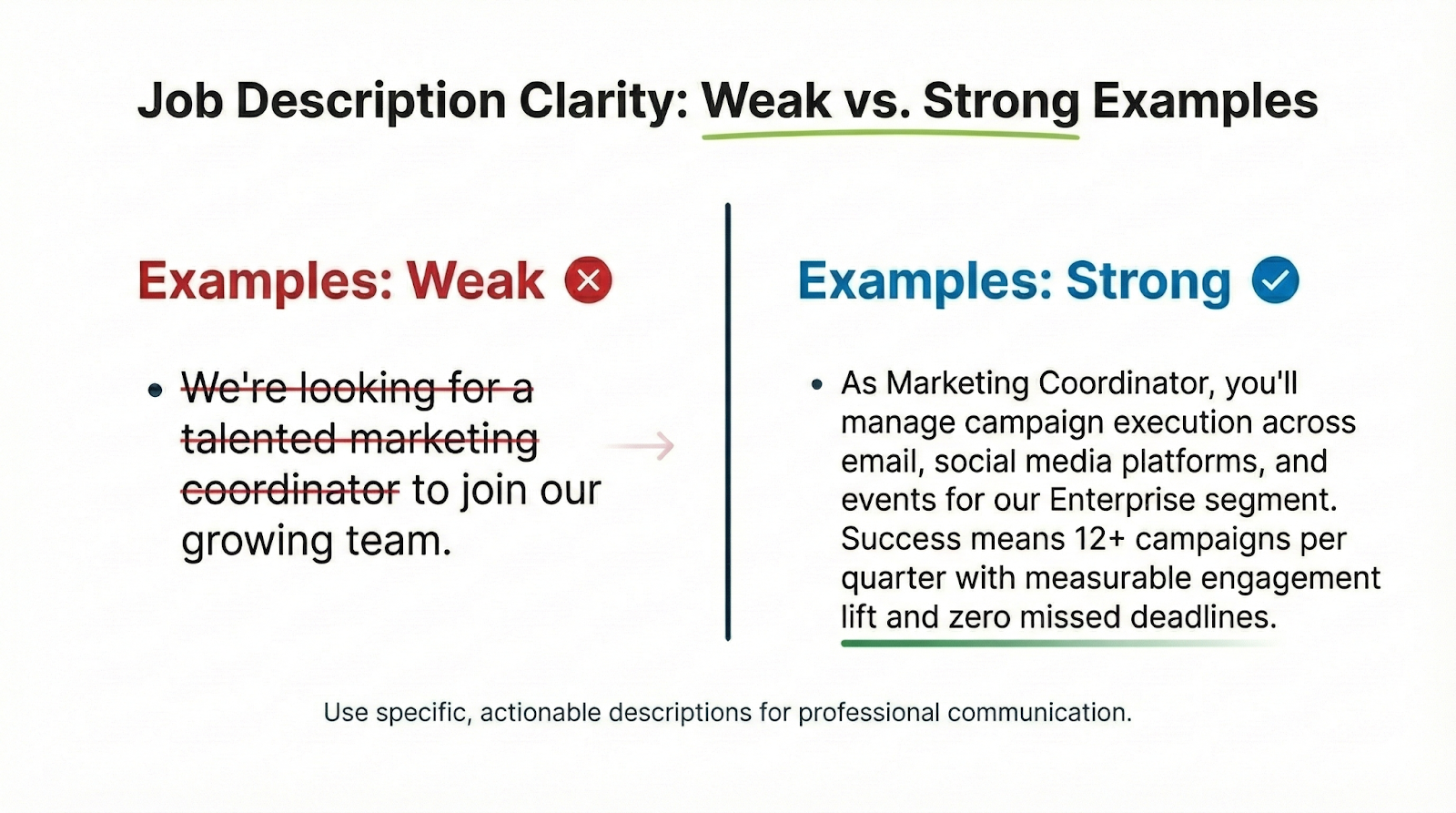
This makes the posting easier to assess and cuts mismatched applications.
4. Make responsibilities specific and skimmable
Responsibilities should be written for fast scanning. Use 3 to 5 bullets that focus on outcomes, not vague tasks.

Clear responsibilities improve screening consistency and help candidates picture the work.
5. Separate must-have job posting requirements from nice-to-haves
Teams lose strong applicants by treating screening criteria as hard filters. Split qualifications into must-haves and nice-to-haves. Must-haves should be few, measurable, and tied to responsibilities. Nice to haves can include tools, industry exposure, or strengths that shorten ramp time.
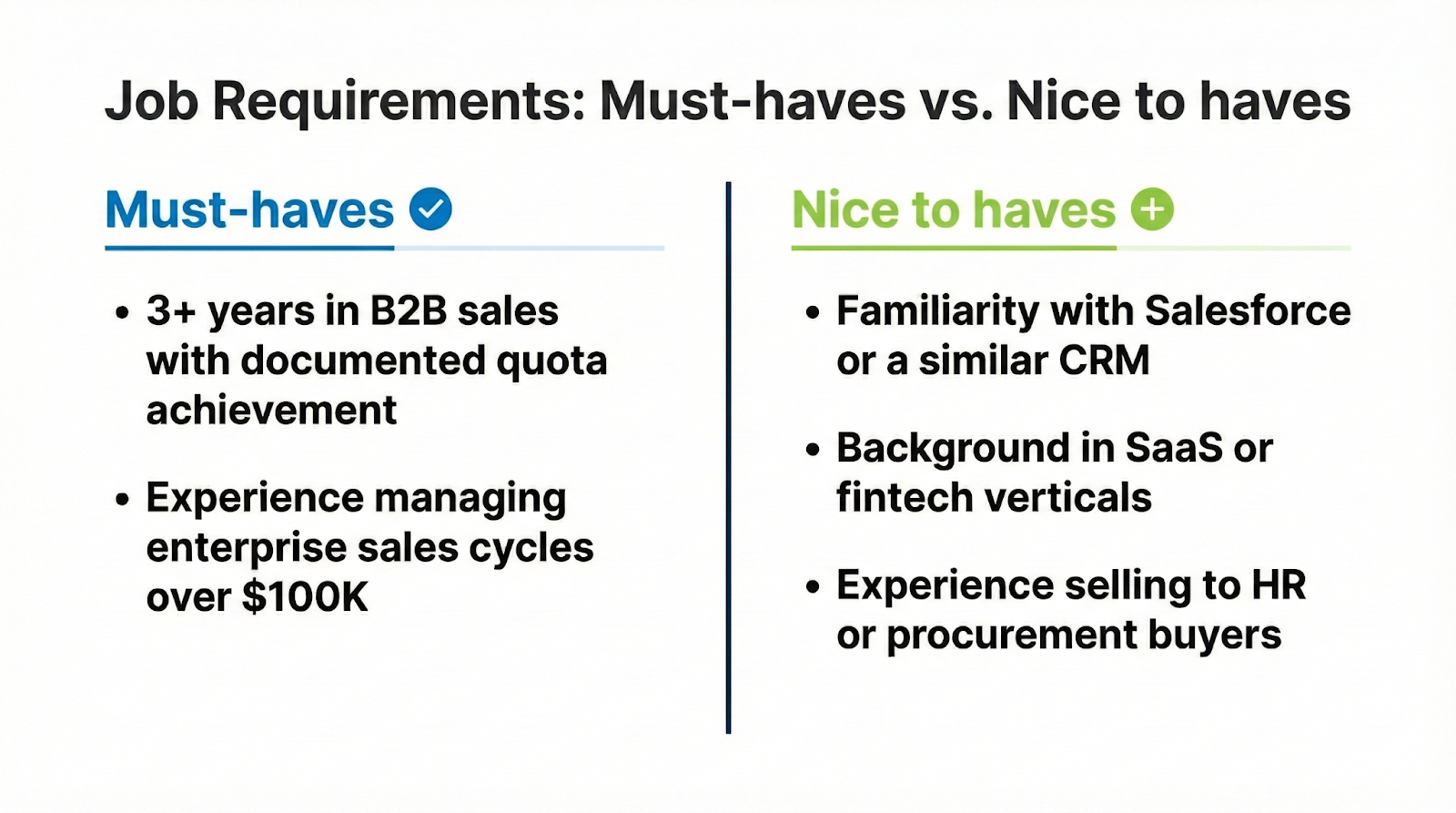
Research from Harvard Business School shows that skills-based hiring leads to better retention. Clear applicant qualifications help recruiters and hiring managers agree on standards before the posting goes live.
6. Use inclusive, plain language and remove bias
Using inclusive and plain language widens the pool without lowering standards. Remove coded terms and unnecessary constraints. Replace “rockstar” or “ninja” with “experienced” or “skilled.” Avoid “native English speaker” when the requirement is writing quality. State it as “strong written communication skills.”
Gender-neutral language also supports neuroinclusive hiring practices by making expectations clear and literal.
7. Include the details candidates decide on
Candidates look for details that help them picture the work. Start with what the company does and why it matters to provide context before job responsibilities.
Include schedule, team context, core tools, travel expectations, and certification needs.

Transparent job details lay the foundation for stronger candidate relationships.
8. Be clear about how to apply and what happens next
Make the application method easy to follow. State what to submit, what formats are accepted, and where to apply. Keep language consistent across channels.
List required materials clearly: resume, portfolio, or certification proof. If the process includes prescreen questions, keep them short and role-relevant.
Outline the hiring steps and timeline. Example: “Application review (3-5 days) → Phone screen → Team interview → Offer.” This reduces uncertainty and keeps candidates engaged.

9. Reduce friction in the application process
The application form shapes the job seeker experience. Drop off happens when forms are long, mobile flow is awkward, or candidates repeat information. With over half of job views occurring on mobile devices, forms need to work smoothly on smaller screens.
Keep the required fields to what’s needed for the first screen. Make the resume upload simple. If you request additional application materials, explain why they matter.
Avoid common friction points: requiring account creation before applying, asking candidates to re-enter resume data, or using overly broad salary ranges that signal a lack of transparency.
10. Follow job posting compliance basics
Job posting compliance should be part of publishing discipline. Keep language non-discriminatory and consistent with equal opportunity practices. Pay transparency requirements vary by location. If personal data is collected, align with data handling and privacy practices.
11. Make job postings easier to find in search and Google for Jobs
Search visibility improves when postings use a clean structure and consistent fields. Use a clear title, scannable sections, and consistent employment type and location details. SEO strategies include stable titles across channels and predictable placement of key details. For Google for Jobs, support JobPosting structured data. Treat job posting guidelines as a checklist for readability and consistency across systems.
12. Treat job postings as performance assets and iterate
A job post should be treated as a working asset. Teams can review view-to-apply rates, apply completion, and qualified applicant flow by source. Iteration often means tightening the title, clarifying must-haves, or simplifying application steps.
Distribution choices can be tested. Some roles benefit from niche job boards, others from broader reach. Teams expanding beyond traditional channels often turn to social recruiting and social media sourcing.
How long will a job posting stay up on common platforms?
| Platform | Typical posting duration | What affects duration |
|---|---|---|
| 30 days | Repost after 30 days to reset freshness | |
| Indeed | 30 days (organic) | Sponsor to maintain visibility after 14 days |
| Google for Jobs | Defined by schema | Use validThrough tag to manage expiration |
Making job posting best practices repeatable at scale
Individual postings are manageable. The challenge surfaces at 50+ job roles across multiple boards with different stakeholders and approval chains.
Quality breaks down predictably: one recruiter includes salary, another doesn’t. Hiring managers copy outdated postings. The same role gets published three ways across platforms. Applicants arrive from disconnected sources.

What a repeatable process includes:
- Approved templates with fixed fields for pay, location, work model, and application steps
- Stakeholder alignment on must-haves before publishing
- Review workflows so edits don’t bypass quality checks
- Clear ownership to prevent conflicting updates
- Centralized tracking to see which postings convert
- Standardized recruitment marketing and automation workflows
This makes it easier to decide how to post jobs without rebuilding the process every time.
Turn better job postings into a repeatable recruiting workflow with Tracker
When publishing, distribution, and applicant intake sit in different systems, it’s harder to keep postings consistent and respond quickly. A unified recruitment software supports faster distribution, centralized review, and clearer follow-up.
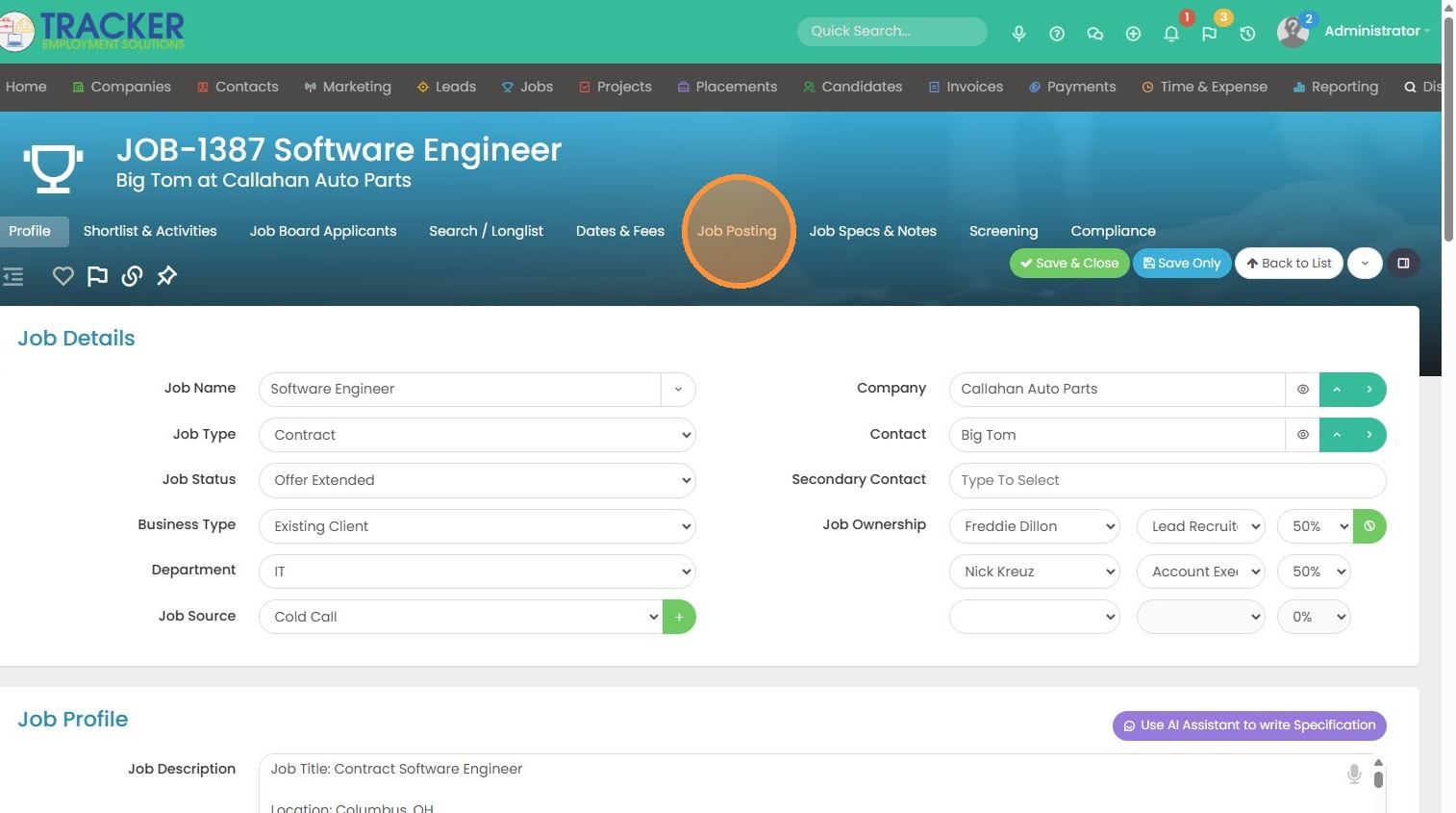
Tracker features connect job posting and applicant handling:
- Website jobs with one line of code: Publishes postings without manual updates
- Jobs+ for full SEO and job management: Supports a job microsite with candidate registration
- Fully integrated job board post: Distributes to integrated job boards with social sharing
- Automatic collection with auto-parse: Captures applicants into structured profiles
- Instant shortlist, long list, keep or reject: Standardizes review actions
- Bulk email and text/SMS: Supports consistent follow-up with automated sequences
- Team coordination: Built-in collaboration tools keep hiring teams aligned
Closing thought: Make job posting best practices part of the process
Job posts perform when treated as a repeatable step in the recruitment process. Clear details, transparent expectations, and simple application steps cut drop off and improve applicant quality.
If the job posting is where the funnel slows down, Tracker keeps posting and applicant handling consistent without extra manual steps.
Request a demo and walk through the workflow from posting to applicant review.