You have 0 items in your cart
Key takeaways
- Converting incoming resumes into structured candidate profiles cuts the manual back-and-forth that slows screening and matching.
- Data rules decide the results. Clear field mapping and consistent intake prevent duplicate records, missing fields, and messy titles that weaken candidate search and reporting.
- Standardized skills and work history fields make matching and redeployment faster, because profiles can be compared without resume formatting getting in the way.
- AI helps handle layout variation, but it does not remove exceptions. Teams still need quick checks on high-impact fields like current title, location, dates, and core skills.
Recruiters and staffing teams often deal with a large number of candidates coming from various sources like job boards, referrals, emails, and direct applications. When candidate information arrives in different formats and locations, it can lead to wasted time due to manual data entry, duplicate records, and inconsistent profiles.
With the right tools in place, resume parsing can alleviate these issues by converting resumes into structured profiles that recruiters can easily search, review, and match with minimal manual effort.
This guide will explain how resume parsing functions in 2026, the operational advantages it offers, and the best practices to maintain data quality across ATS and CRM workflows.
What is resume parsing and how does it work?
Resume parsing converts a resume into structured candidate data that can be stored, searched, and reused. Instead of manually transferring details into an ATS or CRM, a resume parser extracts candidate information and maps it into profile fields.
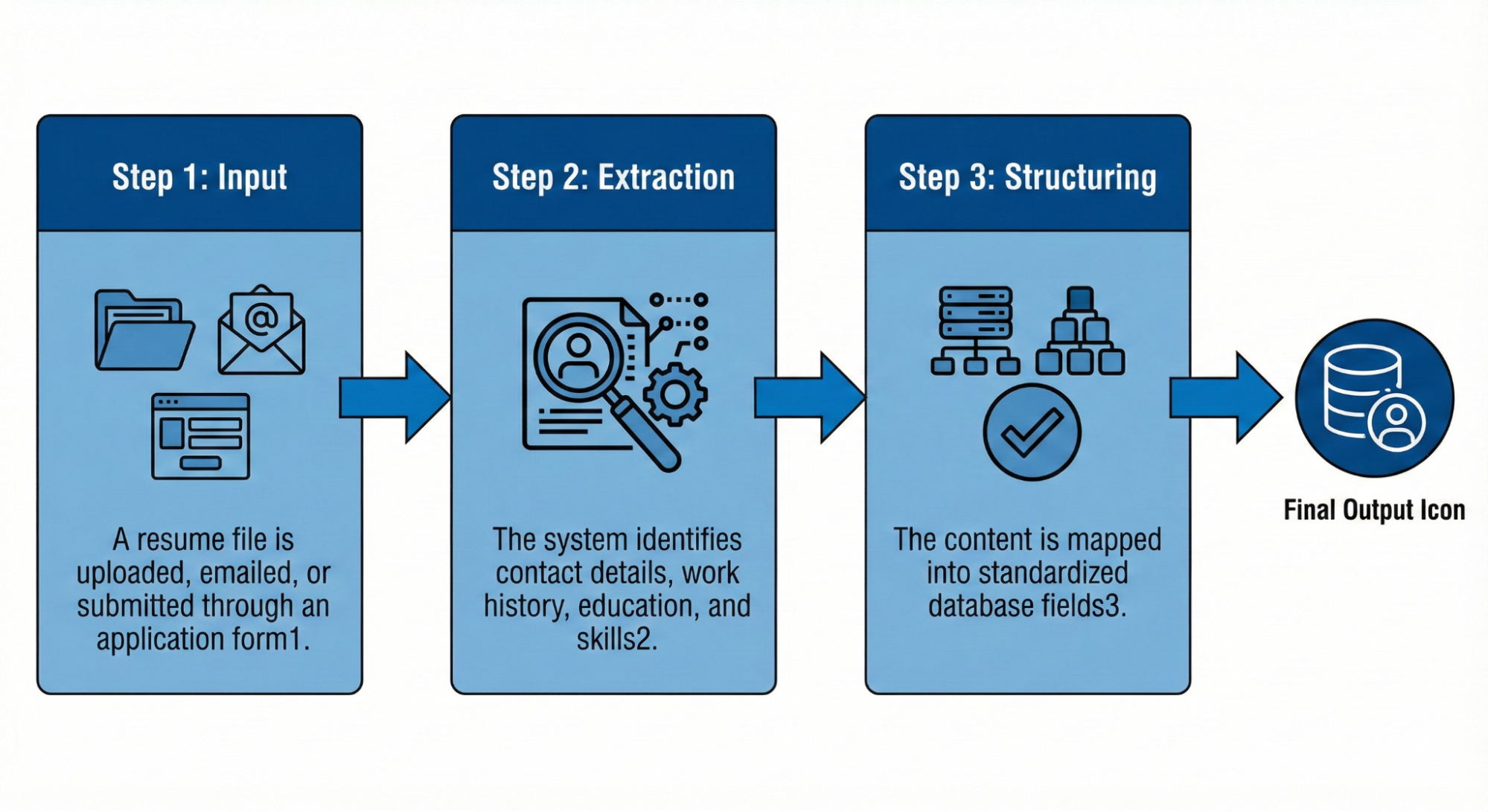
Parsing systems follow a predictable workflow:
- Input: A resume file is uploaded, emailed, or submitted through an application form.
- Extraction: The system identifies contact details, work history, education, and skills.
- Structuring: The content is mapped into standardized database fields.
Most resume parsing software supports common file formats such as PDF, DOC, and DOCX. Many platforms convert resume content into structured formats such as JSON or XML so it can be stored consistently across systems.
In 2026, AI resume parsing is widely used to handle formatting variation and improve skill recognition. However, it still performs best when teams use clear rules for how fields are mapped (such as how job titles and dates are extracted) and apply quick review steps to catch any errors or inconsistencies.
Key benefits of resume parsing for staffing agencies
Structured intake cuts repetitive admin and keeps candidate profiles consistent across teams by using standardized forms and consistent resume submission methods. The value is not just speed. It is stronger search, cleaner records, and a shared database that supports screening, matching, redeployment, and reporting.
Faster screening, shortlisting, and scale
High-volume intake creates delays when teams must retype candidate data before they can screen.
- Reduce time spent entering job titles, dates, and contact details
- Move faster from application to a review-ready profile
Cleaner data, better accuracy, and organization
The quality of your database determines how effective your candidate search and matching can be. Clean records make it easier to filter candidate pools and trust the results.
- Standardize job titles, employers, locations, and core profile fields
- Reduce missing or inconsistent fields that break filters and reporting logic

Stronger matching, redeployment, and fairer shortlists
Matching improves when skills and work history are captured in standardized fields across profiles, not buried in different resume layouts.
- Improve matching when hard skills and work history are captured in consistent fields
- Find candidates again for similar roles without rebuilding a shortlist from scratch
Less admin, more time for relationships and strategy
Cleaner intake protects time for work that drives placements.
- Spend more time on qualification calls and candidate experience follow-up
- Spend more time aligning requirements with hiring teams
Best practices and tips for getting the most from resume parsing
In 2026, talent teams are expected to scale output while keeping costs under control. Resume parsing tools deliver value when inputs are consistent, field mapping is deliberate, and review steps protect the data used for search, matching, and automation.
1. Start with clear job data and field mapping
Field mapping determines what teams can search, filter, and report on later.
- Map the fields that power candidate search and matching, such as job title, location, availability, and hard skills
- Align mapping with the structure used across the ATS and CRM
- Define edge cases such as multiple roles at one company, overlapping dates, and contract extensions

This approach supports skills-based organizations that structure roles around skills. Consistent skills fields make search and match results more reliable.
2. Standardize resume intake across channels
When resumes are submitted through different methods, such as email, online forms, or manual uploads, the quality of parsing can drop.
- Use consistent application forms and resume upload paths where possible
- If scanned PDFs are common, confirm whether Optical Character Recognition (OCR) is used so that text is captured instead of treated as an image
- Use one intake path for referrals and inbound resumes so candidate information stays comparable

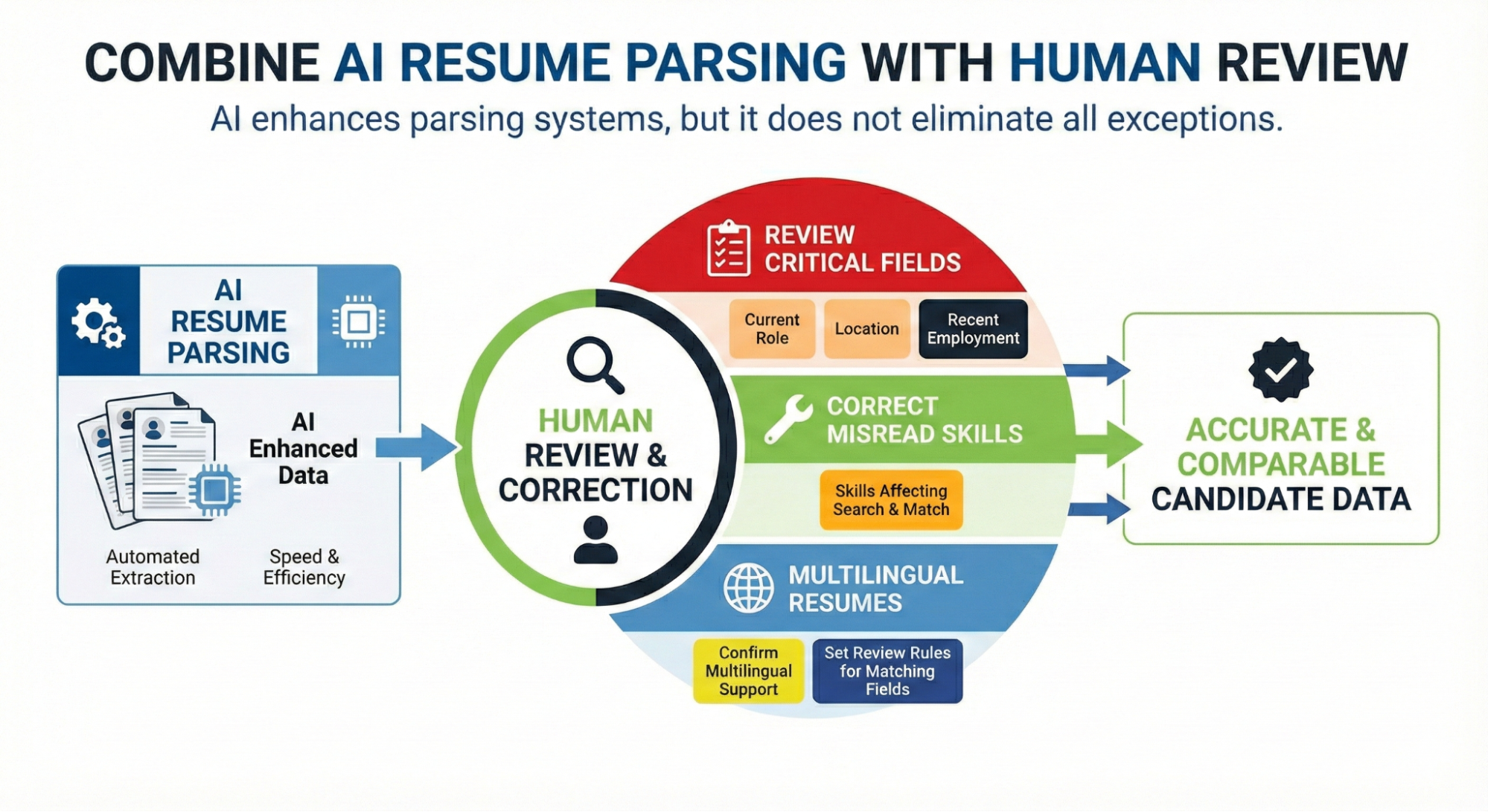
3. Combine AI resume parsing with human review
AI enhances parsing systems, but it does not eliminate all exceptions.
- Review critical fields such as current role, location, and recent employment
- Correct misread skills that affect search and match results
- For multilingual resumes, confirm multilingual support and set review rules for the fields that drive matching
Many teams are adopting human-led, AI-accelerated talent acquisition, where automation increases efficiency while recruiters remain responsible for final decisions. This approach is also evident in AI-driven talent acquisition that enhances sourcing, screening, and matching processes.
Teams evaluating different tools can also examine how AI recruiting tools assist with parsing, matching, and screening workflows.
4. Maintain and clean the database regularly
Parsing is the first step. Outdated records can clutter candidate searches and reports.
- Merge duplicates on a schedule
- Track when a profile was last verified
- Clean incomplete records that block matching logic

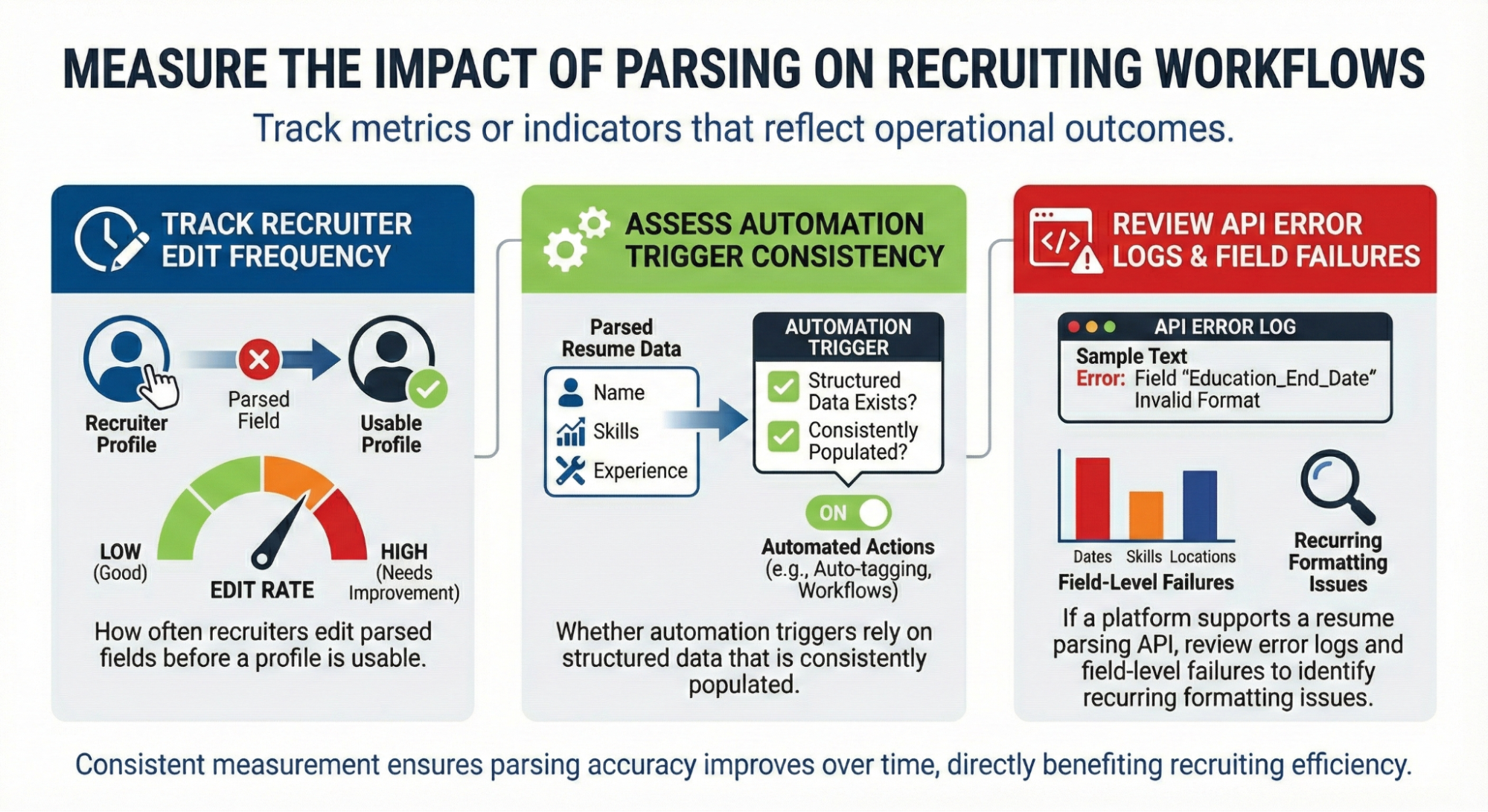
5. Measure the impact of parsing on recruiting workflows
Track metrics or indicators that reflect operational outcomes.
- How often recruiters edit parsed fields before a profile is usable
- Whether automation triggers rely on structured data that is consistently populated
- If a platform supports a resume parsing API, review error logs and field-level failures to identify recurring formatting issues
Leaders must also prove AI value and performance outcomes amid uncertainty, as CHRO priorities focus on realizing AI value and driving performance.
How Tracker uses resume parsing to support recruiters
Tracker includes resume parsing within an ATS and CRM platform that keeps candidate and client workflows in one system. Once resumes are structured into consistent profiles, teams can search, match, and shortlist faster while keeping candidate data easier to manage across recruiters, teams, and offices.

Three capabilities matter most for daily parsing workflows:
- Resume parsing: Converts resume content into structured fields so profiles are searchable and ready for screening.
- Search built for recruiting: Full text, Boolean, profile, and semantic search support real candidate search patterns.
- Matching signals for prioritization: AI ranking, skills profiling, and auto-match to open jobs help surface likely-fit candidates for review.
For teams that want to see what sits around parsing, applicant tracking features cover search, ranking, shortlists, and workflow management. For follow-up and re-engagement, Tracker supports marketing and automation workflows that use structured data to trigger consistent outreach.
Bringing resume parsing into everyday recruiting
Teams get consistent results when parsing is treated as a repeatable workflow with clear field rules and accountable review steps. Start with one high-volume role type, standardize intake, tighten field mapping for the fields recruiters search most, and add a lightweight review step for critical profile data.
If resume parsing needs to do more than move data around, it should connect clean data to search, matching, and outreach workflows. Book a Tracker demo to explore ATS + CRM, automation, and parsing in one platform.
FAQs
Why is resume parsing important for recruiters and job seekers?
Resume parsing turns a resume into structured candidate data that can be searched, filtered, and reused across recruiting processes. It reduces manual entry for recruiters and supports consistent candidate comparison during screening.
How to make sure your ATS system is correctly parsing resumes?
Test a consistent set of resumes across common file formats and layouts, then review how key fields map into the candidate profile. Add a lightweight review step, then tighten mapping rules when repeated errors show up.
How does resume parsing fit into an ATS and CRM workflow?
Parsing happens at intake, when a candidate applies, registers, or is imported from a source. The structured profile then supports screening, candidate search, matching, and engagement, with the same record used across recruiting activity and client workflows.