You have 0 items in your cart
Key Takeaways
- Contract staffing delivers steadier revenue when staffing agencies run it as a core desk with clear pricing rules and repeatable steps.
- Strong margin guardrails keep exceptions from turning every deal into a new negotiation.
- An up-to-date contractor community makes candidate search faster and keeps redeployment moving.
- Simple documentation and classification checks reduce rework and keep delivery predictable from intake to invoice.
Flexible work is now a standard operating model. Projects still ship on deadlines, priorities still shift, and teams still need skilled professionals without long-term commitments. For staffing firms, contract staffing turns that reality into a repeatable revenue line when it runs as a real service line with clear rules and consistent delivery.
In 2026, clients expect speed, cost control, and predictable execution from intake to invoice. For many staffing agencies, contract work is one of the most practical staffing solutions for meeting those expectations without expanding full-time headcount.
How contract staffing fits agency strategy in 2026
Contract staffing is a strategic staffing model in 2026. Clients use it to stay agile, access specialized skills, and scale capacity up or down without permanent hiring commitments. Contractors choose it because flexibility and autonomy shape how they evaluate work, especially in hybrid environments.
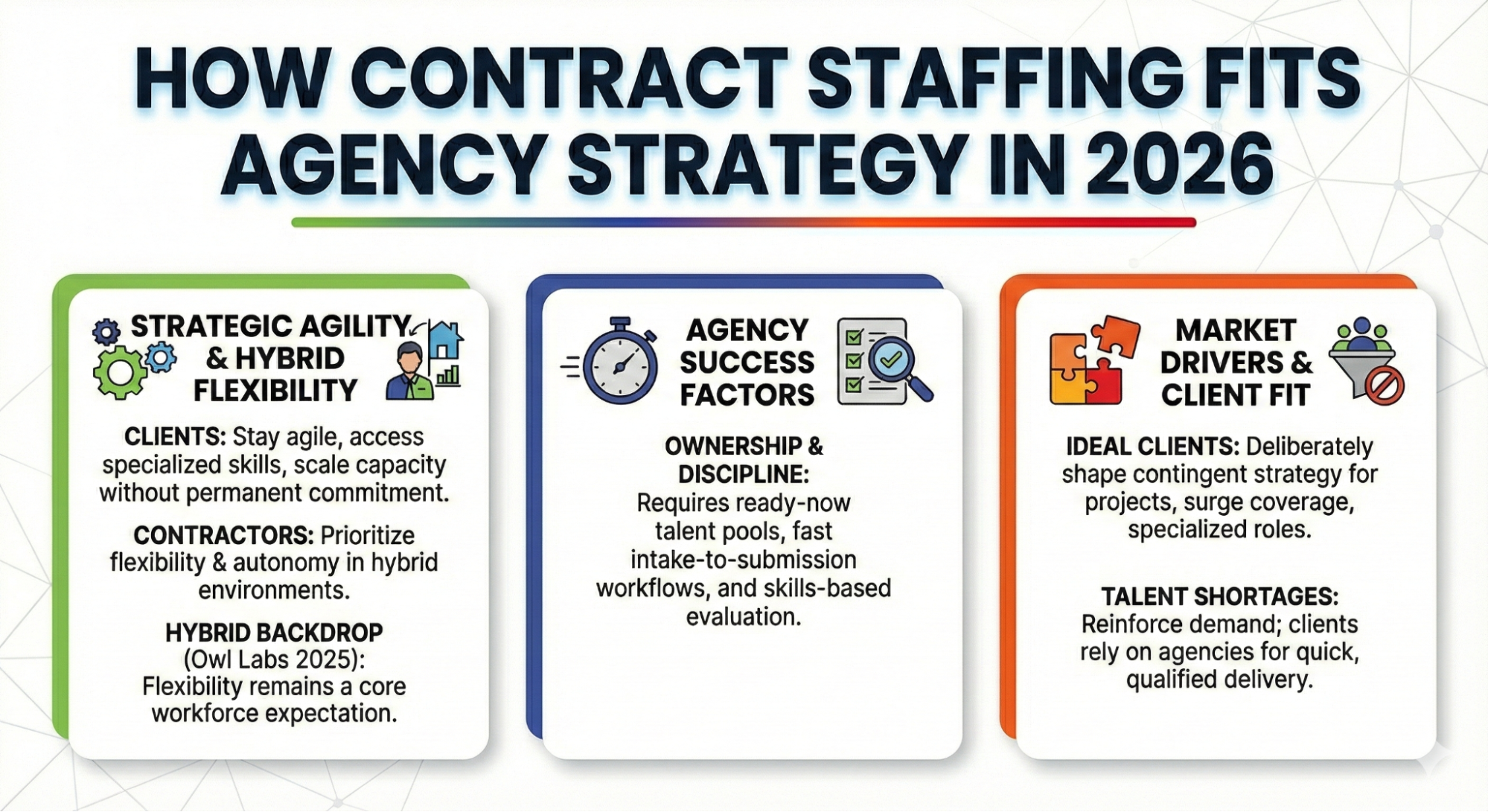
For many employment agencies, contract staffing performs best when it has ownership and process discipline. It requires ready-now talent pools, fast intake-to-submission workflows, and skills-based evaluation that maintains standards while expanding coverage. It also fits clients that are deliberately shaping a contingent workforce strategy for project delivery, surge coverage, and specialized roles.
Talent shortages reinforce this demand. Clients compete for the same skills, and they rely on agencies that can deliver qualified contractors quickly and consistently.
Many recruitment teams still treat contract staffing as a side desk, understanding what is contract staffing and how it works makes it easier to standardize expectations across clients and contractors.
Revenue-led benefits of contract staffing
Contract staffing supports revenue when it runs like a system. It creates a steadier billing rhythm, adds repeatable role flow inside existing accounts, and strengthens retention when clients view the agency as an operating partner instead of a last-minute option.
That predictability improves when a contract staffing agency runs the desk with clear pricing rules, defined handoffs, and consistent expectations for clients and contractors.
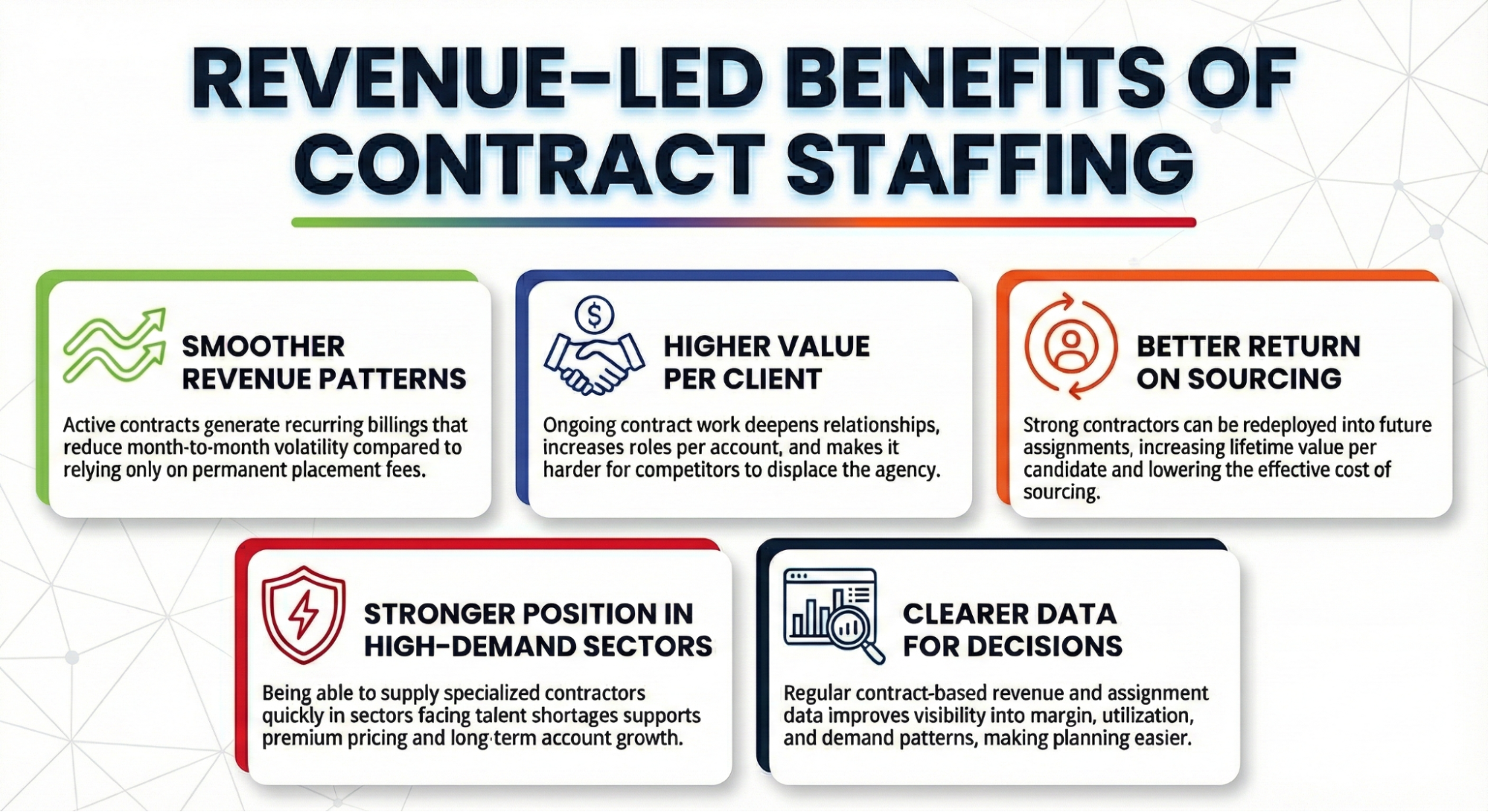
The commercial upside shows up in repeatable ways:
- Smoother revenue patterns: Active contracts generate recurring billings that reduce month-to-month volatility compared to relying only on permanent placement fees.
- Higher value per client: Ongoing contract work deepens relationships, increases roles per account, and makes it harder for competitors to displace the agency.
- Better return on sourcing: Strong contractors can be redeployed into future assignments, increasing lifetime value per candidate and lowering the effective cost of sourcing.
- Stronger position in high-demand sectors: Being able to supply specialized contractors quickly in sectors facing talent shortages supports premium pricing and long-term account growth.
- Clearer data for decisions: Regular contract-based revenue and assignment data improves visibility into margin, utilization, and demand patterns, making planning easier.
5 best contract staffing practices for 2026
The best teams protect margin, protect candidate quality, and remove workflow friction from intake through invoicing.
1. Put clear rules around pricing and margin
Pricing rules protect margin and reduce friction. They also reduce negotiation drag when a client compares one staffing provider to another.
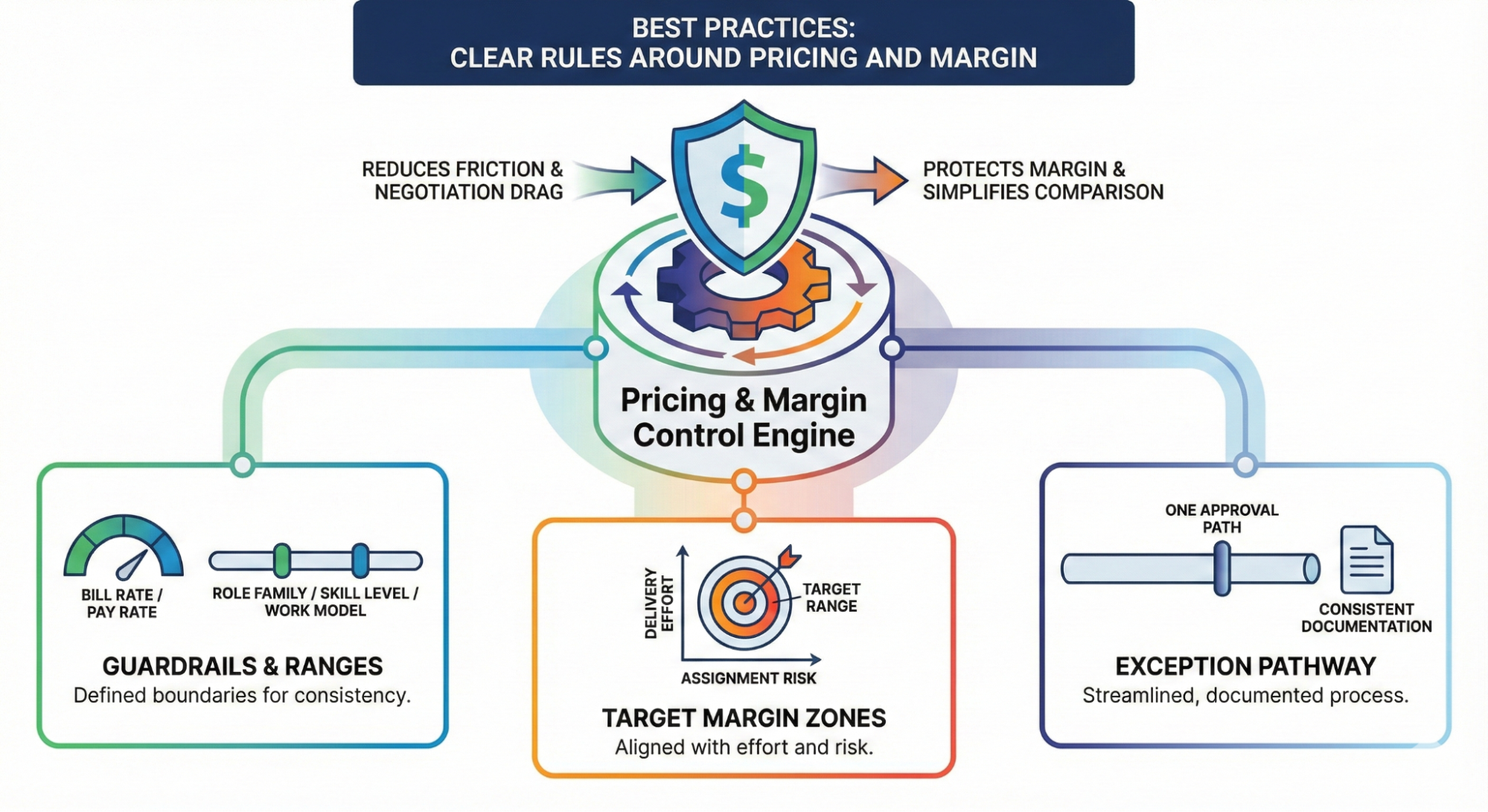
A practical pricing baseline includes:
- Bill rate and pay rate guardrails by role family, skill level, and work model
- Target margin ranges tied to delivery effort and assignment risk
- One approval path for exceptions, with consistent documentation
2. Build a skills-based, always-on contractor community
A current contractor community is the fastest path to consistent delivery. Contractors need accurate skills, verified experience notes, and updated availability, not stale profiles.
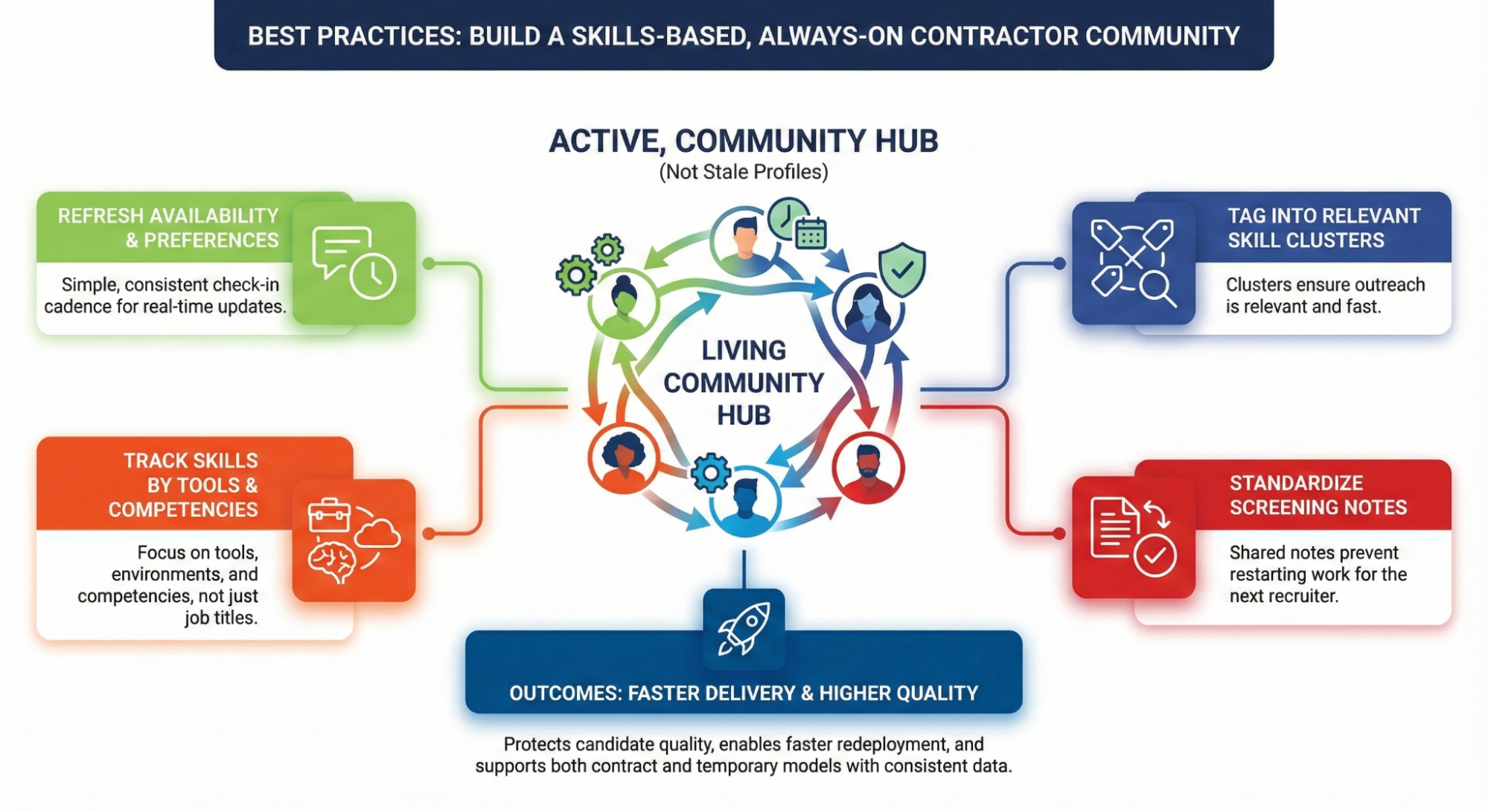
This is how agencies protect candidate quality. Contract staffing recruiters keep records current, close the loop after assignments, and treat redeployment as a standard workflow. That discipline also supports agencies that offer temporary recruiting services, because the same data quality makes both delivery models faster.
To keep the pool usable:
- Refresh availability and work preferences through a simple, consistent check-in cadence
- Track skills by tools, environments, and competencies, not only job titles
- Tag contractors into skill clusters so outreach stays relevant and fast
- Standardize screening notes so the next recruiter does not restart the work
3. Protect contractor experience, well-being, and inclusion
Contractor experience is an operating advantage. Contractors respond faster, stay engaged longer, and redeploy more reliably when onboarding and communication are consistent.
This also protects candidate quality. Clear expectations reduce avoidable issues that damage delivery and client trust.
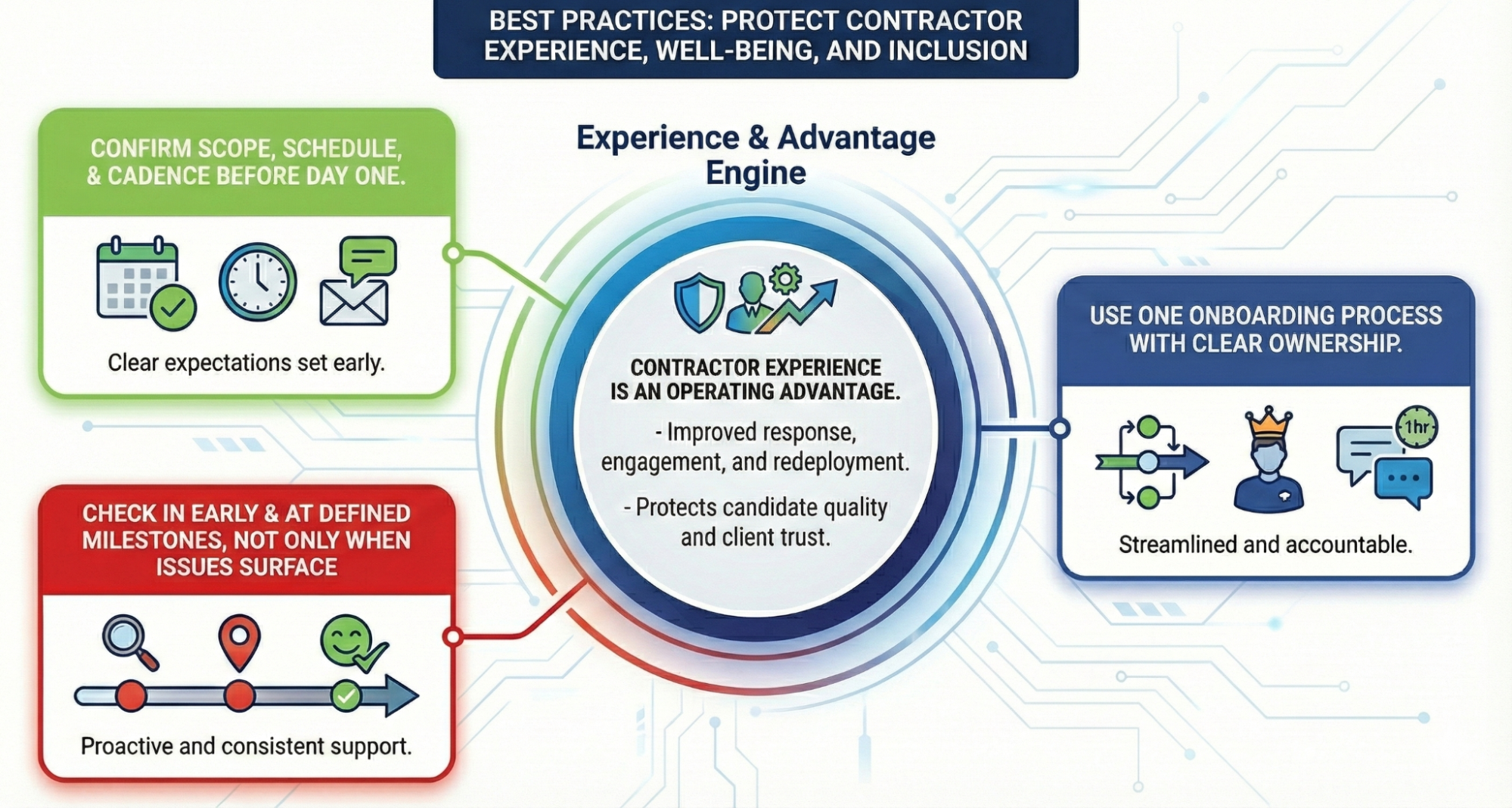
A reliable baseline includes:
- Confirm scope, schedule, and communication cadence before day one
- Use one onboarding process with clear ownership and response expectations
- Check in early and at defined milestones, not only when issues surface
4. Build simple risk, compliance, and clarity guardrails
Contract staffing breaks down when classification, documentation, and time tracking vary by recruiter or account. Guardrails prevent rework, protect compliance consistency, and keep delivery predictable across contingent staffing services and contract-to-hire workflows.
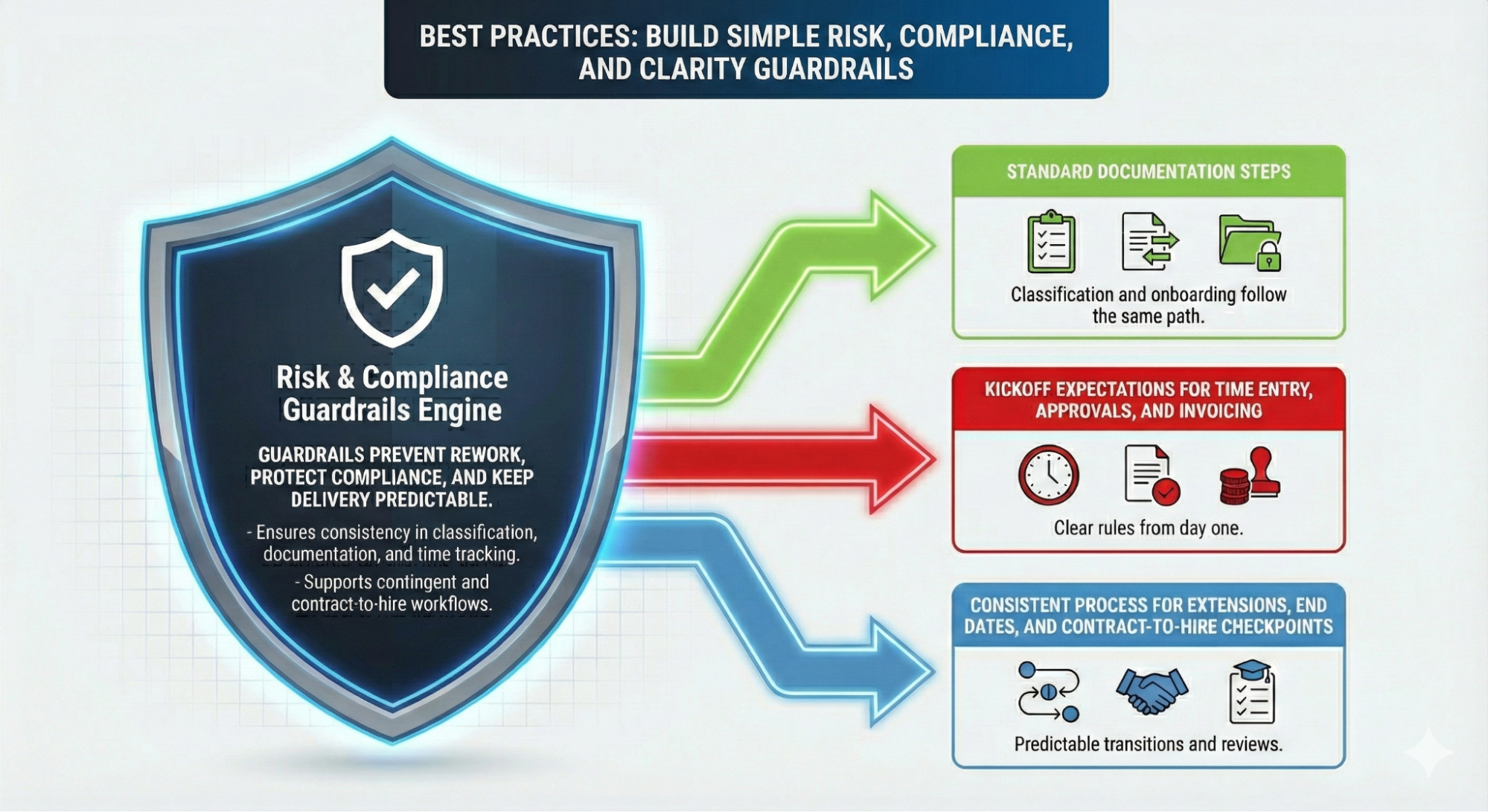
A strong baseline covers:
- Standard documentation steps so classification and onboarding follow the same path every time
- Kickoff expectations for time entry, approvals, and invoicing
- A consistent process for extensions, end dates, and contract-to-hire checkpoints
For a high-level reference point on classification language, the IRS overview provides clear definitions that agencies can translate into internal checklists.
5. Use AI and contract staffing software for insight, not just admin
AI and automation increase speed when they support recruiter judgment, not replace it. The right contract staffing software also makes end dates, redeployment readiness, and workflow bottlenecks visible early, so teams protect revenue before gaps show up.
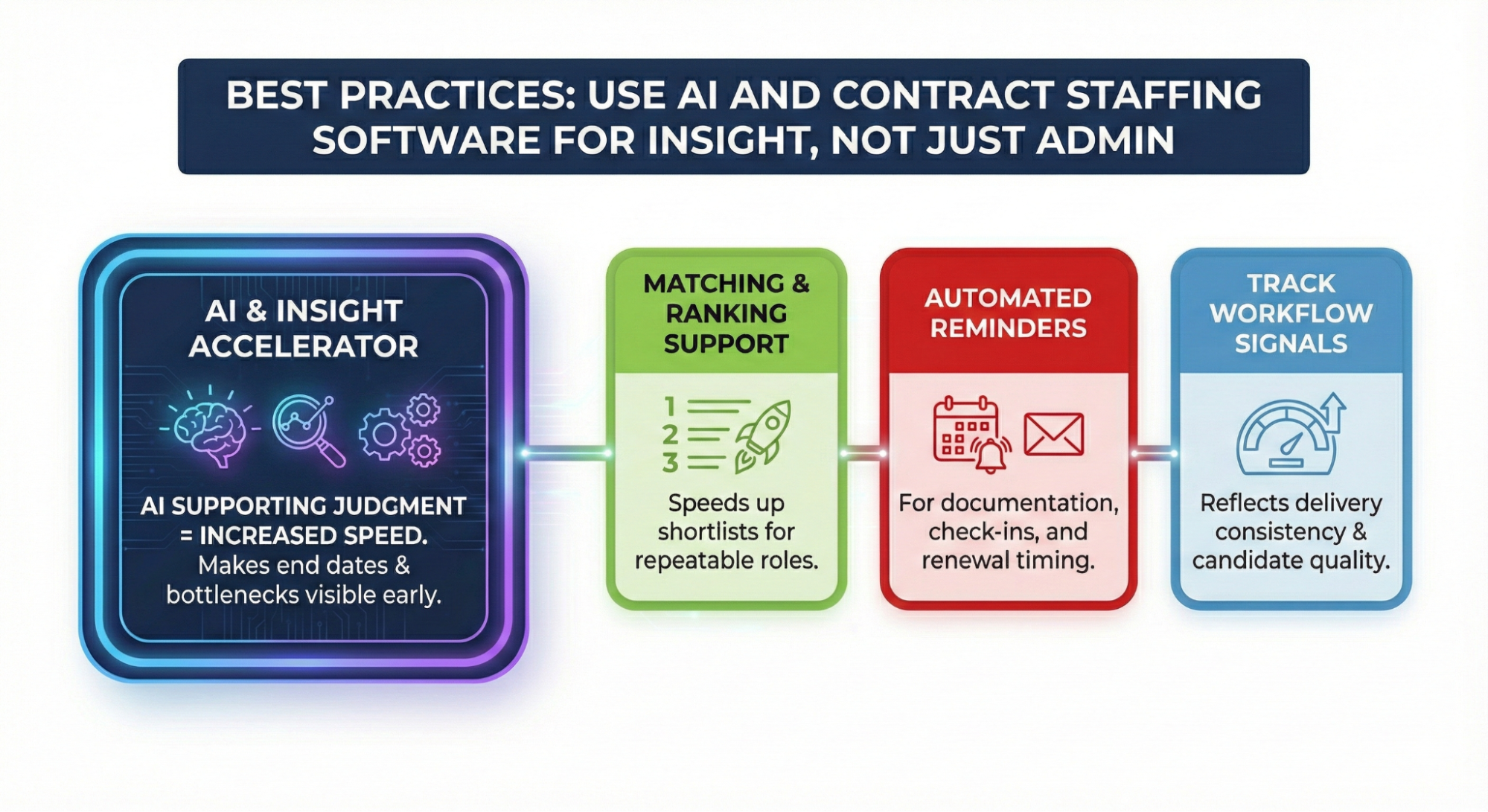
- In 2026, speed is an end-to-end system. Agencies win by moving fast from intake to shortlist, shortlist to start date, and start date to invoice without lowering standards.A practical approach includes:
- Use matching and ranking support to speed up shortlists for repeatable roles
- Automate reminders for documentation steps, check-ins, and renewal timing
- Track workflow signals that reflect delivery consistency and candidate quality, not vanity activity
A 2026 roadmap for growing contract staffing revenue
Contract staffing growth comes from building a repeatable system. The goal is a contract staffing process that scales through consistent workflows, not individual heroics.
First 90 days: Get the baseline right
- Review revenue mix and identify accounts with repeatable contract demand
- Map intake-to-assignment steps and flag where handoffs slow delivery
- Check margin consistency across recent assignments and document exception patterns
- Audit contractor data quality, focusing on skills tagging and availability accuracy
Next 6 to 12 months: Make contract delivery a system
- Apply pricing and margin rules across focus accounts and tighten exception controls
- Set a contractor community routine for updates, tagging, and re-engagement
- Standardize onboarding, check-ins, extensions, and redeployment steps to reduce rework
- Build a minimum reporting cadence that shows end dates, pipeline coverage, and workflow friction
This is where agencies stabilize the economics of contract labor. Predictable workflows reduce last-minute scrambling and improve consistency across accounts.
Beyond 12 months: Expand with less risk
Expansion works when redeployment works. Once contract delivery is consistent in one focus area, agencies can scale coverage without multiplying risk.
- Extend into adjacent role families once redeployment is consistent
- Tighten proactive planning by comparing demand patterns with ready-now pool coverage
- Align sales and delivery on one standard offer, including terms and service cadence
- Review performance signals quarterly and fix the steps that create drop-offs
Contract staffing also scales faster when the offer is consistent. Agencies that run contract work with a repeatable service model, including a temporary employment agency motion where it fits, reduce friction across scope, pricing, and start dates. The same is true during seasonal hiring, when volume spikes expose weak handoffs.
How Tracker underpins a contract staffing strategy
Tracker helps staffing firms run contract work as a repeatable service line through an integrated ATS and CRM approach:
- Keep candidate, contractor, client, and job search activity connected with Recruitment ATS and CRM, which supports faster handoffs and cleaner records.
- Improve speed to shortlist with Auto match and AI ranking, especially for repeatable contract roles where match logic and structured profiles matter.
- Reduce follow-up overhead with Sequences and automation so check-ins, documentation reminders, and renewal timing stay consistent.
- Keep pipelines active through Watchdogs and job board integrations, which source from external boards and flag new profiles that match recurring contract roles.
- Track activity and flow in dashboards so teams see gaps early and protect delivery consistency.
Making contract staffing a stable part of agency revenue
Contract staffing becomes a stable revenue line when the fundamentals are tight. Pricing rules protect margin. Clean contractor data protects speed. Consistent onboarding and communication protect delivery. Guardrails protect compliance consistency and reduce rework.
This is where staffing solutions become operational reality. It also makes it easier to deliver across contract, contract-to-hire, and related contract employment services without rebuilding the process on every request.
If your team is ready to treat contract staffing as a core, repeatable revenue line, take a closer look at how Tracker supports sourcing, onboarding, and contractor management in one place.
Book a live demo to see how it could work for your agency.
FAQs
How should agencies explain the value of contract staffing to clients who prefer permanent hires?
Contract roles cover project demand and specialized skill gaps while keeping long-term commitments flexible. Contract-to-hire also gives clients a defined window to evaluate performance before making a permanent decision, especially when the client wants the right to hire after that evaluation period.
Which KPIs matter most for tracking contract staffing revenue health?
Margin consistency, extension activity, redeployment coverage, and end-date visibility show whether the contract book is stable. These signals also protect candidate quality by showing where drop-offs happen during screening, onboarding, and assignment execution.