ATS Features for Staffing Agencies
Tracker handles the admin work. Your team handles the people work.
Job boards search themselves overnight, AI ranks the candidates with placement history first, and the record builds itself the moment a CV lands. So your team can stop processing candidates and start placing them.
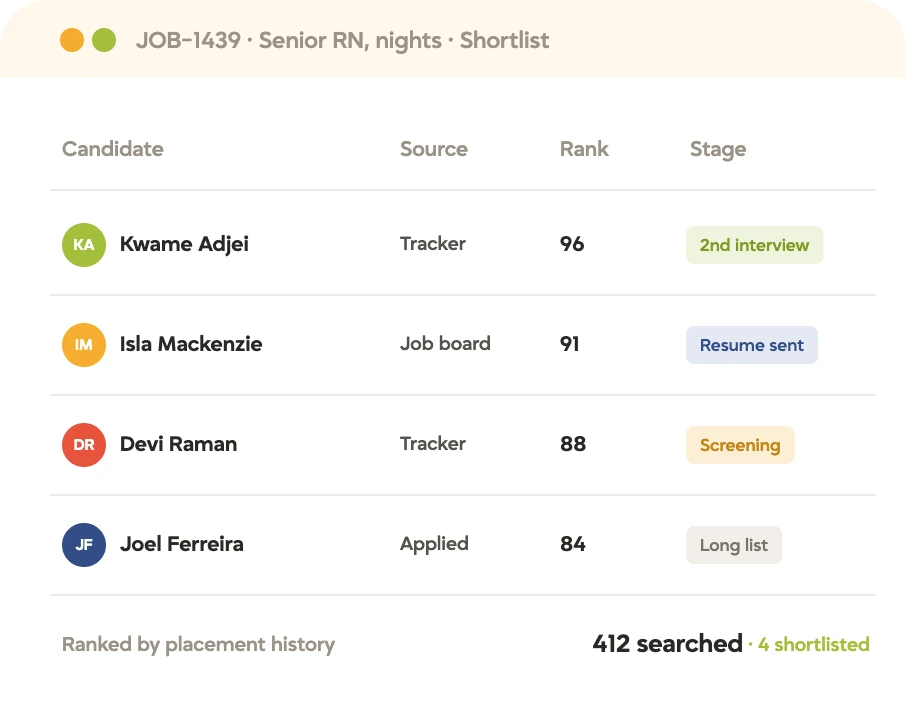
Post and search across the boards you already use
What it is
Your team doesn’t start the day on the keyboard. They start on the phone.
For many recruiters the day starts the same way: downloading CVs from four job boards, reformatting them to the agency template, entering details, and running last month’s search from scratch because the system never remembered what worked. By the first call, half the morning is gone. Tracker handles that work, so shortlists are ready before the recruiter arrives, ranked by what’s actually worked. It’s the same platform as the CRM and the back office, so the desk stays personal because the platform stays operational.
ATS · Long list · Shortlisting
The whole job, finished without leaving the job
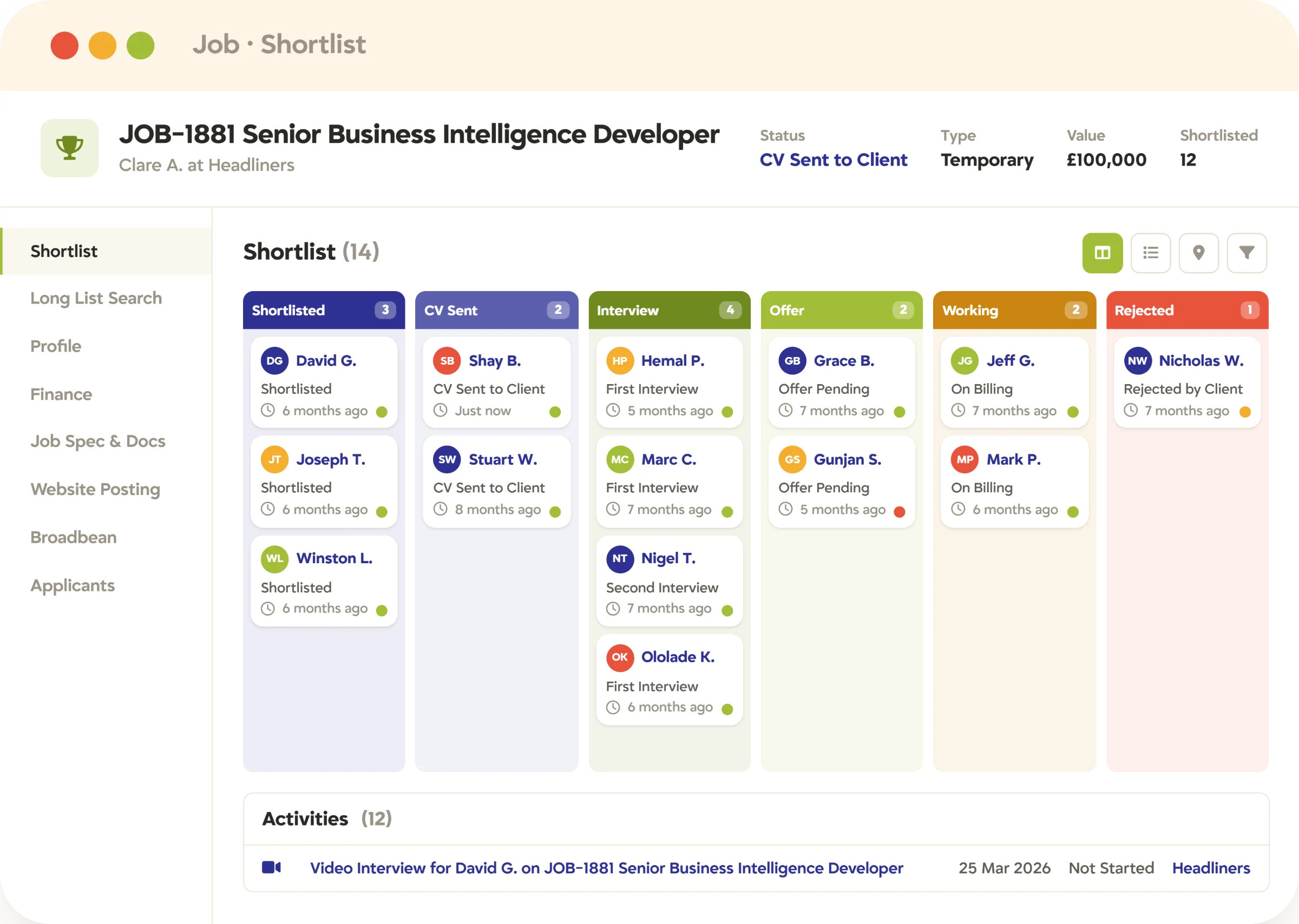
Card view for the pipeline, list view for the detail, and a workflow that lets a consultant run a role end to end from one record.
Card and list views, with 60+ columns and shareable saved filters. Everyone sees the desk the way they work.
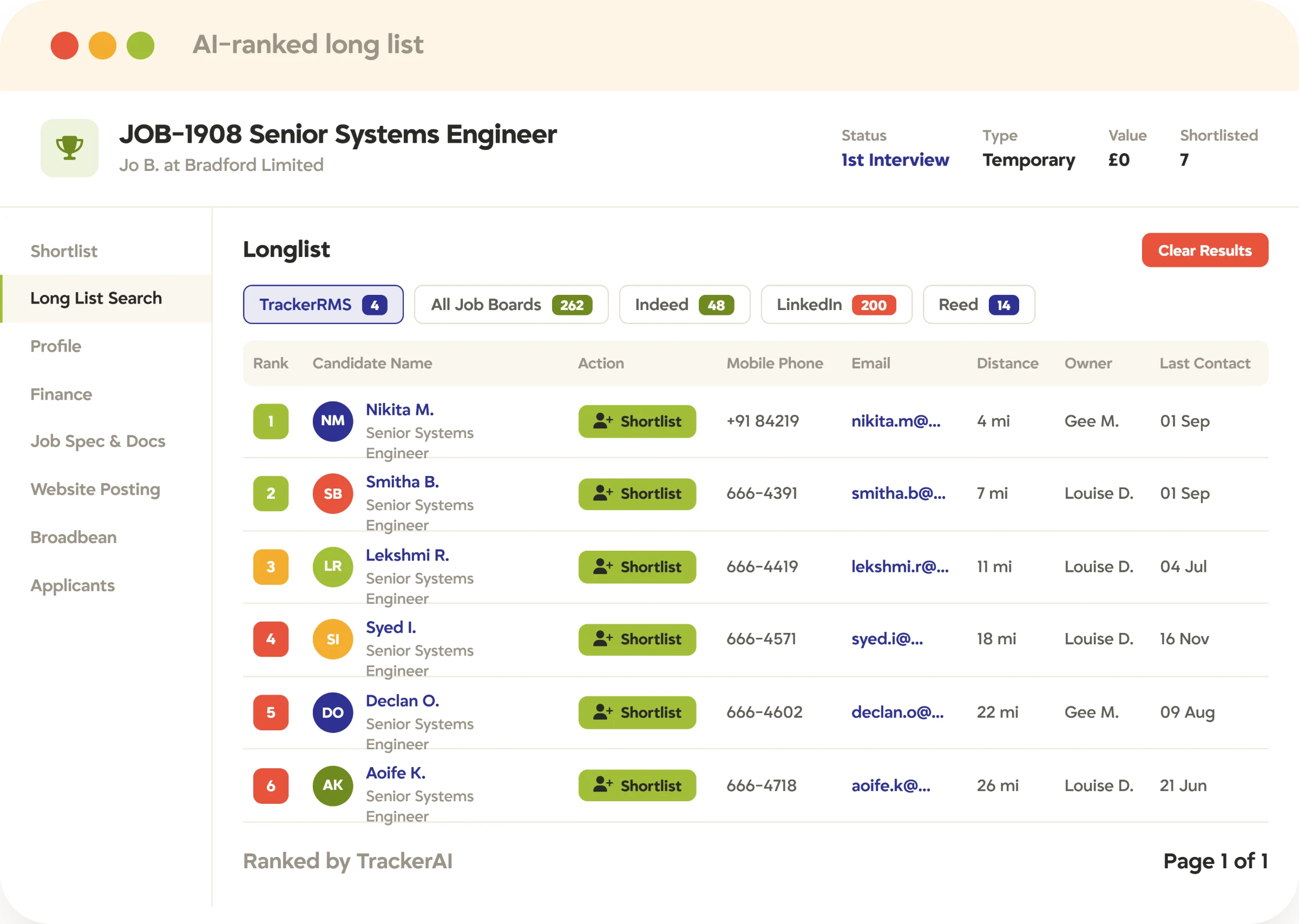
Long list, applicants, and job board results in one combined list. One place to work, not three tabs.
One-click shortlisting with a traffic-light status on every name. Anyone can see where a candidate stands.
Drag and drop through stages, with every linked record updating itself. Move the candidate, not the paperwork.
A stage change can fire automations, so the next activity or action is already set up. The move does the admin for you.
Every interaction across the whole team shows on the shared candidate record. Nobody calls a candidate a colleague has worked for six weeks.
Matters most to 360 recruiters & delivery managers
AI ranking · CV parsing · EVA search
Every search starts smarter than the last
Tracker’s AI starts from every placement the desk has ever made, so the sixth marketing director search starts from a much shorter list than the first. Parsing builds the profile and auto-codes the skills without a single manual entry.
AI ranking puts the best match at the top, not the most recent, using a decade of placement data: how often each candidate was shortlisted, submitted, interviewed and placed, and for which clients and roles. TrackerAI ranks by what converted, not just what matched.
Parsing reads any format, including scanned images, and pulls the photo. A full profile before anyone types a word.
Forward resumes as email attachments, singly or in bulk, and they parse themselves. The database grows from your inbox.
Ask EVA for the best candidates the way you’d ask a colleague. She writes the Boolean search, so you don’t have to.
Natural language throughout, in your vocabulary rather than Tracker’s. Say what the role needs, in your own words.
80+ filters, full Boolean and semantic search, radius search and map view. Exact when the brief demands exact.
Skills auto-code on arrival, with ranked and dated profiles for certifications. The database stays searchable on its own.
Duplicate detection on name, email, and cell, with auto-merge. One candidate, one record, no technical help needed.
Matters most to Resourcers & system administrators
Job boards · Multiposting · LinkedIn Chrome extension
The search keeps running after everyone’s gone home
In recruitment, the first call wins. Post once to 1,000+ boards, search hundreds at a time, and Watchdogs surface new candidates against open roles overnight, so the shortlist is ready before the first coffee.
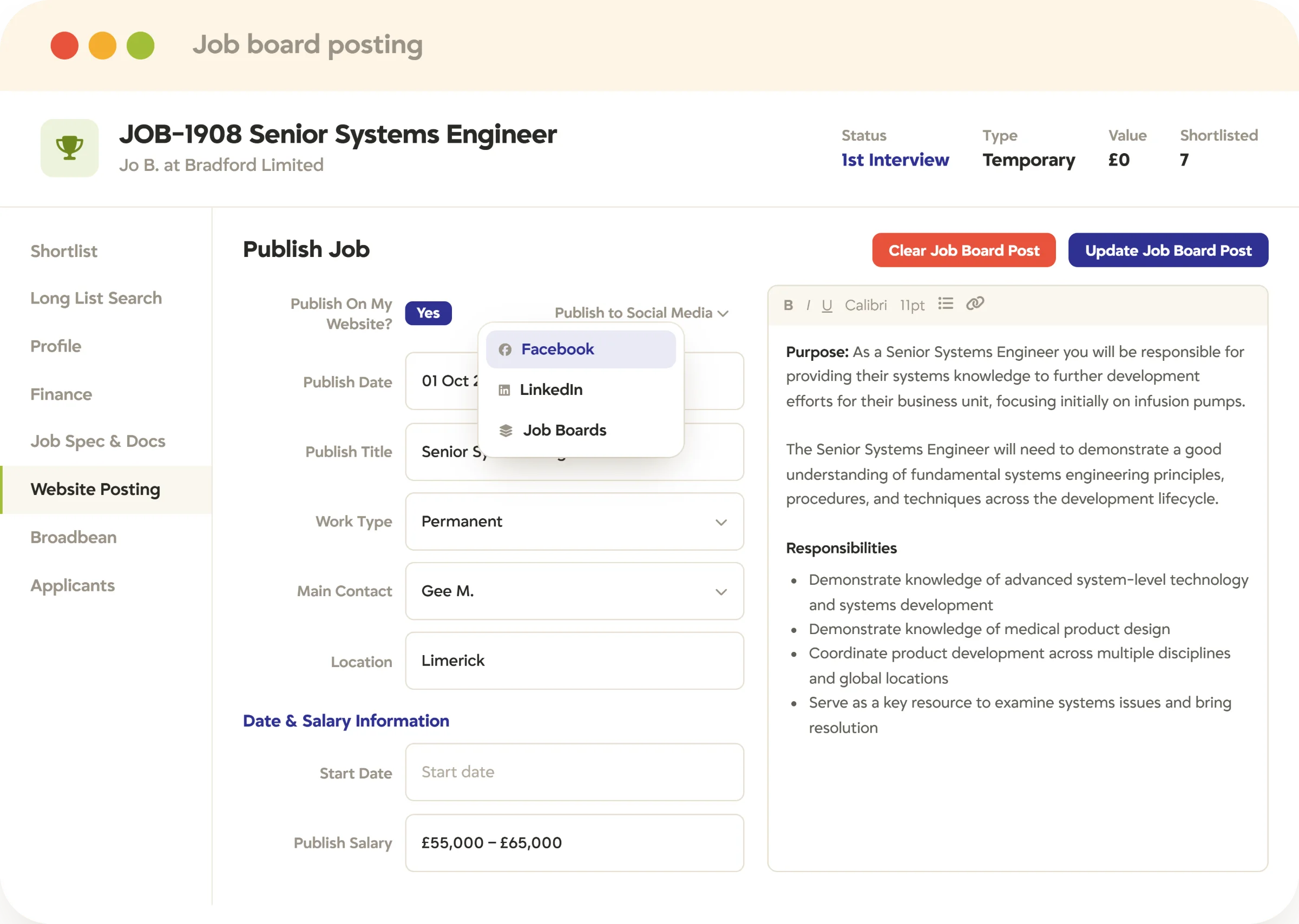
The spec parses into a post-ready job and goes out from a single page. Online and attracting candidates in a few clicks.
Broadbean or LogicMelon posting and Daxtra search included in the Job Board plan. No third-party contract to sign.
Board results arrive de-duplicated and ranked in one list. Every board, one set of results.
Candidates you already hold are flagged before you download them. No credit spent on someone you already know.
Applicants land in the job and auto-match to other open roles. No more trawling the inbox every morning.
The LinkedIn Chrome extension parses profiles from LinkedIn and any job board straight onto a shortlist. No logging in, no copy and paste.
AI candidate prospecting matches a candidate to the clients most likely to hire them, by skills, location and past placement success. New business from the candidate base.
Matters most to Resourcers & sourcing teams
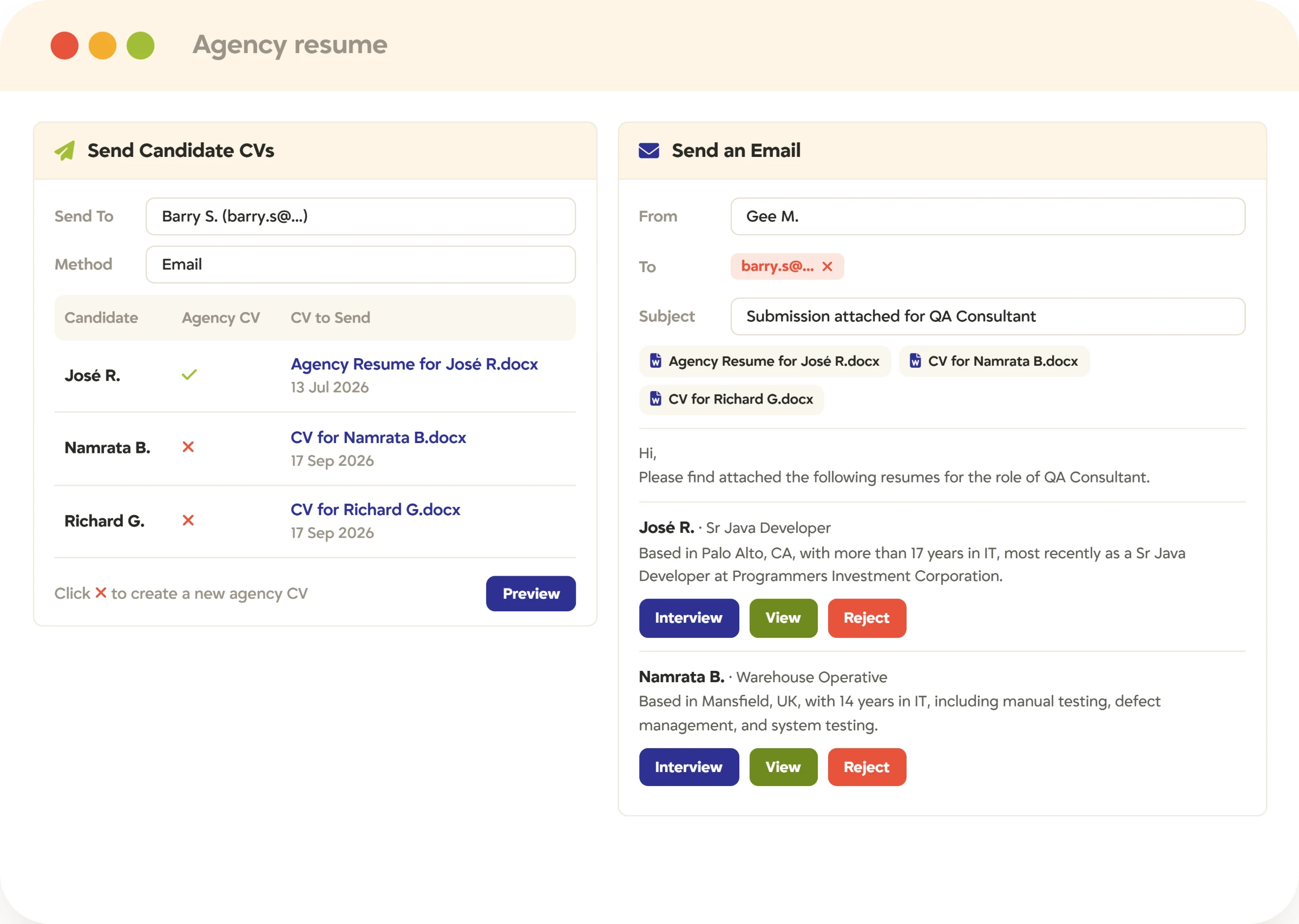
Submissions · CV formatting · Video interviews
Four clicks from their resume to your letterhead
Agency CVs, interview scheduling, and placement confirmations all run from the shortlist, in bulk when the role needs it.
Reformat a candidate resume into your branded Word or PDF template. Consistent submissions without the retyping.
The shortlist workflow structures each step: CV formatted, details confirmed, then client delivery. Nothing leaves the system before it’s ready.
Or let an agent do it the moment a new candidate lands. Client-ready before anyone opens the record.
Send by email or through the client portal, with document and video CVs. However that client prefers to receive it.
One-way and two-way video interviews built in, no third party needed. Screening that happens while you sleep.
Unlimited interview phases, then placement confirmations for e-signature. Offer to signed, on the same record.
Matters most to Delivery managers & contract desks
Onboarding · Portals · Redeployment
The relationship doesn’t end at placement. Neither does Tracker.
The candidate who just finished an engagement is the easiest placement you’ll make, if the relationship stays warm. The first call they get when it ends should be from the recruiter who placed them.
Onboarding triggers from the placement record the moment a candidate is confirmed. Documents, signatures and forms collected on a mobile-first portal.
Candidate and client portals keep both sides connected to the desk. Availability, timesheets, shortlists and feedback, all writing back to the same record.
Redeployment reminders fire before the engagement ends. Redeployment shouldn’t start when the contract ends.
Reporting shows which placements held and which didn’t. So the next shortlist starts from something real.
The client who just filled a role hears from the desk again. With something worth saying, not a generic check-in.
Matters most to 360 recruiters & contract desks
Compliance · Automation · Tracker OTM
Compliance, communication and the full desk, from anywhere
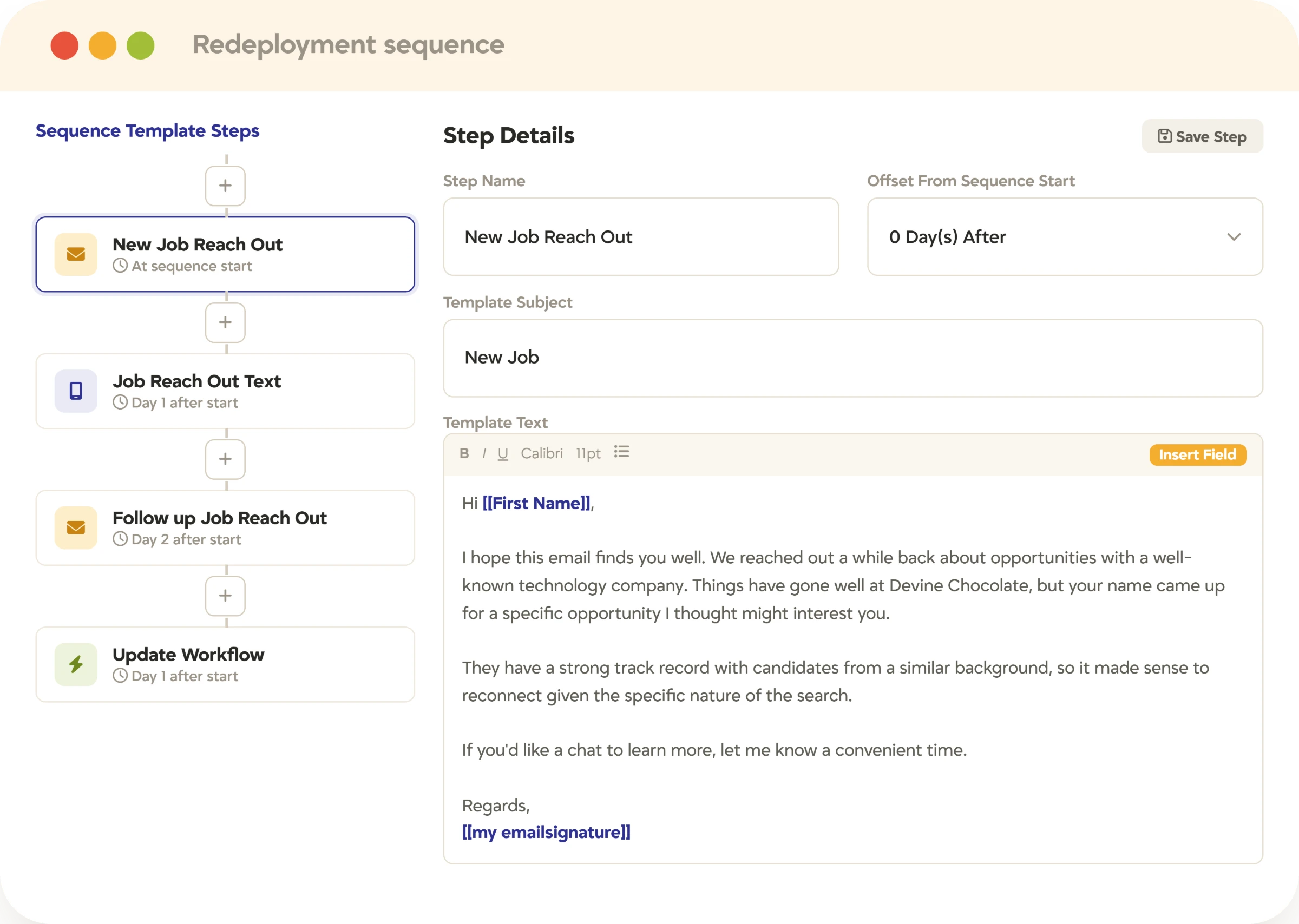
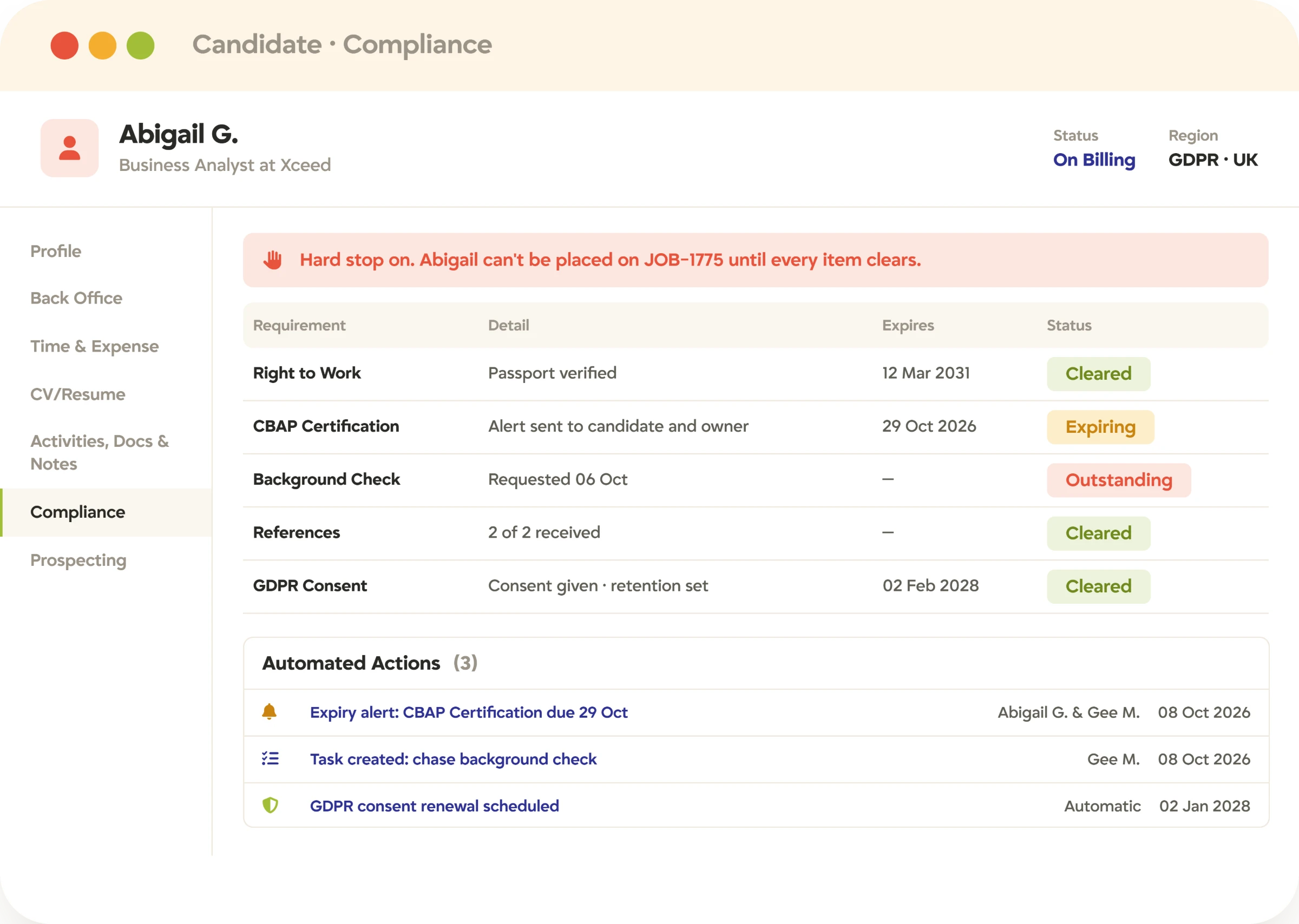
Every manual step that used to slow the desk down, gone, without a separate tool for each one.
Credential tracking, expiry alerts and hard stops that prevent non-compliant placements. Custom fields by industry, client and contract type.
GDPR, CCPA and PIPEDA compliance across 40+ countries. Subject access, erasure, consent and retention run automatically.
Workflow automation built natively into the ATS: tasks, sequences, chasers and candidate communications. Every handoff automatic, every touchpoint on schedule.
Click-to-call, screen-pop, automatic call logging and recordings on the record, plus TrackerChat with @mentions. Every conversation on the record.
Tracker OTM gives 100% functionality on any smartphone. Activity logged as it happens, not when someone gets back to the office.
Publish jobs to your website with one line of code, with Jobs+ for Google for Jobs. An SEO-optimised microsite included.
Matters most to Compliance, operations & managers
Case study · Elevation Recruitment Group
Placements made from people already in Tracker, with no external sourcing spend
Held through systematic contact cycles rather than a recruiter’s memory
Across 80+ recruiters, after a staged rollout led by 12 super users
24-hour temp fills, permanent placements and 6-month retained search
“Tracker has given me the ability to do a recruiter’s job in 3 days rather than 5, because everything stays in front of me until it’s done.” Read the Elevation story
In practice
What a normal week looks like
Monday, 8:40am
Rosa opened the job to eleven new board applicants. They had been parsed, ranked, and checked against the database before she sat down.
Parsing & applicant collection
Tuesday, 11:15am
Rosa needed a paediatric nurse within 20 miles by Thursday. She asked EVA in one sentence and had a ranked longlist before the client call ended.
EVA & natural language search
Thursday, 6:50am
Nobody searched overnight. The Watchdog did, and three candidates who posted after Tuesday’s search were waiting on the long list.
Watchdogs
What changes
Stop processing candidates. Start placing them.
Applications pull straight into the job, profiles build themselves and acknowledgements send automatically, so consultants are on the phone by 9, not still processing Monday’s applicants.
Watchdogs and AI ranking surface the right candidate against the open role automatically, before a competitor calls them.
Turning a candidate’s resume into a branded agency submission. Same format every time, whichever consultant sends it.
The shared record shows every interaction across the team before anyone picks up the phone.
The shortlist workflow confirms formatting and details before a CV reaches the client.
The recruiter who placed them is the first to call, because Tracker reminded them before the engagement ended.
In their words
The shortlist, sooner
That’s a gold mine. In our old system you had to click into every candidate’s profile to figure that out. In Tracker it’s incredibly clear how far someone got before a job closed out.
From the customer service, the ease of use, and having a fully functional back office, in my mind, there's probably nothing better. I looked at 16 different ATS and CRMs. Tracker is the one.
That’s a gold mine. In our old system you had to click into every candidate’s profile to figure that out. In Tracker it’s incredibly clear how far someone got before a job closed out.
From the customer service, the ease of use, and having a fully functional back office, in my mind, there's probably nothing better. I looked at 16 different ATS and CRMs. Tracker is the one.
That’s a gold mine. In our old system you had to click into every candidate’s profile to figure that out. In Tracker it’s incredibly clear how far someone got before a job closed out.
From the customer service, the ease of use, and having a fully functional back office, in my mind, there's probably nothing better. I looked at 16 different ATS and CRMs. Tracker is the one.
That’s a gold mine. In our old system you had to click into every candidate’s profile to figure that out. In Tracker it’s incredibly clear how far someone got before a job closed out.
From the customer service, the ease of use, and having a fully functional back office, in my mind, there's probably nothing better. I looked at 16 different ATS and CRMs. Tracker is the one.
Tracker was the easiest ATS implementation I’ve ever had, across five implementations, over 25 years.
We are able to track and visualize real-time date in regards of open jobs and each active candidate’s journey. Plus, we are now able to organize our candidate pipelines and schedule in-bulk outreach messages when it is applicable.
Tracker was the easiest ATS implementation I’ve ever had, across five implementations, over 25 years.
We are able to track and visualize real-time date in regards of open jobs and each active candidate’s journey. Plus, we are now able to organize our candidate pipelines and schedule in-bulk outreach messages when it is applicable.
Tracker was the easiest ATS implementation I’ve ever had, across five implementations, over 25 years.
We are able to track and visualize real-time date in regards of open jobs and each active candidate’s journey. Plus, we are now able to organize our candidate pipelines and schedule in-bulk outreach messages when it is applicable.
Tracker was the easiest ATS implementation I’ve ever had, across five implementations, over 25 years.
We are able to track and visualize real-time date in regards of open jobs and each active candidate’s journey. Plus, we are now able to organize our candidate pipelines and schedule in-bulk outreach messages when it is applicable.
See it for yourself
See the shortlist build itself
Book a 30-minute demo and we’ll show you the desk, yours, running on Tracker. Brief to long list to submitted CV, without leaving the job.
FAQ
Applicant tracking questions, answered
The core applicant tracking system features are job management, resume parsing, candidate search, long lists and shortlists, job board posting and search, interviews, and placements. An ATS for staffing agencies also needs agency CV formatting, AI ranking based on placement history, compliance hard stops, candidate and client portals, onboarding and redeployment, because an agency places the same people repeatedly across many clients.
Tracker uses industry-leading parsing to extract employment history, education, qualifications, skills, and contact details from any document format, including scanned images, and even pulls the photo. Skills are auto-coded as the CV arrives, so candidates are searchable and rankable without anyone tagging them by hand.
Two ways, depending on the job. A consultant can ask EVA in plain English, and she builds the Boolean search behind the request, runs it across the searchable candidate database, and ranks the results using Tracker’s existing longlist ranking. Or they can search directly across 80+ fields with full Boolean logic, semantic matching, and radius search with a map view. EVA doesn’t need Tracker terminology, and understands that a job spec and a job description are the same thing.
Over 1,000 worldwide. The job specification parses into a post-ready version, and standard board fields are completed for you. Broadbean or LogicMelon multi-posting and Daxtra board search are included in the Tracker Job Board plan, so no separate third-party contracts are required.
Yes. Job Board Search queries hundreds of boards alongside your Tracker candidates and returns one de-duplicated, ranked list. Candidates you already hold are flagged before download, so no credit is spent on a resume you already own. Watchdogs continue the search overnight to catch people who post after you looked.
Yes. One-way and two-way video interviews are built into Tracker with no third party required, alongside unlimited question sets and unlimited interview phases. Interviews can be arranged from the shortlist, and candidates can record asynchronously so screening happens outside your working hours.
Yes. Standard website integration publishes your live job list with one line of code, including candidate registration and application pages with parsing on submission. Jobs+ adds automatic SEO and Google for Jobs optimisation, distribution to boards and aggregators, and candidate job alerts.
Yes. Tracker OTM gives 100% functionality on any phone or tablet, including the client and candidate portals. Consultants can search the whole system, view CVs, get directions to a client site, and log calls and activity from the phone, tracked instantly in Tracker.
The Mason Group’s move off Mindscope ran about six weeks end to end: two weeks of data-mapping sessions, a review pass on the migrated data before anyone went live, then a week of structured training with a test environment open beforehand. Their contract team switched over a single weekend and was working on the Monday, with full team adoption inside three months.
Yes. Candidate search filters on the furthest status a candidate reached, so you can surface everyone who got to interview or offer on a role that has since closed, without opening a single profile. For agencies placing repeatedly into the same skill sets, that is usually the fastest shortlist in the database.
Elevation Recruitment Group reached 100% adoption across 80+ recruiters. Their rollout kept the old system running while 12 super users piloted Tracker first, drip-fed the results to the wider team, then delivered training in bite-sized modules with features staged rather than switched on all at once.