AI Recruiting Tools for Staffing Agencies
TrackerAI works on the records you already have. Ask EVA a question in plain English, set an agent running on a trigger to screen CVs and write summaries, or enable an add-on like Natural Language Reporting and build any report by describing it. Your data never leaves the Tracker network, and a person still presses send.
How it works
Three ways to hand work over
The difference matters when you’re deciding what to delegate to AI recruitment software. One responds when you ask. One runs on a trigger. One you switch on where you need it.
You ask
EVA, the AI assistant
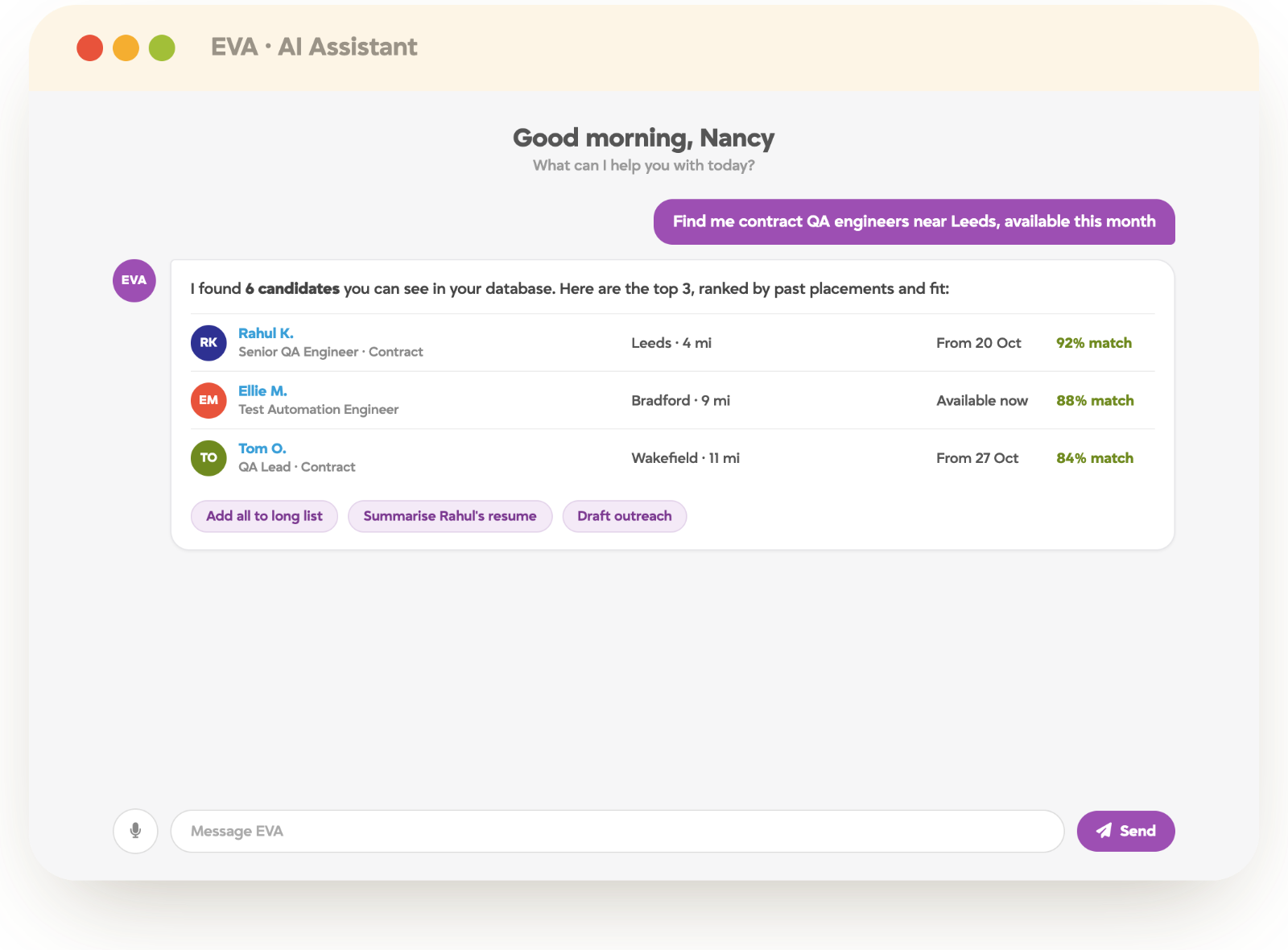
Ask about your candidates, clients and jobs in plain English. EVA finds, summarises, drafts and logs, then hands it back to you. She responds; you decide.
“Find me contract QA engineers in Leeds”
It runs itself
AI agents
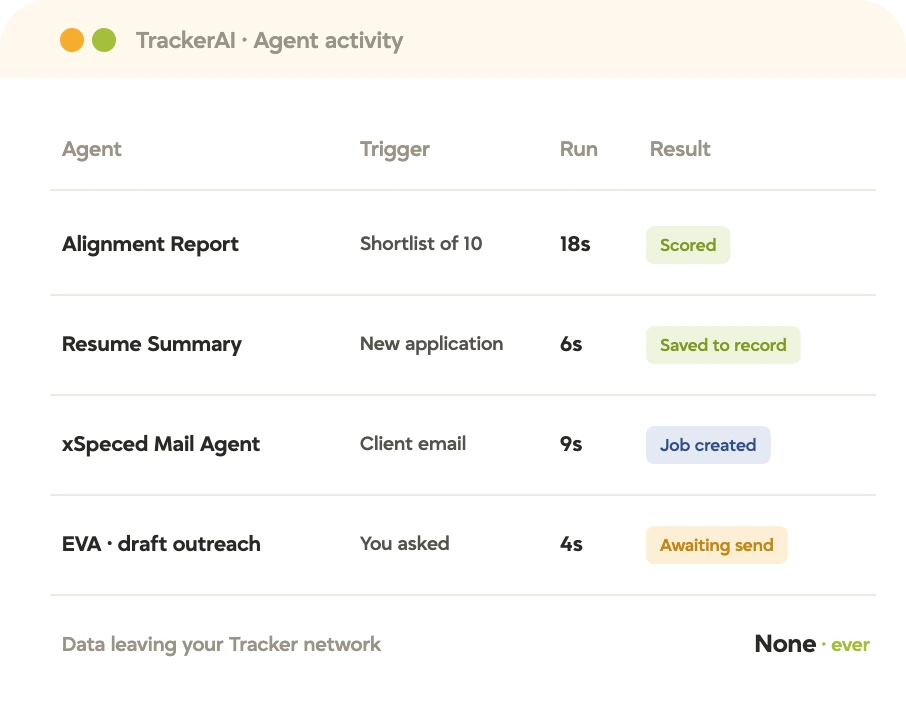
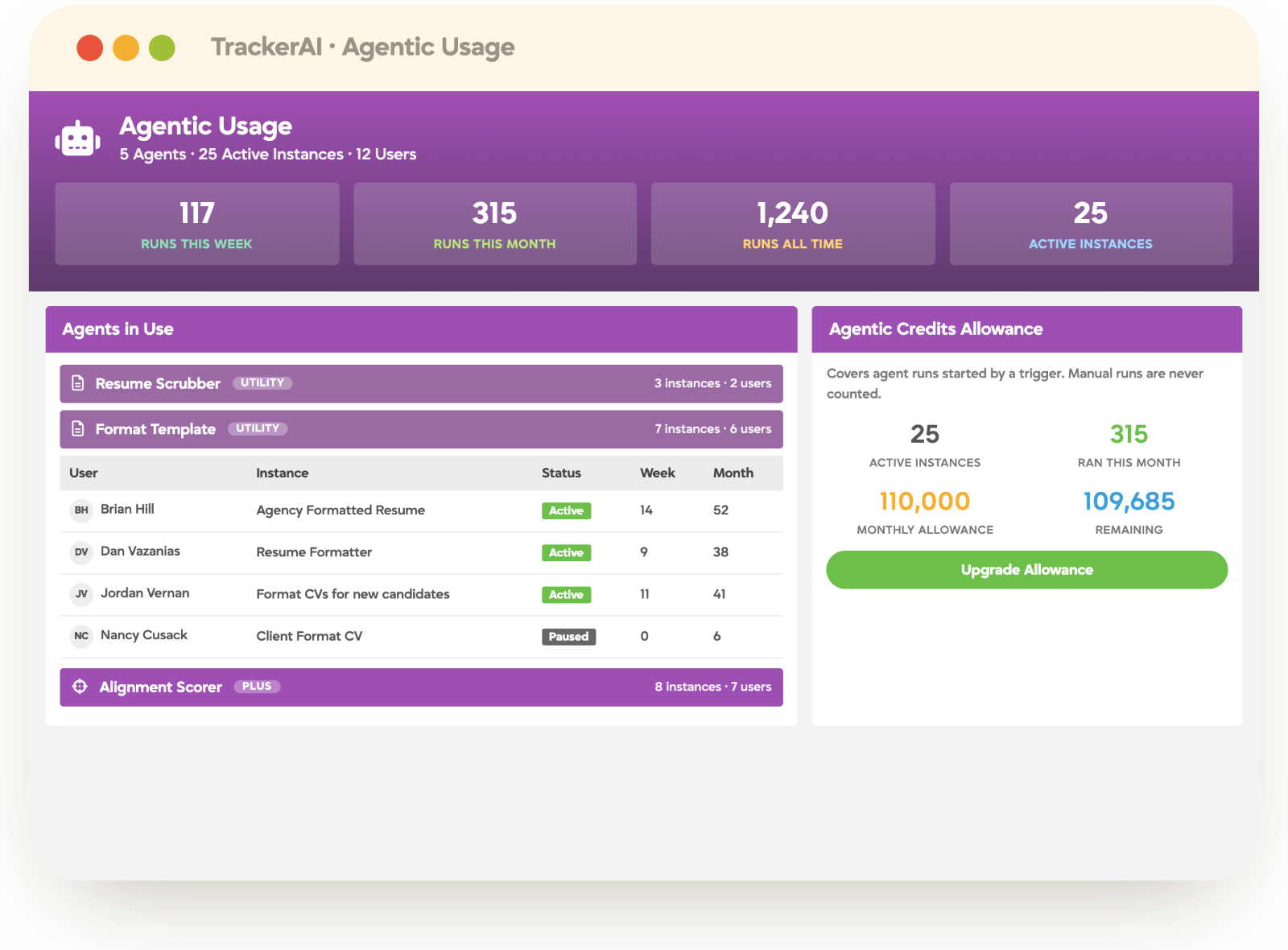
Each agent takes one job a consultant would otherwise do by hand and runs it on a trigger you set, or on demand across a batch. Nobody has to remember to start it.
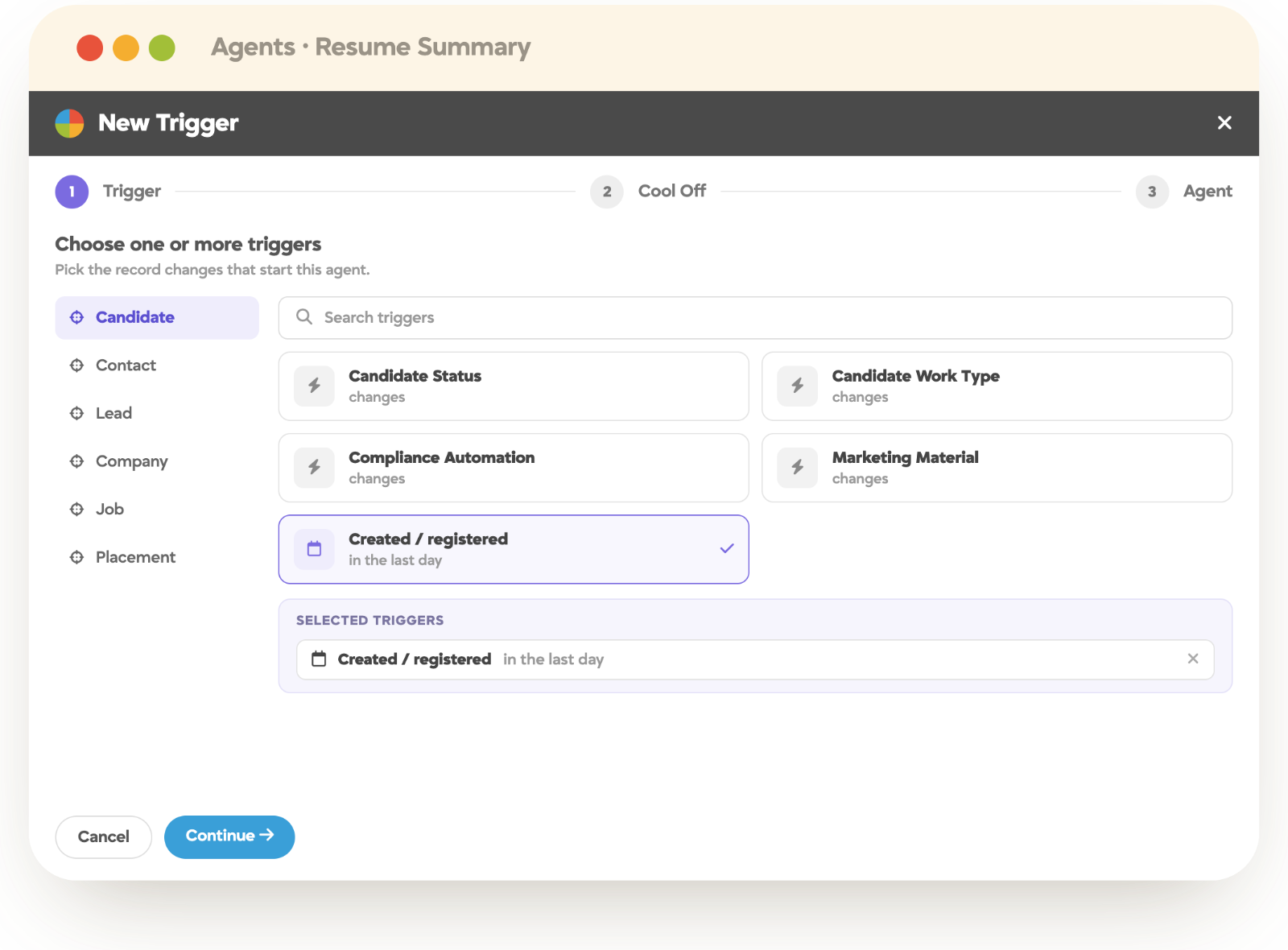
A new application arrives, it’s already summarised
Switched on when you need it
Add-ons
AI capabilities you enable per client from the marketplace, sitting inside the part of Tracker they belong to rather than in a separate tool. Live where the work already happens.
Natural Language Reporting, in the report builder
Rules can’t read a resume, and a model shouldn’t be deciding when a certification expires. Using the right layer for each job is most of the value.
How AI Recruitment Software and Automation Work Together
Automation decides when. AI decides what.
Neither layer is much use alone. A rule fires reliably but can’t read; a model reads well but shouldn’t be trusted to remember a date. Chain them and one application moves from inbox to shortlist without anyone touching it.
Automation
An application lands against an open job and the trigger fires.
AI agent
Resume Summary writes the profile. Alignment Report scores it against the spec.
Automation
High scorers route to the owning consultant’s task list. The rest get a courteous reply.
A person
The consultant reads three paragraphs and makes the call that matters.
Both layers write to the same record, so whoever picks it up next sees the whole story. See how recruitment automation works.
EVA · Natural language search · Summaries
Ask in your own words. Get your own data back.
EVA sits inside Tracker with access to the records you’re permitted to see, which is what separates a useful answer from a plausible one.
Plain-English search across candidates, clients, contacts and jobs. No Boolean, no saved-search maintenance.
She works within your permissions. Ask about “my clients” and she means the records you own.
Summaries, screeners and agency CVs on request. The same output the agents produce, on demand.
Notes, tasks, appointments and communication logs created as you talk. The admin happens in the conversation.
Pre-trained model, so it never learns from your database. Your data isn’t the product.
Matters most to Recruiters & business development
AI Agents for Recruitment Workflows
Triggered by the work, not by a person
An agent is only useful if it runs at the right moment. You choose the trigger, and the output lands where the next person will look for it.
Run on a record event, on a schedule, or on demand across a batch. The same agent, three ways.
Output saves to the record as a note, a PDF or a Word document. Not into a chat window nobody revisits.
Guardrails and prompts are configured per agency. Your tone and your rules, not a generic default.
Conditions let agents skip records that don’t need them. No re-running work that already exists.
Every run is logged. You can see what the agent did and why.
Matters most to Operations & admins
AI Recruitment Data Security & Governance
The questions your compliance lead will ask
Recruitment data is personal data. TrackerAI is built so the answers to the obvious questions are short ones.
Nothing leaves the Tracker network, and the model can’t reach outside your database. No public model sees your candidates.
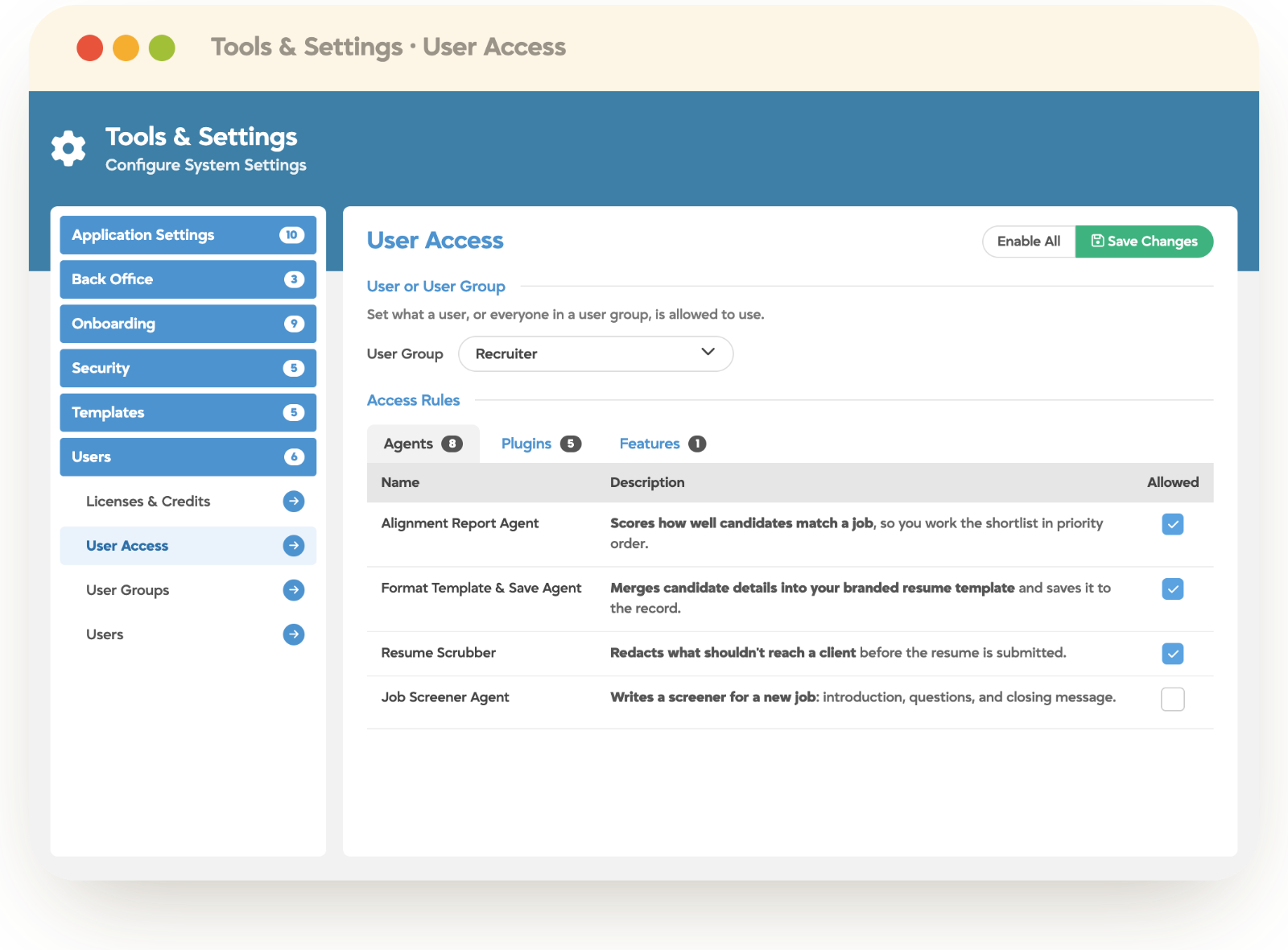
EVA and agent creation are separate permissions, granted by user group. You choose who can build and who can use.
Core identity and ownership fields are off-limits to AI. A model cannot reassign your accounts.
Resume Scrubber removes what shouldn’t reach a client before submission. GDPR handled at the point of risk.
Client-facing email always requires a human to send. The last step stays yours.
Matters most to Compliance & legal
Natural Language Reporting · AI add-ons · Reporting
Switched on where you need it
Add-ons are AI capabilities you enable per client from the marketplace. Each one lives inside the part of Tracker it belongs to, rather than as a separate tool your team has to learn.
Natural Language Reporting builds any report from a plain-English description. Across every data point in Tracker.
It sits in the Reporting menu and the report builder you already use. Not a simplified tool alongside them.
Refine the output through chat, then edit and share it as normal. The result is an ordinary Tracker report.
Enabled per client from the marketplace. Available on the Power tier.
Reporting stops being a specialist skill. Every user builds their own.
Matters most to Managers & operations
See the agents working
Watch EVA work a live desk.
Bring the part of the day you’d most like back (sourcing, screening, note-taking) and we’ll show you which agent covers it and what it hands back to you. Thirty minutes, live, no slides.
What changes
The reading, the writing, the retyping. Gone.
Building a screener for a new job. The Job Screener agent writes the introduction, the question set and the closing message, ready to send.
Reviewing applications. Alignment scores against the job description mean you work the list in priority order rather than in arrival order.
GDPR review before submission. The Scrubber reads all of them, not just the ones somebody had time to open.
AI does the reading. You do the deciding.
As AI recruitment software, TrackerAI is deliberately narrow. It reads, summarises, scores, formats and drafts. It doesn’t make the placement decision, and it doesn’t talk to your clients unsupervised.
Alignment scores are a sort order, not a hiring recommendation.
Summaries are factual by design and don’t infer what isn’t on the CV.
Client-facing email is drafted, never sent, without a person.
Rules-based work belongs in automation, not in a model.
In their words
What people actually hand over
I haven’t seen anything else on the market as AI-enabling as Tracker. The larger you are and the more legacy tech you have, the harder it is to become AI-enabled.
EVA rolling out is going to be an absolute game changer for us. It’s going to completely change how we search in the system and how we’re able to bring back candidates and match candidates to jobs, quickly.
I haven’t seen anything else on the market as AI-enabling as Tracker. The larger you are and the more legacy tech you have, the harder it is to become AI-enabled.
EVA rolling out is going to be an absolute game changer for us. It’s going to completely change how we search in the system and how we’re able to bring back candidates and match candidates to jobs, quickly.
I haven’t seen anything else on the market as AI-enabling as Tracker. The larger you are and the more legacy tech you have, the harder it is to become AI-enabled.
EVA rolling out is going to be an absolute game changer for us. It’s going to completely change how we search in the system and how we’re able to bring back candidates and match candidates to jobs, quickly.
I haven’t seen anything else on the market as AI-enabling as Tracker. The larger you are and the more legacy tech you have, the harder it is to become AI-enabled.
EVA rolling out is going to be an absolute game changer for us. It’s going to completely change how we search in the system and how we’re able to bring back candidates and match candidates to jobs, quickly.
Especially for new consultants, or people that maybe aren’t doing a job that’s similar, it allows them to look at where the AI thinks there’s a weakness.
Promising new AI functionality for sourcing and documentation purposes: recently we’ve started successfully using AI generated resume summaries.
Especially for new consultants, or people that maybe aren’t doing a job that’s similar, it allows them to look at where the AI thinks there’s a weakness.
Promising new AI functionality for sourcing and documentation purposes: recently we’ve started successfully using AI generated resume summaries.
Especially for new consultants, or people that maybe aren’t doing a job that’s similar, it allows them to look at where the AI thinks there’s a weakness.
Promising new AI functionality for sourcing and documentation purposes: recently we’ve started successfully using AI generated resume summaries.
Especially for new consultants, or people that maybe aren’t doing a job that’s similar, it allows them to look at where the AI thinks there’s a weakness.
Promising new AI functionality for sourcing and documentation purposes: recently we’ve started successfully using AI generated resume summaries.
See it for yourself
See the agents work on a role like yours
Book a 30-minute demo and we’ll run Tracker’s AI recruitment software against your own kind of work, so you can judge the output rather than the promise.
FAQ
AI questions, answered
TrackerAI is the AI recruitment software built into Tracker’s ATS and CRM. It has three parts: EVA, an AI assistant you ask questions in plain English; a library of AI agents that run on triggers you set; and AI add-ons you enable from the marketplace, like Natural Language Reporting. It works alongside Tracker’s rules-based automation.
EVA is Tracker’s AI assistant, built into the platform rather than bolted on. Ask her for candidates, a resume summary, a screener or an agency resume in your own words. She works within your permissions and can create notes, tasks, appointments and communication logs as you go.
EVA is an assistant: she responds when you ask. AI agents run on triggers you set, so the work happens without anyone starting it. Add-ons are the third part: AI capabilities you enable per client, living inside the area of Tracker they belong to.
Add-ons are AI capabilities you enable per client from the Tracker marketplace, and they appear inside the part of the product they belong to rather than as a separate tool. Natural Language Reporting is the first, available on the Power tier.
Automation decides when something should happen; AI decides what the content of it is. A rule fires on a new application, an agent summarises and scores the CV, then another rule routes the strong matches to the owning consultant. Both layers write to the same record.
No. EVA is a pre-trained model that does not train on your data. She cannot reach outside your database, and nothing leaves the Tracker network.
Only where an authorised action exists, which covers opportunities, activities and documents. Core candidate, client and contact fields including owner, name, status, address, type, department, email, phone and job title are not changed by AI, and neither is account ownership.
It drafts, you send. AI-generated client-facing email always requires a person to press send. Automated candidate status updates and nurture sequences are separate, rules-based, and configured by you.
Yes. Prompts, guardrails, triggers and skip conditions are configured per agency, so output follows your tone and your process. Using AI and creating agents are separate permissions, granted by user group.
The Resume Scrubber reviews every resume before submission and redacts or rewrites what shouldn’t reach a client, keeping the meaning, structure and formatting intact. The clean version saves back as a new document, leaving the original untouched.