How it works
Three ways a conversation reaches someone
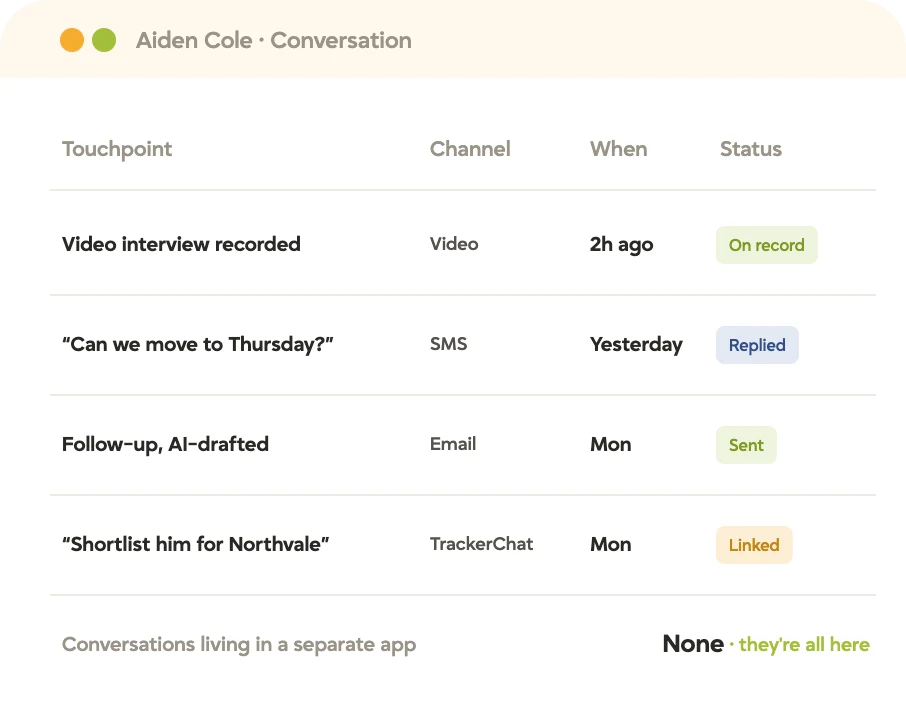
A single relationship is built across dozens of touchpoints. What matters is that they go out on the right channel, in the right voice, and all land back in the same place.
Sent by a person
Video, email, text
Record a video message, send an email, or text the candidate who never opens email. Every channel from the record, every reply back onto it.
The reply came in two minutes, because it came as a text
Drafted by TrackerAI
Personal at scale
The recruiter sends a follow-up TrackerAI drafted from everything already on the record, after making it theirs. Not a template, not a mailshot.
Five placements, five personal follow-ups, one morning back
Fired by the platform
Touchpoints on schedule
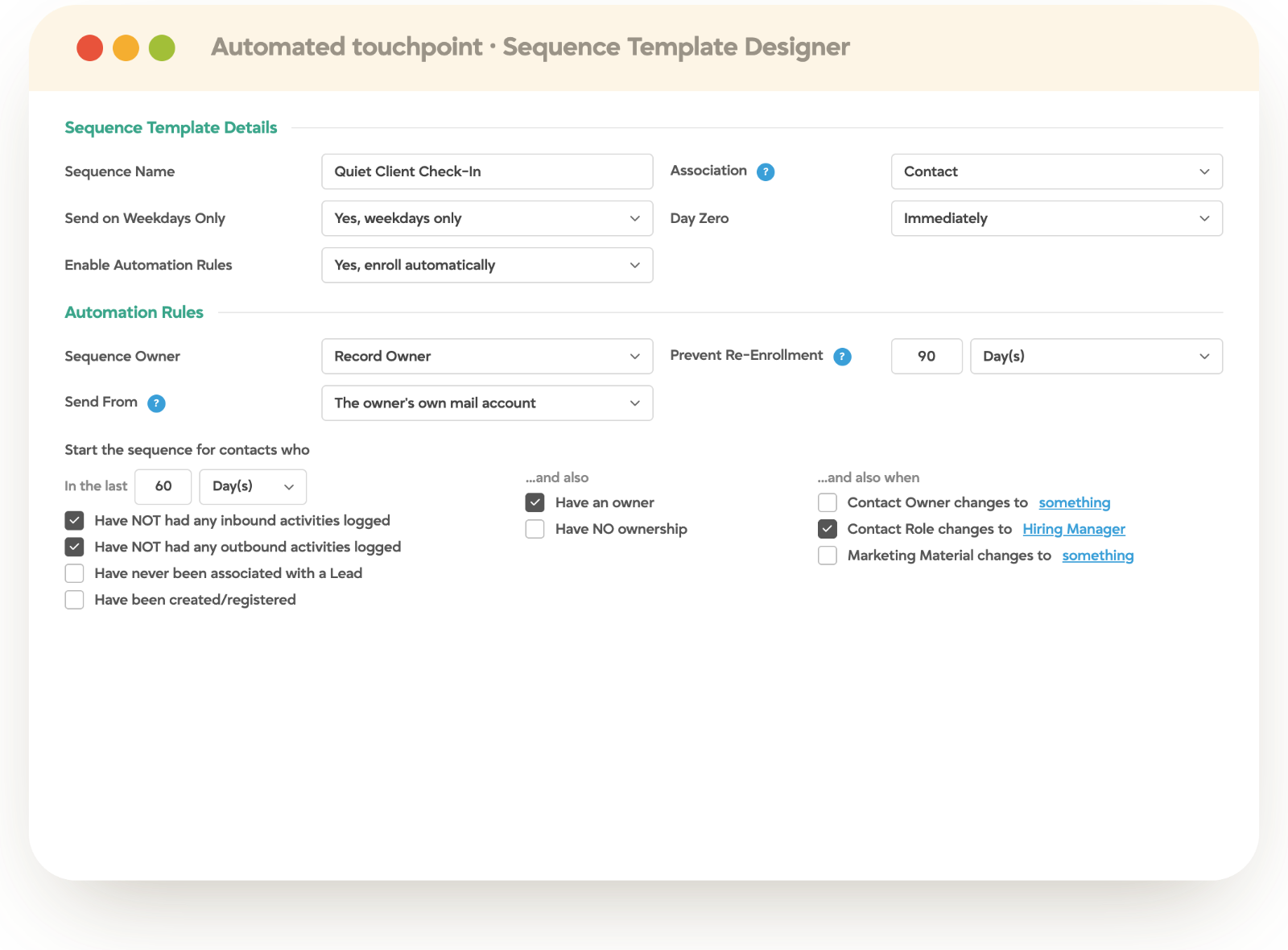
Check-ins, shift reminders, renewal chases and BD sequences go out when they should. Set once by automation, sent without anyone remembering.
The placed candidate hears from the desk before they go quiet
All three write to the same record, so the next person to open it sees the whole conversation rather than their part of it.
Video interviews · Video email · Scheduling
A CV lists what someone did. Video shows who did it.
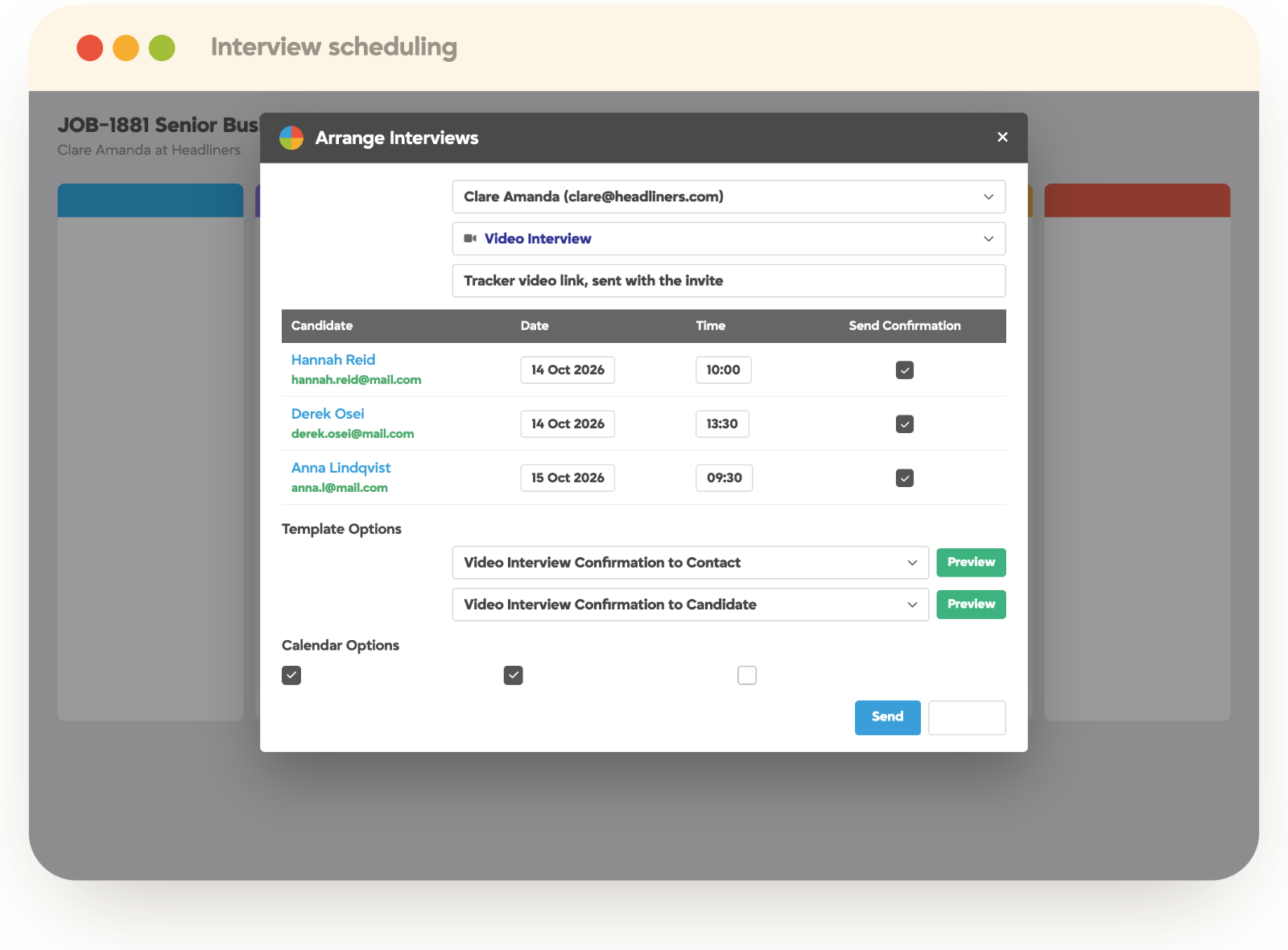
Interviews on the candidate’s time, reviews on the client’s. Nobody has to find a slot that works for all three.
One-way video interviews recorded by the candidate when it suits them. No calendars, no reschedules, no chasing a slot.
Screening questions built by TrackerAI from the spec and the CV. The call starts sharp.
Send the client a person, not a document describing one. Video sits alongside the CV in the submission.
Video email for outreach that has a face and a voice. The message that stands out in an inbox full of text.
Live interviews scheduled and logged against the job. Recording and notes on the record afterwards.
Matters most to Recruiters
SMS · Email · AI drafting
Personal at scale isn’t a contradiction
It’s what happens when the message is built from the record instead of from a template, and sent on the channel that person actually checks.
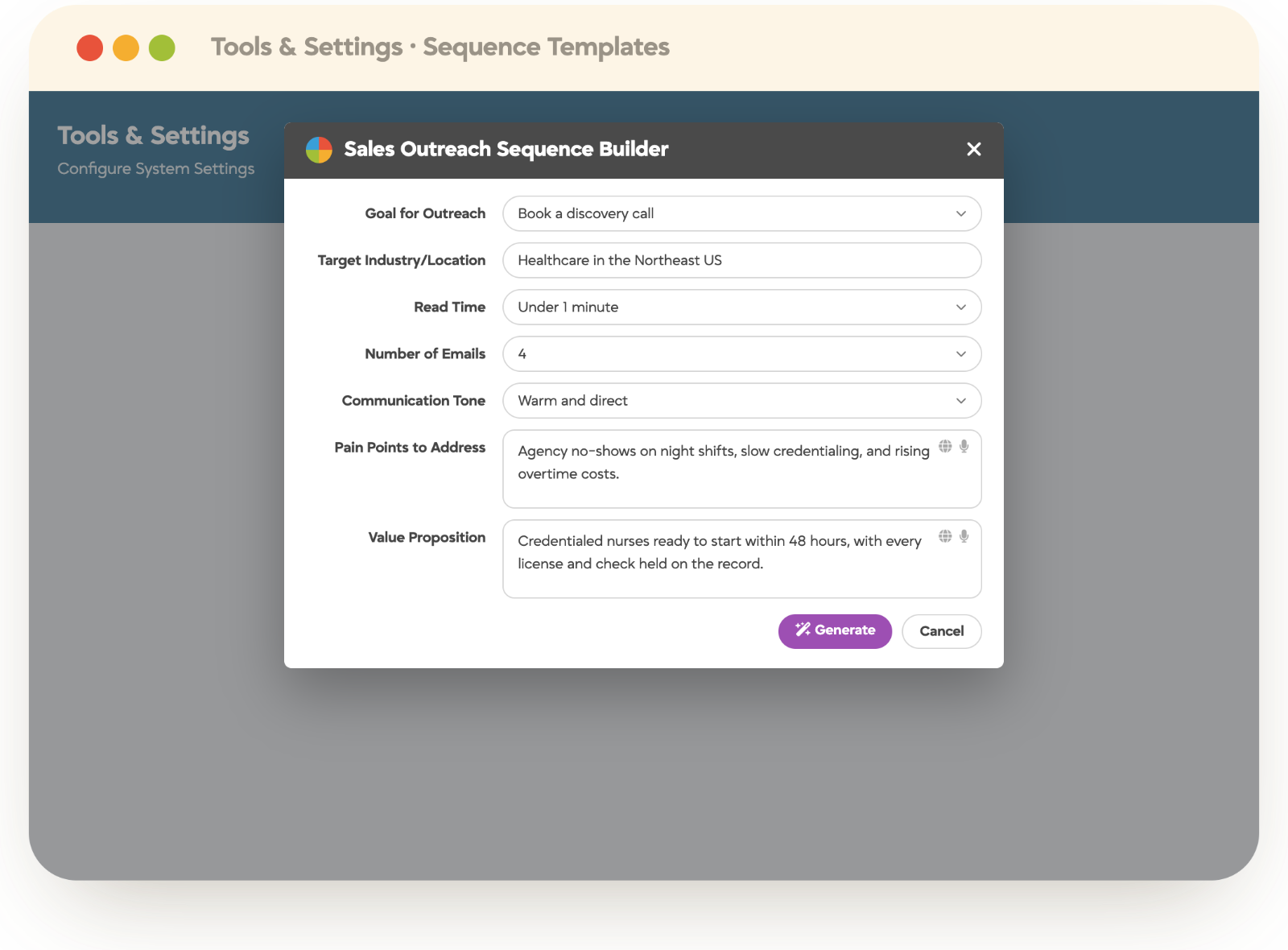
The recruiter edits and sends a follow-up TrackerAI drafted from the CV, the spec and the history. Personal, without starting from blank.
SMS from the record, with replies threaded back onto it. The candidate who ignores email replies to a text.
Email sent and captured against the right contact by the Mail Agent. Nothing stuck in a personal inbox.
Templates and AI email templates your admins set up once. House voice, per-candidate detail.
Every send visible on the timeline, whoever or whatever sent it. Including automated touches.
Matters most to Recruiters & business development
Automated touchpoints · BD sequences · Aftercare
Stay in touch with everyone, without anyone keeping in touch
The check-in at three months. The shift reminder on Sunday evening. The renewal chase that starts thirty days out. Nobody triggers any of them.
Milestone messages fired from the record’s own dates. Written once, sent every time.
BD sequences that warm a prospect over months. So the first real call is never cold.
Aftercare for placed candidates and contractors on shift. They hear from the desk before they go quiet.
Send on email or SMS, chosen per audience and moment. The channel that gets answered.
Built in automation, reported in reporting. You can see what actually went out.
Matters most to Operations & marketing
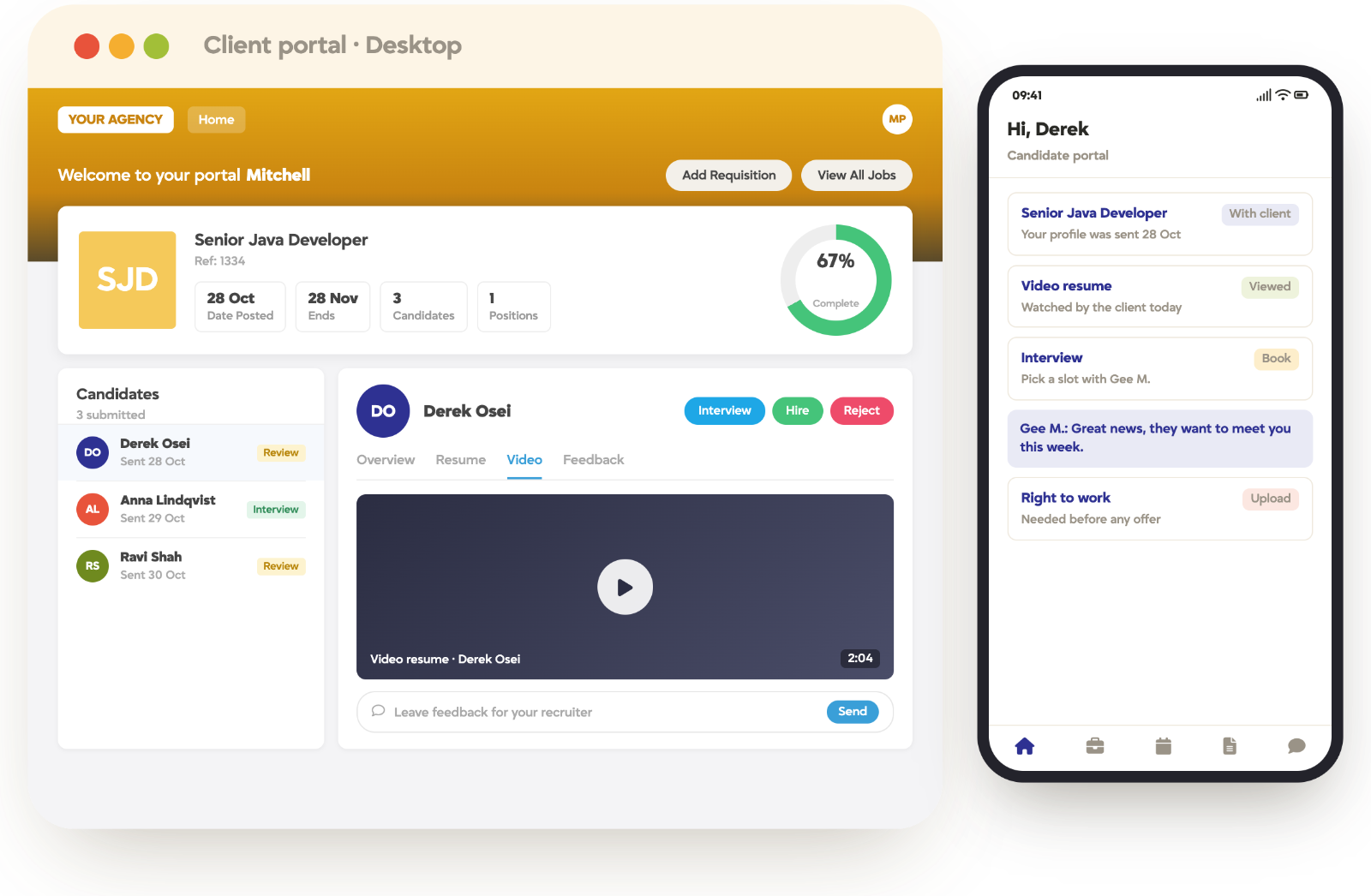
Client portal · Candidate portal · Interview booking
Let both sides communicate on their own terms
The back-and-forth that used to fill the day goes away when the client and the candidate can act without waiting on an email.
Clients review submissions, leave feedback and approve in the portal. No reply required.
Candidates get updates, guidance and nudges as they go. Communication that doesn’t wait for office hours.
Interviews booked from the portal against the recruiter’s calendar. Scheduling without the three-email thread.
Documents, timesheets and paperwork handled in the same place. See back office.
Everything done in the portal lands on the record in real time. Client to desk, candidate to record.
Matters most to Clients & candidates
See it on your own desks
Run one placement through every channel.
Tell us how a candidate reaches you today and we’ll walk the same placement in Tracker: video, text, AI-drafted follow-up, portal, all on one record. Thirty minutes, live, no slides.
Inside the office
The conversations between your own people
Half the communication in an agency never reaches a candidate or a client. It’s consultants talking to each other, and it belongs on the record too.
TrackerChat
Internal chat inside Tracker, not in a messaging app with the record open in another tab.
Talk to a colleague without leaving the candidate
The weekend chat about Aiden ends up on Aiden’s record
Find the conversation from three weeks ago in one place
No rebuilding context each time someone new joins
@mentions
Pull a colleague into the work rather than into a side conversation about it.
Mention a delivery manager, AE or another department
They see the whole conversation, not a forwarded line
Activities on contacts and candidates stay linked
Debrief to client call in minutes, not the next day
Wallboards
Team performance you see rather than read, live on a screen in the office.
Placements, pipeline and activity in real time
Sam closes at 11:47, the office knows at 11:48
Wins celebrated as they happen, not in a debrief
Same numbers as reporting, no report to open
What changes
Every touchpoint, where it belongs
Video, chat, email, text and portal activity stop living in separate apps, so the day isn’t spent finding the conversation.
A client who has already watched three candidates decides faster than one meeting three shortlisted CVs at a time.
Check-ins, reminders and BD sequences run on schedule, so relationships stay warm without anyone driving them by hand.
More channels only help if they all write back
Adding video, SMS and chat to a desk that already has email is noise unless every one of them lands on the record. That’s what keeps the whole desk looking at the same conversation.
Every channel logs to the candidate, contact, client or job it belongs to.
AI drafts messages; a person reads them and presses send.
Automated touchpoints are visible on the timeline like any other send.
Consent and opt-out rules apply to SMS and email alike.
In their words
What changes when every conversation lands in one place
They make it easier to communicate updates and notes between our sales team and our recruiters. It also helps us automate our sales marketing.
The @mention function has changed the game. A recruiter can @mention their delivery manager or account executive, or someone from a different department, and the activities on contacts and candidates are all linked now.
They make it easier to communicate updates and notes between our sales team and our recruiters. It also helps us automate our sales marketing.
The @mention function has changed the game. A recruiter can @mention their delivery manager or account executive, or someone from a different department, and the activities on contacts and candidates are all linked now.
They make it easier to communicate updates and notes between our sales team and our recruiters. It also helps us automate our sales marketing.
The @mention function has changed the game. A recruiter can @mention their delivery manager or account executive, or someone from a different department, and the activities on contacts and candidates are all linked now.
They make it easier to communicate updates and notes between our sales team and our recruiters. It also helps us automate our sales marketing.
The @mention function has changed the game. A recruiter can @mention their delivery manager or account executive, or someone from a different department, and the activities on contacts and candidates are all linked now.
The recruiter writes the debrief notes and @mentions the AE, who sees the whole conversation and can call the client straight away. It could be within minutes versus potentially the next day.
If I'm a remote recruiter I can go into Tracker and get all the updates I need on the job orders I'm working on without talking to anyone. That could not happen at all before.
The recruiter writes the debrief notes and @mentions the AE, who sees the whole conversation and can call the client straight away. It could be within minutes versus potentially the next day.
If I'm a remote recruiter I can go into Tracker and get all the updates I need on the job orders I'm working on without talking to anyone. That could not happen at all before.
The recruiter writes the debrief notes and @mentions the AE, who sees the whole conversation and can call the client straight away. It could be within minutes versus potentially the next day.
If I'm a remote recruiter I can go into Tracker and get all the updates I need on the job orders I'm working on without talking to anyone. That could not happen at all before.
The recruiter writes the debrief notes and @mentions the AE, who sees the whole conversation and can call the client straight away. It could be within minutes versus potentially the next day.
If I'm a remote recruiter I can go into Tracker and get all the updates I need on the job orders I'm working on without talking to anyone. That could not happen at all before.
See it for yourself
Bring us the message that never gets a reply
Book a 30-minute demo, tell us where your candidates and clients go quiet, and we’ll show you the channel and the touchpoint that reach them.
FAQ
Communication questions, answered
Video interviews and video email, standard email, SMS, internal chat through TrackerChat, and candidate and client portals. Each one sends from the record and logs back to it, so the whole history sits in one timeline.
You send the candidate a set of questions and they record their answers when it suits them. The recruiter reviews on their own time, and the recording can go to the client alongside the CV, so no one has to coordinate a calendar to screen.
It drafts them. The recruiter starts from a draft TrackerAI builds from what’s already on the record, the CV, the spec and the history, then edits and sends. Nothing goes out without a person pressing send.
Yes. SMS sends from the record and replies thread back onto it, so the conversation is visible to whoever picks the candidate up next rather than sitting on one person’s phone.
Messages set up once in automation and fired from the record’s own dates: the three-month check-in, the Sunday shift reminder, the renewal chase thirty days out, a BD sequence over months. They appear on the timeline like any other send.
Clients review submissions, leave feedback, approve and schedule. Candidates get updates and guidance, book interviews and handle documents. Everything they do writes to the record in real time, with no email in the middle.
It isn’t trying to be your whole company’s chat tool. It’s there so conversations about a candidate or a job happen next to that record, and @mentions link the activity rather than starting a thread somewhere else.
Live placements, pipeline and team activity on a screen in the office, drawn from the same numbers as reporting. The point is that a win is visible the moment it happens rather than in the next debrief.