
You have 0 items in your cart
Key Takeaways
- Agentic AI handles up to 80% of transactional recruiting tasks when deployed with clear rules and human oversight for complex decisions.
- Skills-first hiring workflows help agencies widen talent pools and improve client alignment by separating skills from job titles in matching and search.
- Predictive analytics supports better workforce planning when paired with data discipline and helps teams spot pipeline gaps before they impact delivery.
- Platform consolidation reduces workflow handoffs and improves reporting integrity by keeping core data in one system with deep integrations.
- Recruitment automation works best when teams standardize processes first and define clear rules for when automation advances work and when recruiters step in.
Automation in staffing is shifting from isolated features to connected systems that change how work flows across teams. Clients and candidates expect faster responses and clearer status updates, and agencies need tighter documentation since each decision can affect trust and compliance.
This guide covers what recruitment automation trends mean for daily operations and where staffing teams should keep people in control.
Why 2026 is a turning point for recruiting automation
The change isn’t about adding more automation. It’s about automation that connects stages and makes the full workflow run consistently. Nearly 9 in 10 HR professionals using AI tools in recruiting report time savings, with more than one-third citing reduced hiring costs.
Agencies are facing pressure on three fronts: clients expect faster delivery, candidates expect better communication, and regulations require clearer audit trails. Recruiting automation now needs to be measurable, auditable, and easier to adjust when hiring conditions change.
Trend 1: Agentic AI and autonomous recruiting workflows
Agentic systems complete sequences of actions instead of generating content or ranking candidates. Research shows that agentic AI can handle up to 80% of transactional tasks when properly deployed. In staffing, AI recruitment automation appears as assistants that move work forward when rules are clear. These include triggering follow-up tasks, flagging missing candidate data, or proposing video interview times after availability gets confirmed. Fewer dropped tasks means fewer hidden queues that depend on individual habits. AI sourcing handles candidate discovery around the clock, while automation manages the follow-through.
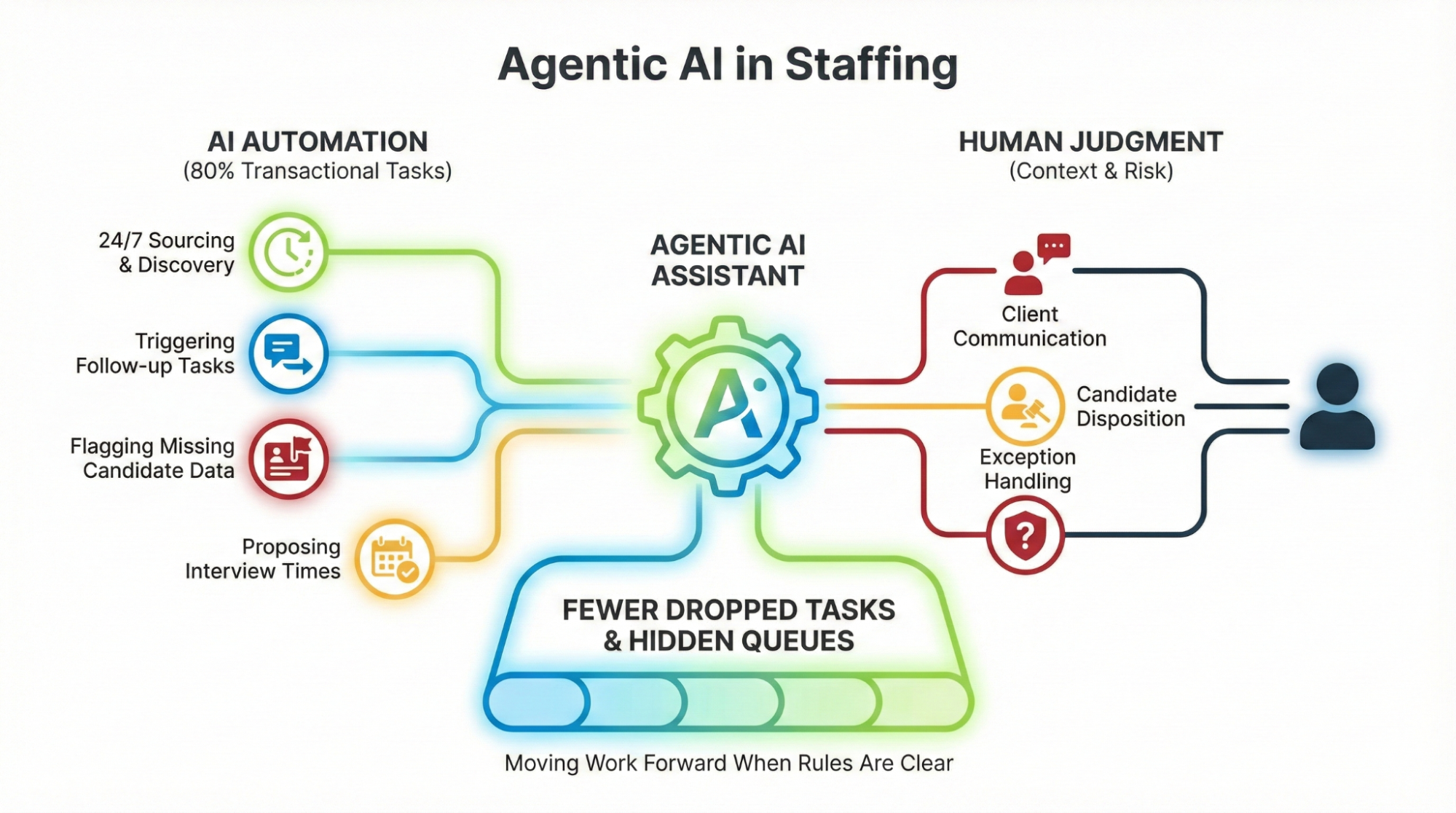
Human judgment still matters when context is unclear or risk is higher. This includes client communication, candidate disposition, and exception handling.
Trend 2: Skills-first hiring and skills inference at scale
Many agencies track skills, but the next shift makes skills the backbone of candidate matching, redeployment, and pipelining. Automation in recruiting improves how teams infer skills from work history, certifications, and outcomes, then maps those skills to roles across industries. Agencies widen talent pools without lowering standards, and transferable skills become visible earlier.
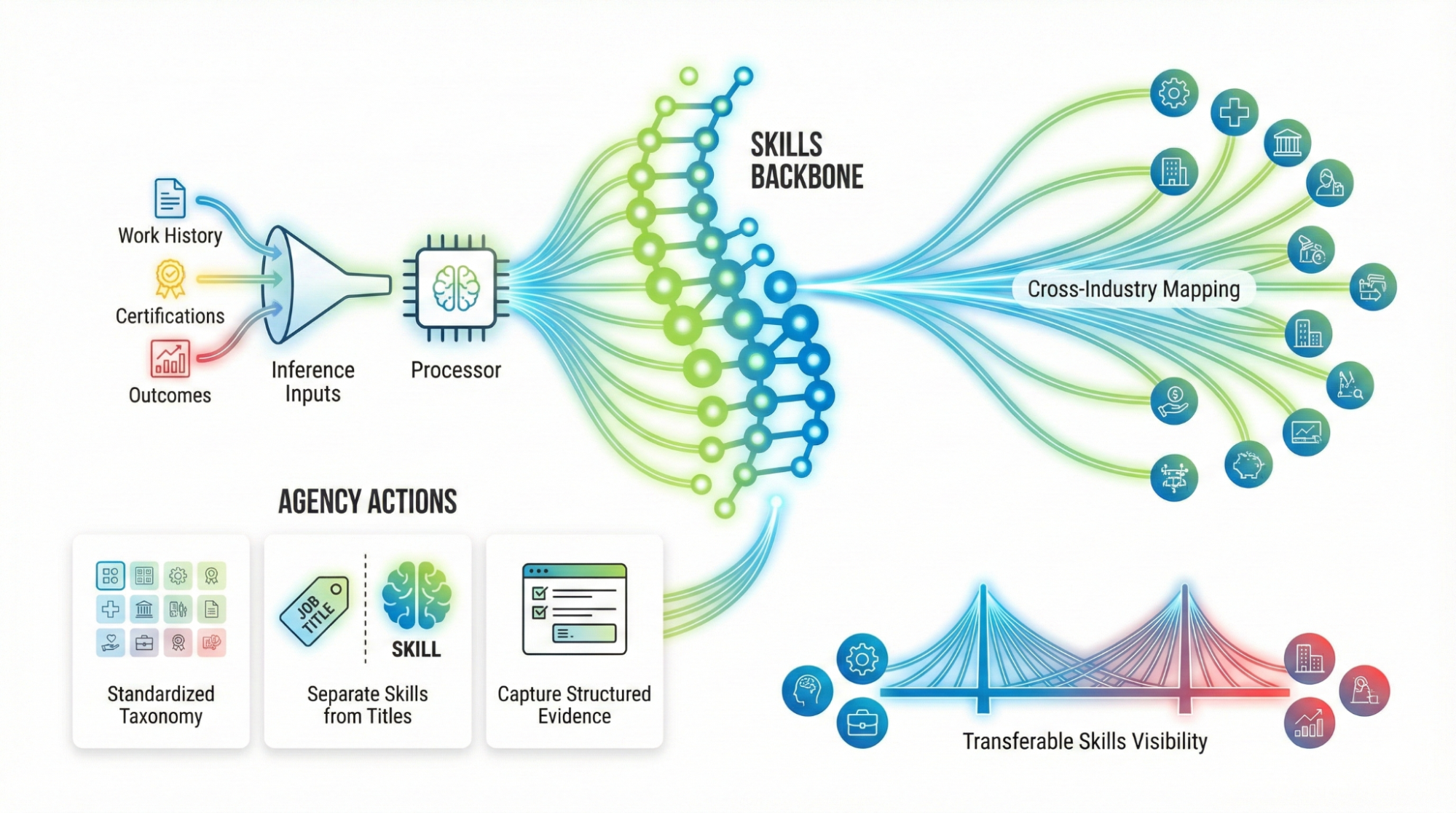
Skills-based hiring workflows improve client alignment, too. Recruiters can explain fit consistently across the team, even when titles vary across industries. Agencies are making these moves:
- Standardizing a skills taxonomy by vertical
- Separating skills from job titles in search and segmentation
- Capturing skill evidence in structured fields instead of notes
Trend 3: Predictive analytics and talent intelligence for better decisions
Forecasting helps staffing agencies when it supports decisions, not when it promises certainty. Recruitment automation software spots where pipelines thin out, where response rates drop, and which stages create avoidable delays. Organizations using AI-powered workforce planning report a 15% reduction in labor costs through more accurate demand forecasting and resource allocation. It supports workforce planning by helping teams anticipate coverage needs, plan recruiter capacity, and align pipelines to expected client demand. Talent intelligence converts raw data into actionable insights for strategic hiring.

This depends on discipline more than tooling. When candidate profiles are incomplete or stages get used inconsistently, outputs can look precise but still mislead. Agencies get better results when they pair analytics with clear definitions, routine data checks, and a habit of reviewing outcomes with the team.
Trend 4: Candidate nurturing at scale without losing trust
Automation keeps candidates warm between opportunities, but only when communication stays relevant and easy to understand. Staffing agencies that treat nurturing as a workflow reduce gaps in follow-up and keep redeployment readiness higher. The goal is consistency without sounding like a sequence.
Hyper-personalized candidate experience
A stronger candidate experience comes from fewer surprises and faster clarity, not flashy messaging. Recruitment process automation supports that by sending timely status updates, surfacing next steps, and prompting recruiters when a candidate has been waiting too long. AI chatbots handle basic Q&A, confirm details, and provide instant acknowledgements so candidates aren’t left guessing.
Process-level personalization keeps the human layer visible. Teams do that by:
- Using chatbots for simple questions and updates, then routing sensitive issues to a recruiter
- Keeping recruiter ownership clear in every stage
- Making it easy for candidates to update availability and preferences

Compliance, privacy, and explainability expectations
This section covers operational safeguards. Each agency should align details with client requirements and internal legal guidance. As automation expands, teams will be expected to show how decisions were made, what data was used, and who approved exceptions. Research from MIT Sloan emphasizes that organizations must choose a path where AI serves human decision-making rather than replacing it entirely, particularly when ethics and accountability are at stake. A practical baseline includes:
- Keeping an audit trail for automation rules, edits, and overrides
- Defining required data before automation can trigger actions
- Setting review points and periodic checks to confirm rules are producing consistent outcomes
- Monitoring outcomes after placement and escalating issues when results look inconsistent
Trend 5: Platform consolidation and total talent ecosystems
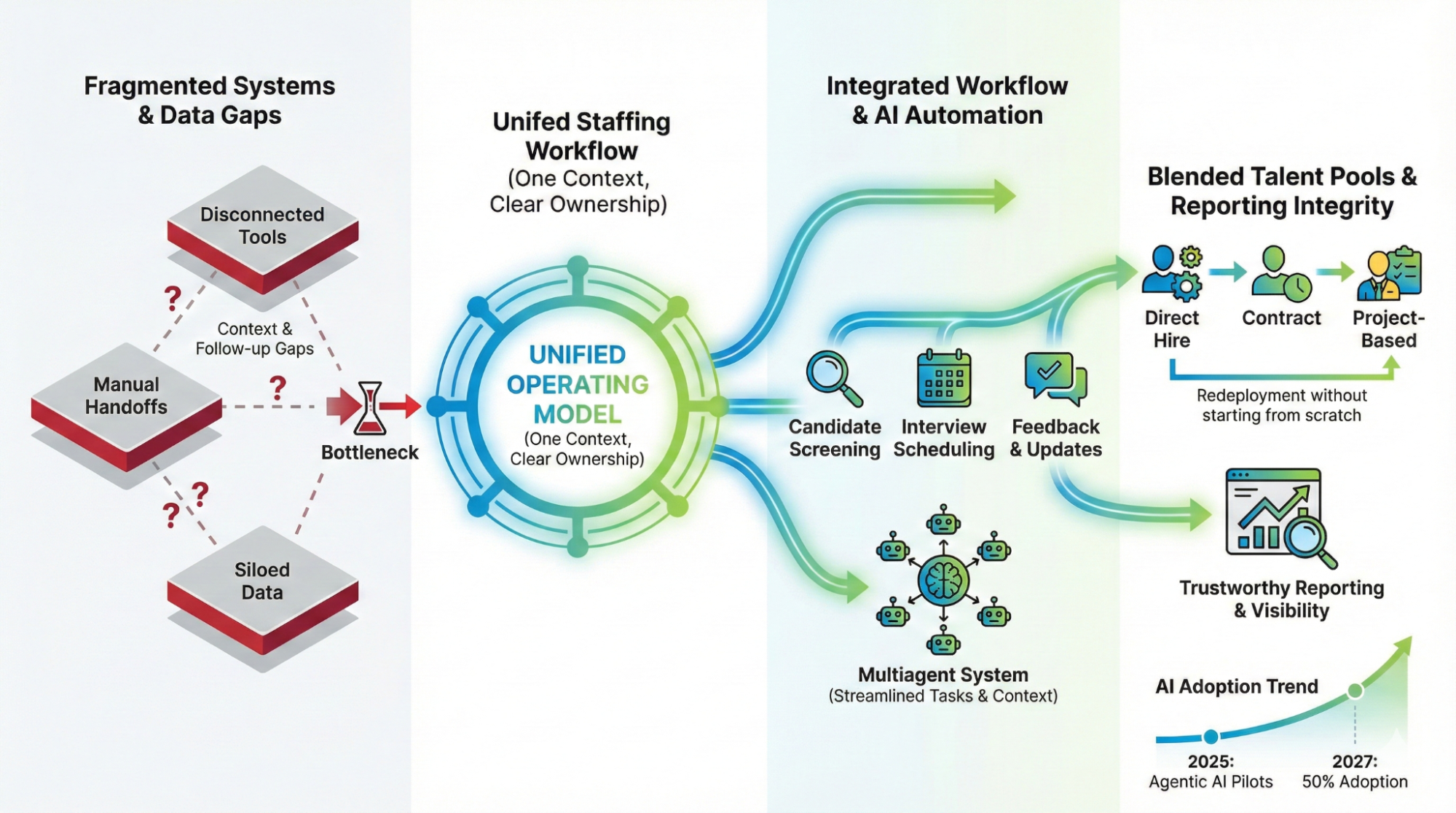
Staffing teams rarely struggle from a lack of tools. The bigger problem is work spread across systems that don’t share context, which creates gaps in follow-up and reporting. Predictions suggest that 1 in 4 companies using generative AI will launch agentic AI pilots in 2025, with AI adoption reaching 50% by 2027. Consolidation is pushing agencies toward fewer platforms with clearer ownership, stronger data discipline, and better visibility across the full process.
Deep integrations and fewer workflow handoffs
Recruitment automation tools perform better when core data lives in one place and updates flow both ways. Multiagent systems excel at streamlining workflows by handling tasks like candidate screening, interview scheduling, and feedback collection while maintaining context across all interactions. For staffing agencies, that reduces time spent reconciling notes, fixing duplicates, and re-entering details between systems. Submission readiness improves when recruiters can see the full history, not just the latest touchpoint.
Fewer handoffs improve reporting integrity too. When activity gets captured where work happens, leaders can trust what dashboards show and diagnose bottlenecks without chasing down manual reports.
Managing blended talent pools in one operating model
More agencies manage direct hire, contract, and project-based talent in parallel, often with different rules for availability, credential checks, and client reporting. A unified operating model helps recruiters avoid running separate workflows that create inconsistent service across work types. It supports redeployment, since the same candidate can move between work types without starting from scratch.
The core requirement is clear workflow design with shared definitions, consistent stage usage, and a system that handles variations without breaking reporting or ownership.
What staffing agencies should do next
Trends only matter when they turn into operating decisions that teams can repeat. Staffing leaders should treat automation as workflow design, with clear rules for when work moves forward and when a recruiter steps in. Measurement becomes realistic when the team isn’t relying on individual workarounds.
Baseline AI fluency matters too. Recruiters need to understand what automation is doing, challenge questionable outputs, and document overrides consistently. Start here:
- Map the current workflow and mark where handoffs cause delays or missed follow-up
- Standardize data fields and stage definitions so reporting reflects reality
- Start with one high-volume workflow, then expand once ownership and review points are working
A practical plan turns recruitment automation trends into changes recruiters can apply every week.
Tracker’s ATS and CRM: Supporting automation with visibility and control
Automation is easier to manage when recruiting and relationship work sit in the same system. Tracker’s ATS and CRM supports staffing teams by keeping candidate and client context connected, so workflows stay consistent across desks.
- Sequences and automation: Run email, text, and workflow sequences that trigger tasks, notifications, and follow-ups

- Reporting and dashboards: Track pipeline health, time in stage, and team activity using dashboards and custom reporting
- TrackerAI: Use intelligent ranking, resume summarization, and candidate screening to speed up decision-making
- Marketing and automation: Build targeted campaigns recruitment marketing in social media and nurture sequences that keep candidates and clients engaged
- Sourcing and job boards: Connect with multiple job boards and sourcing channels from a single platform

Closing thought: Standardize, measure, improve
Recruitment automation works when teams treat it as a managed system, not a set of shortcuts. Standard processes make outcomes easier to track, and clear ownership makes it easier to catch issues early. Agencies that keep improving workflow discipline will be better prepared for what comes next.
See how staffing teams use Tracker to build repeatable recruiting workflows and keep recruiters in control. Request a demo.
FAQs
What are the most common mistakes staffing agencies make with recruitment automation?
Common mistakes include automating unclear steps, skipping data standards, and letting exceptions pile up without review. Agencies get better results when they document the workflow first and define what must be true before automation runs.
How can staffing agencies roll out recruitment automation without disrupting the current hiring process?
Start with one workflow that has clear inputs, clear ownership, and a defined review point. Keep the rollout small enough that recruiters can give feedback quickly, then expand once the team trusts the rules and the data.
What metrics should organizations track to measure the success of recruitment automation?
Track measures that show workflow health: time in stage, follow-up timeliness, response rates, redeployment activity, and documentation completeness. Choose metrics tied to weekly decisions, not reporting for its own sake.
