You have 0 items in your cart
Key Takeaways
- Recruiters own hiring decisions when using AI while the technology handles repeatable screening and sourcing tasks.
- AI-assisted pipelines improve candidate success rates but human review stays required to confirm intent and cultural fit.
- Bias monitoring must be continuous because training data and inconsistent rules introduce hiring risks that algorithms cannot self-correct.
- Clear workflow boundaries specify where AI suggests candidates and where human approval is required before anyone advances.
- Integrated ATS and CRM systems keep AI activity reviewable so staffing teams maintain accountability across every hiring stage.
AI is transforming talent pipelines across recruitment. MIT Sloan research shows 87% of companies have deployed AI hiring systems, with the market projected to surpass $1 billion by 2027. When decisions get automated in talent acquisition, they get harder to defend. A candidate challenges a rejection. A client questions your shortlist. “The algorithm said so” doesn’t cut it.
The role of recruiters in AI is clear. They set standards, validate outputs, and stay accountable for candidate trust and hiring outcomes.
The role shift: From task owner to decision owner
Gartner analysis shows that as AI takes low-complexity work, recruiters’ ability to deliver high-complexity hiring, in talent strategy and role design, becomes the critical differentiator.
Artificial intelligence evolved from a passive tool to agentic AI systems that act as autonomous teammates. Recruiters now manage AI recruitment agents while maintaining human oversight. This demands strategic thinking rather than task execution.
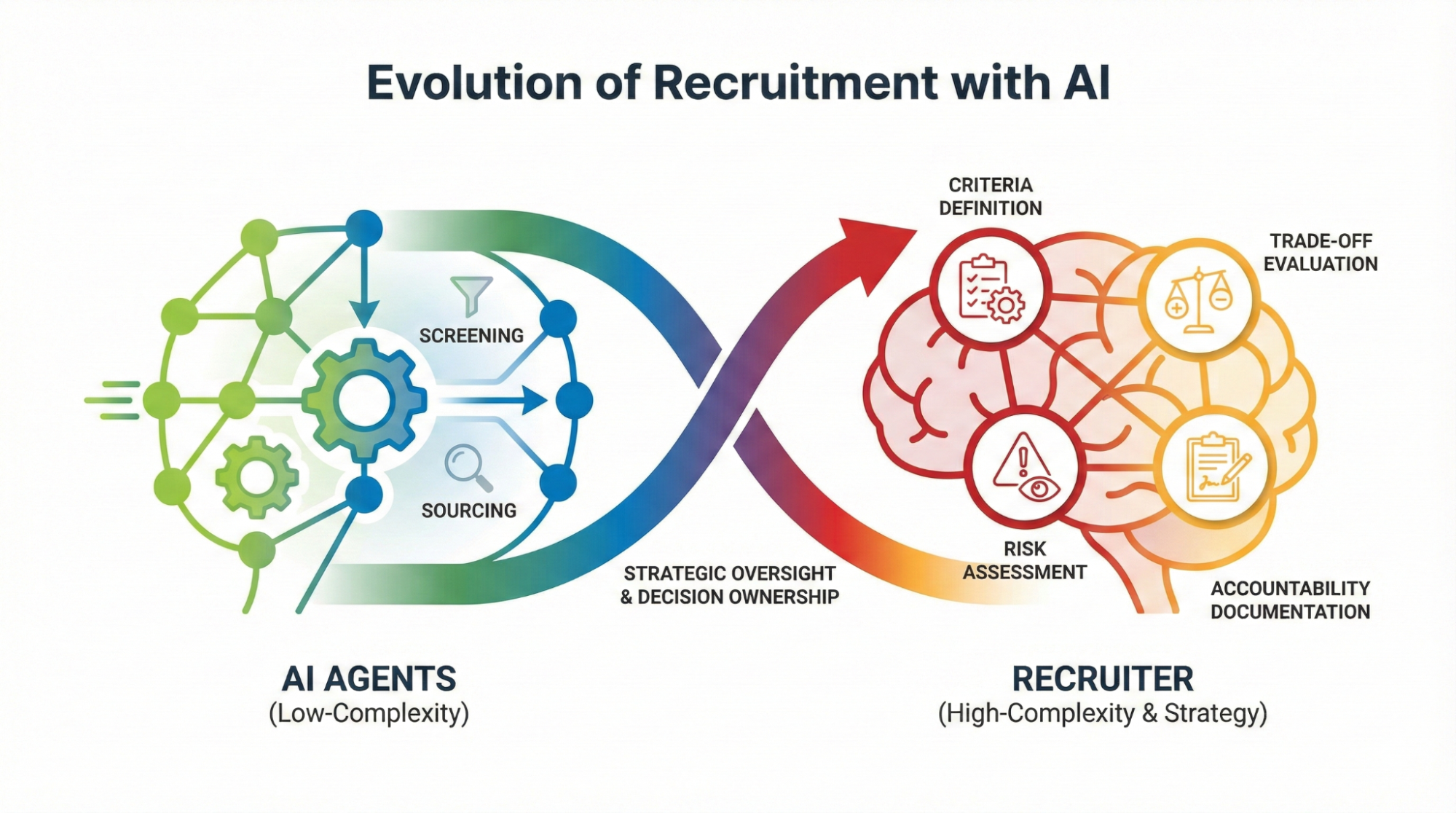
Using artificial intelligence in recruitment, automation speeds up screening and sourcing. But it can’t define “qualified.” Recruiters decide what matters, how it’s measured, and what disqualifies candidates.
Decision ownership shows up in four places:
- Criteria definition: Set role requirements and keep evaluation standards consistent
- Trade-off evaluation: Weigh strengths against gaps instead of pass/fail screening
- Risk assessment: Spot red flags in misaligned expectations or unrealistic timelines
- Accountability documentation: Document decisions for hiring managers, clients, and candidates
Where AI fits in the recruitment process
Understanding where AI in recruitment process adds value, and where it creates risks, determines success.
Successful workflows treat agentic AI as a signal generator, not a decision maker. Talent acquisition teams automate high-volume, pattern-based tasks and reserve strategic decisions for human judgment.
Sourcing and screening support
AI sourcing tools expand candidate sourcing by identifying adjacent job titles, related skills, and alternative search terms. Machine learning algorithms analyze talent pipelines to surface patterns, while natural language processing enables semantic matching. This helps staffing teams build stronger talent pipelines activated quickly when roles open.
World Economic Forum research found candidates advancing through AI-assisted pipelines were 20 percentage points more likely to succeed in human interviews than those selected by resume screening.
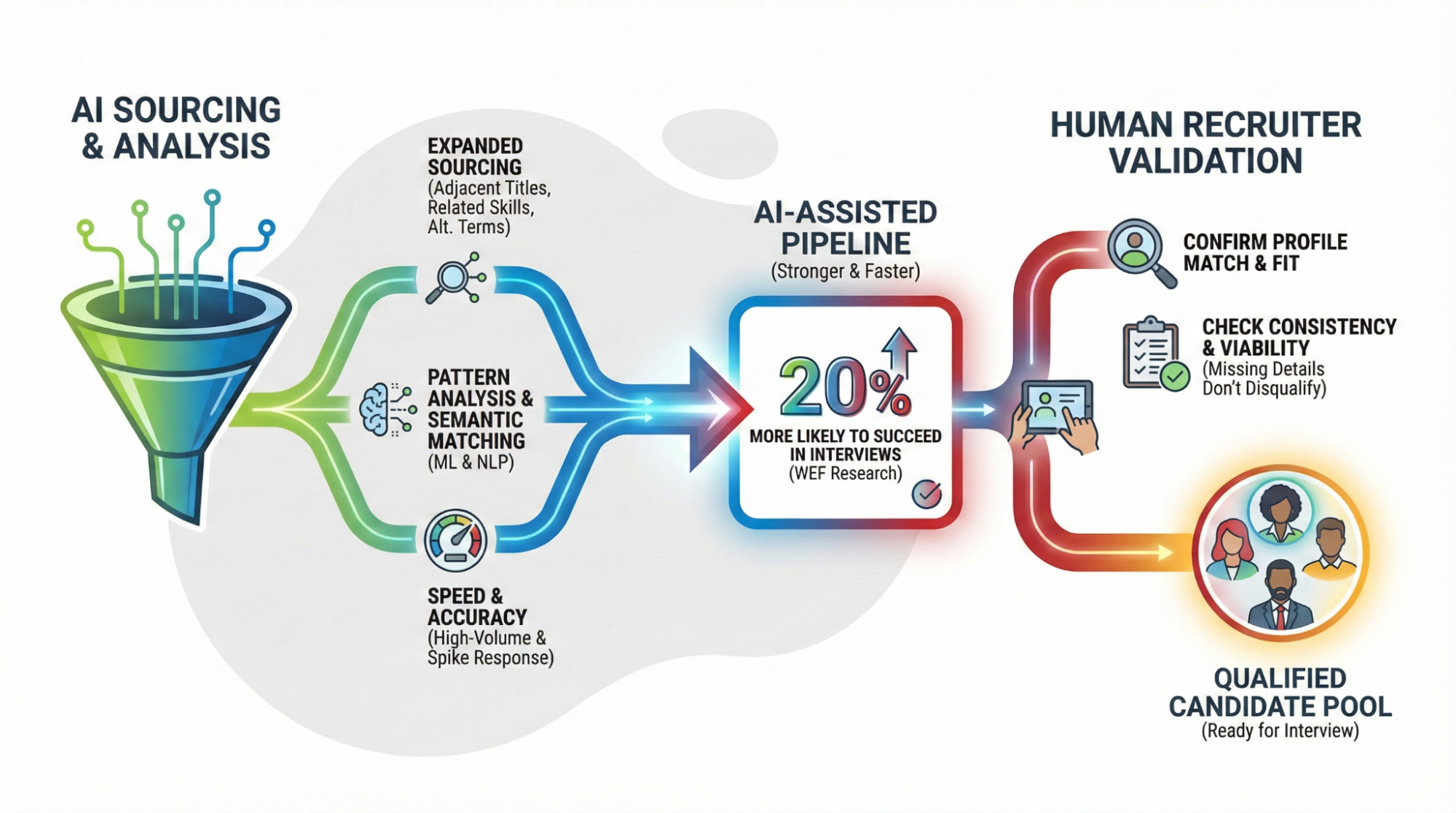
AI speeds up high-volume pipelines, improves resume screening accuracy, and helps teams respond when job applications spike.
Human recruiters validate fit before moving anyone forward. They confirm profiles match the job, missing details don’t change viability, and information stays consistent.
Coordination and content support
Automation handles interview scheduling, reminders, rescheduling, and updates that maintain candidate engagement. Natural language processing enables systems to understand scheduling preferences.
AI recruiting tools produce first drafts for job ads, outreach, interview guides, and summaries. Human review is required because accuracy drives response rates, candidate experience, and client confidence. Emotional intelligence helps recruiters refine AI content to match the company’s voice.
Where human judgment still matters most
AI recommends. Recruiters own the decision and the relationship.
Intent verification and quality control in noisy pipelines
Research from Joveo shows job application volume increased 48% year-over-year while quality declined. Only 2% of applicants advance to interviews.
AI tools make it easy for job seekers to submit job applications in minutes. AI recruitment agents can sort job applications fast, but they still cannot confirm genuine intent or follow-through.
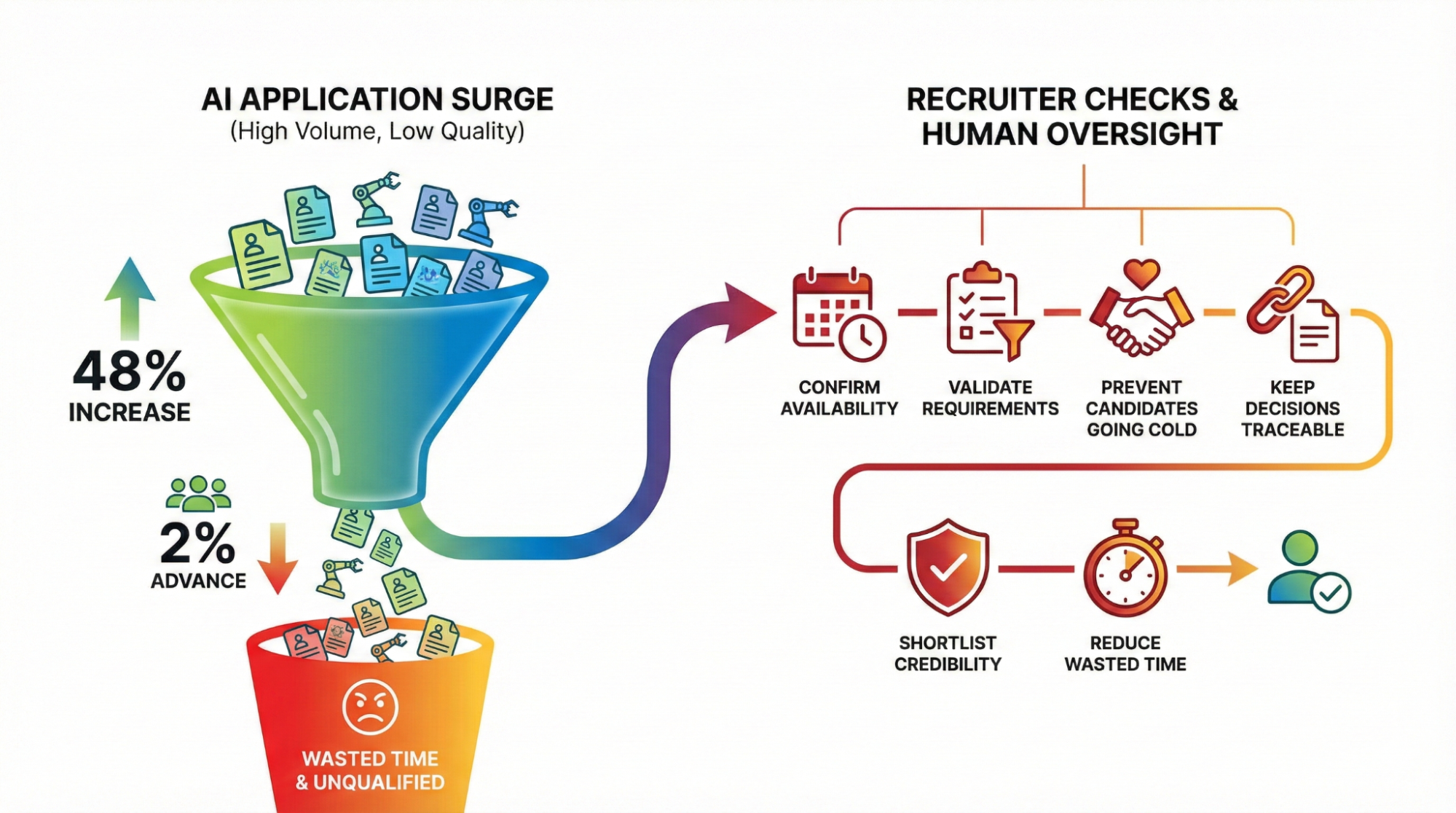
When using AI in job recruitment, recruiters must implement checks like: confirm availability before advancing candidates, validate baseline requirements to filter mass job applications, prevent strong candidates from going cold, and keep decisions traceable.
These checks protect shortlist credibility and reduce wasted time on unqualified job applications.
Reading context AI cannot see: Nuance, soft skills, and risk signals
AI can identify patterns across resumes and profiles. But it cannot tell if an applicant will perform in a specific role, or work well with the team, or the client.
Human recruiters fill that gap by applying context that AI systems do not have. They can evaluate body language and interpersonal dynamics that AI systems miss.
Emotional intelligence supports better screening, stronger candidate experience, and successful closes by clarifying intent, reading hesitation, and addressing concerns.
Human judgment still proves valuable when assessing soft skills against working conditions, balancing role trade-offs, and spotting potential risks during application.
Building candidate trust and closing offers
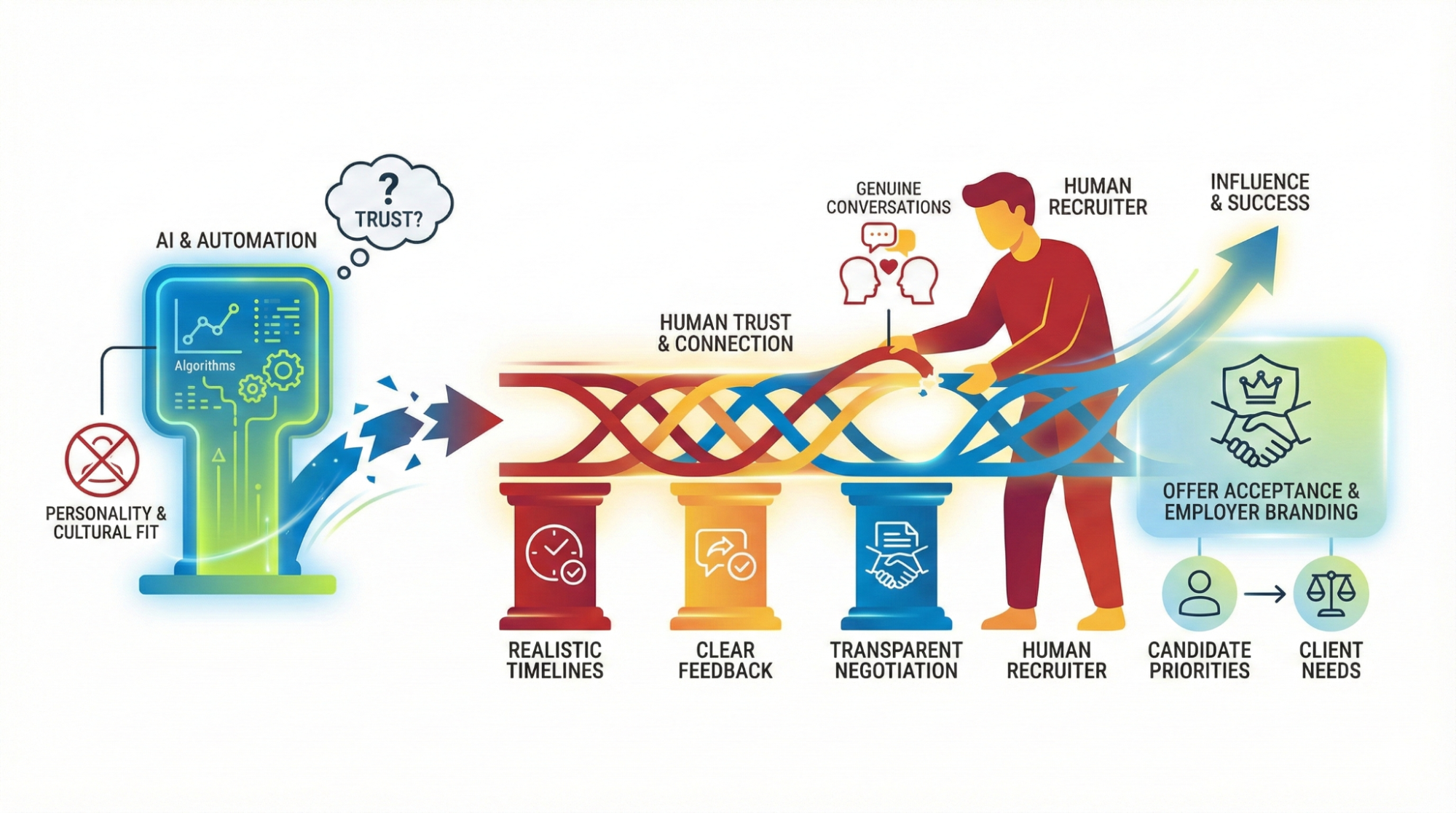
Candidate trust comes from consistent communication. Pew Research reports candidates fear AI ignores “the human side,” such as personality traits and cultural fit, influencing long-term success.
Trust builds through genuine human conversations. Recruiters protect this trust in moments that change outcomes: realistic timelines, clear rejections with feedback, and transparent negotiation.
Every candidate interaction shapes employer branding and influences offer acceptance.
Closing requires influence, negotiation, and alignment between candidate priorities and client needs.
Hiring guardrails: Fairness, transparency, and accountability
AI increases the need for process discipline. Staffing teams must align AI usage with internal legal and HR policies before scaling workflows in talent acquisition. Decisions must stay explainable and reviewable.
Bias monitoring and documentation standards
Bias shows up fast in AI-supported hiring when the inputs are skewed or the rules are inconsistent.
MIT Sloan research documents how Amazon scrapped an AI tool penalizing resumes containing “women.” HireVue’s algorithms disadvantaged non-white and deaf applicants.
Bias mitigation works when teams treat AI output as reviewable work, not automated truth. Predictive analytics can surface patterns, but bias also shows up in basic places like job ad language and uneven screening logic between teams.
Guardrails that work focus on visibility: review screened-out samples to catch false negatives, monitor outcome patterns by cohort and demographic groups, document override decisions with rationales, maintain stable criteria, and audit workflow changes before rollout.
A practical operating model for staffing teams using AI
Organizations implementing responsible AI governance focus on establishing AI principles, creating frameworks, operationalizing accountability, providing ethics training, and implementing auditing. This prevents quality drift and unreviewed automation.
Effective AI tool management requires clear protocols for when agentic AI systems, large language models, and other HR technology get deployed in talent acquisition.
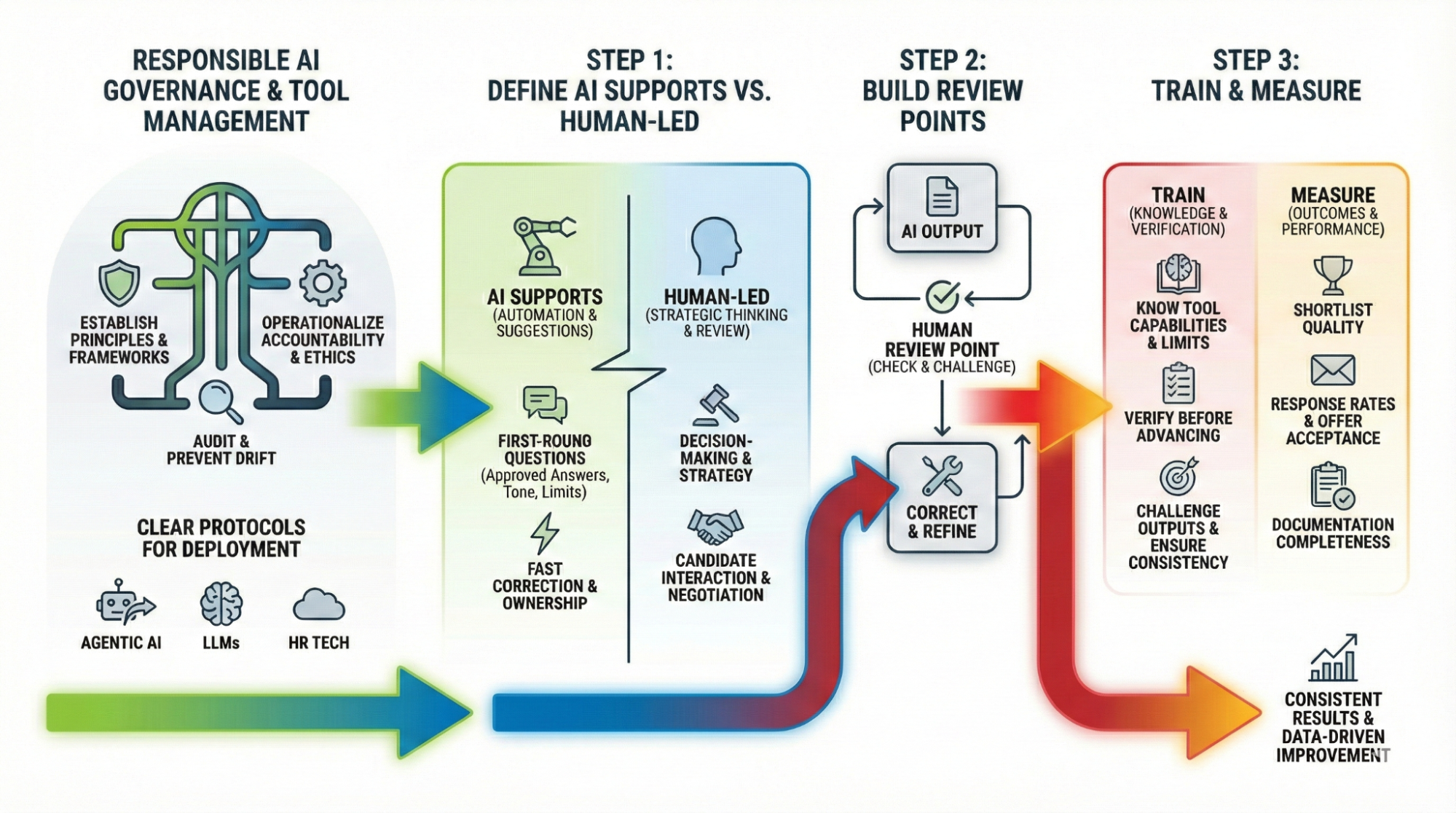
As AI recruitment agents get smarter and more independent, it’s crucial to lay out clear rules for when they need a human check-in and who to call for backup.
Step 1: Define what AI supports versus what stays human-led
Map boundaries for each recruitment workflow stage. Be clear about where AI can suggest next steps and where a human review is required. Decide upfront which calls can be supported by automation and which ones need human strategic thinking.
Step 2: Build review points into the workflow
AI output needs the same treatment as any other screening input. It gets checked. It gets challenged when it looks off. A few review points in the right places keep AI from quietly shaping decisions without scrutiny.
If the talent acquisition team uses an AI chatbot for first-round questions, the chatbot needs approved answers, a consistent tone, and clear limits so it stays accurate and compliant. The point is fast correction with clear ownership.
Step 3: train and measure what matters
Teams do not get consistent results by “turning on AI.” They get consistent results when recruiters know what the tool can do, what it cannot do, and what must be verified before a candidate moves forward.
Training should cover how to challenge outputs and keep evaluations consistent across recruiters, roles, and clients. It should also separate use cases, because generative AI for writing job ads and messages is not the same thing as machine learning models used for matching and resume screening.
Measurement should track outcomes that reflect real performance, not activity.
Focus on shortlist quality, candidate response rates, offer acceptance, and documentation completeness. Regular data analysis shows where AI tool management is improving flow and where human judgment is still doing the heavy lifting.
Tracker’s ATS and CRM: supporting AI-assisted recruiting
AI works best when it runs inside a clean, connected workflow. An integrated ATS and CRM keeps candidate data, outreach history, and decision notes in one place, so AI in recruitment stays reviewable and easy to explain.
Tracker provides AI for recruiters through these capabilities:
- TrackerAI: AI-powered candidate summaries, screening questions, and ranking provide starting points for recruiters who make the final call
- Full-text, Boolean, profile, and semantic search: Multiple search methods speed up shortlists while recruiters review for nuance and intent
- Sequences and automation: Email, text, and workflow sequences maintain consistent follow-up at scale with sentiment signals for review
- Automated candidate-to-job matching: Matching criteria and alerts surface candidates as signals to review, not automatic decisions
- Reporting and dashboards: Real-time dashboards and KPIs provide visibility into pipeline health and team consistency
This approach keeps AI activity reviewable while maintaining recruiter oversight and accountability.
Conclusion: AI-supported recruiting still needs human judgment
AI takes on more steps without human prompts, recruiters keep hiring accountable by setting boundaries, building review points, and writing down why candidates move forward.
The next step is to identify where AI is helping and where it is creating blind spots, then tighten the workflow so accountability stays clear. Better decisions matter more than faster activity.
Tracker ATS and CRM help staffing teams keep every step reviewable, consistent, and reportable. Get a demo.