
One recent survey found that 88% of HR leaders say their organizations have not realized significant business value from AI tools. That number should give any staffing agency pause before its next automation purchase, because the shortfall rarely traces back to the software itself.
Recruitment process automation is often described simply as using technology to handle repetitive hiring tasks. That answers the basic question of what recruiting automation is, though most of today’s tools blur the line between automation and AI as predictive matching and adaptive messaging get layered onto the simpler rule-based work underneath.
Automation in recruitment process work succeeds or fails based on what happens at each stage of the rollout, not which platform gets purchased. That’s the throughline running through the four stages below.
Stage 1: Planning and foundation
Automating a broken or unmapped workflow
The most common failure pattern starts before automation even goes live: teams buy or activate a tool before mapping the workflow it’s meant to support. Automating a broken process doesn’t fix it. It just makes the agency inefficient faster.
Two-thirds of HR leaders have shared concerns that they implemented new technology solutions without transforming how work gets done. That gap between buying automation and redesigning the process around it is where most Stage 1 failures start.
Fix: Map the existing workflow first, and standardize the steps before automating any of them. Pilot recruitment workflow automation on one process, then expand once it’s actually holding up.
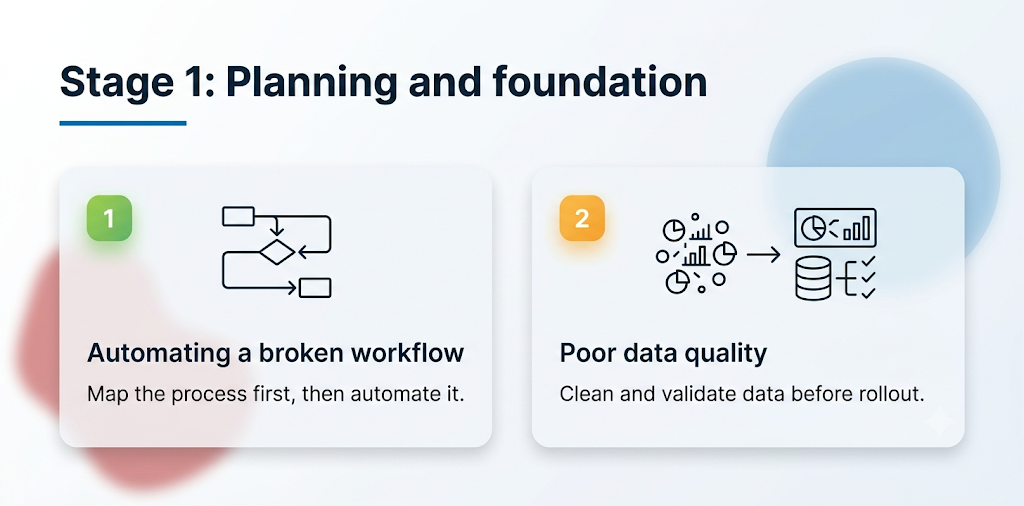
Poor data quality
Incomplete, duplicate, or outdated candidate data undermines automation before it’s even running. A workflow can be mapped perfectly and still produce bad outcomes if the data feeding it can’t be trusted. Bad inputs will undo an otherwise well-planned rollout just as fast as a poorly mapped process will.
Fix: Clean the data before automation goes live, not after. Put validation rules in place at the point of entry so duplicate or incomplete records stop piling up in the first place, and assign someone to own data hygiene on an ongoing basis so the cleanup doesn’t have to happen twice.
Stage 2: Implementation
Low user adoption
Low adoption is the failure pattern recruiters feel first. When automation isn’t trusted or fully explained, people build workarounds instead of raising the issue, things like spreadsheets or side processes that replace the official system without anyone flagging it. 38% of employees have had to create new processes because of technology, and 41% report working around formal processes entirely.
A workaround is usually a sign the rollout skipped a step, not that the tool itself is wrong. Recruiters who don’t understand why a process changed, or don’t trust the new system, will default to what they already know.
Fix: Start small. Pilot one workflow, decide what success actually looks like before rollout, and explain the reasoning to the team, not just the instructions.
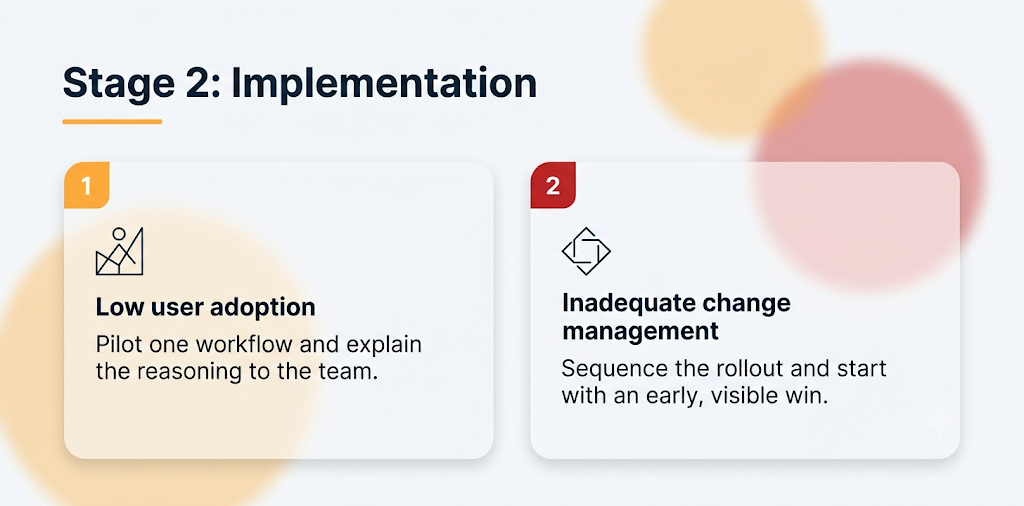
Inadequate change management and unprepared leadership
Change management gets treated as a soft skill when it’s the biggest lever in the whole rollout. Only 32% of business leaders report achieving healthy change adoption among their employees. That’s the gap between signing a contract and having recruiters trust the plan enough to automate recruitment process steps instead of reverting to old habits.
Leadership readiness is a separate, and often overlooked, half of this problem. A recruiter can be fully on board and still watch a rollout stall if leadership doesn’t understand what the tool changes about their own role. High performers are three times more likely to strongly agree that senior leaders demonstrate ownership of and commitment to their AI initiatives than their peers.
Fix: Sequence the rollout deliberately, prioritize an early and visible win, and hold off on flipping the switch agency-wide on day one. Leadership also needs to understand the tool’s boundaries well enough to communicate what’s changing to the team, beyond simply approving the purchase.
Stage 3: Execution

Over-automating candidate touchpoints that need a human
Automation is excellent at logistics and poor at nuance. Generic, templated outreach might work fine for scheduling a phone screen, but it damages employer brand fast when it’s used on passive candidates or senior-level hires who expect to be treated like people, not records in a database.
Candidate resentment toward impersonal, automated hiring hit its highest point in over a decade of benchmark research, per 2024 data. Industries leaning hardest on automated outreach saw the steepest drop in candidate experience and satisfaction.
Fix: Better targeting is what actually works here. Automated tools handle confirmations, reminders, and scheduling well. Final-round communication, offers, and any high-stakes conversation should stay personal.
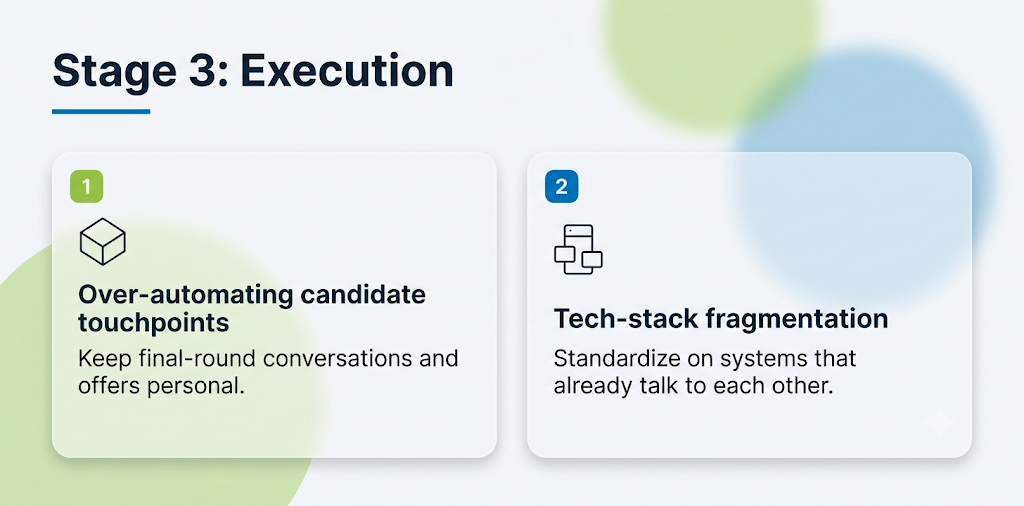
Tech-stack fragmentation
Agencies running several disconnected systems create their own interoperability problem before automation even enters the picture. Most organizations use two to four separate HR solutions from different providers, and 81% say poor integration limits their ability to meet HR goals.
Fix: Standardize on systems that actually talk to each other before adding more automation on top, and check any new tool purchase against what’s already in the stack instead of layering in another point solution. Integrating automation software with your existing tech stack covers how to do that without ripping out systems that already work.
Stage 4: Ongoing oversight
No ownership or measurement
Automation that runs without anyone watching it drifts. Exceptions pile up, edge cases go unnoticed, and nobody realizes the process has broken until a candidate complains or a client asks a question no one can answer.
Fix: Ownership needs to be concrete: assigned to one person, not left as a vague responsibility everyone assumes someone else is handling. Each automated workflow needs clearly defined key performance indicators and a review cadence set before launch. What counted as healthy at launch may not hold months later, so revisiting those metrics on a set schedule matters, not just checking them once at the start.
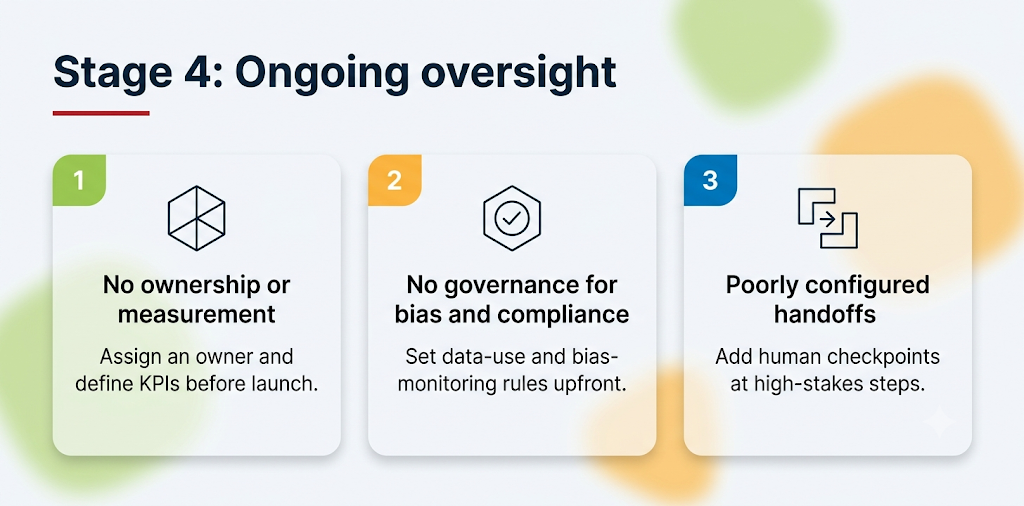
No governance for bias, compliance, and explainability
Bias, compliance, and explainability are concerns that rule-based automation never had to answer for, and staffing agencies rolling out AI-enabled tools are running into governance gaps as a result. AI deployment decisions inside many organizations get made without any HR involvement at all, which is a meaningful part of why adoption stalls and expectations go sideways, rather than a technology problem.
Fix: Setting the rules before rollout matters more than fixing them after something goes wrong. Assign who owns data-use decisions, decide how bias gets monitored, and be upfront with candidates about how the process works.
Poorly configured multi-step handoffs
As automation stretches across more steps, and increasingly involves agentic tools handling several tasks in sequence, an unaudited handoff between two automated steps can quietly compound into an error that’s hard to trace back to its source. A candidate gets miscategorized in step two, and by step five, three different systems have already acted on bad information. Agentic automation is only going to get more common, which means more handoffs to watch, not fewer.
Fix: Building in human checkpoints at the highest-stakes decision points takes deliberate design, not a default setting. Map every handoff between automated steps, not just the start and end of the workflow, and decide in advance which of those handoffs need a person to confirm the output before it moves forward. Audit the full chain on a regular schedule, not just the step where something eventually broke, and revisit that list as new agentic tools and automation trends take on more of the sequence. Don’t assume it still works the way it did at launch.”
How Tracker supports each stage of recruitment process automation
Tracker was built around the idea that the automation of recruitment process tasks should support each stage of a rollout, not just the moment it goes live.
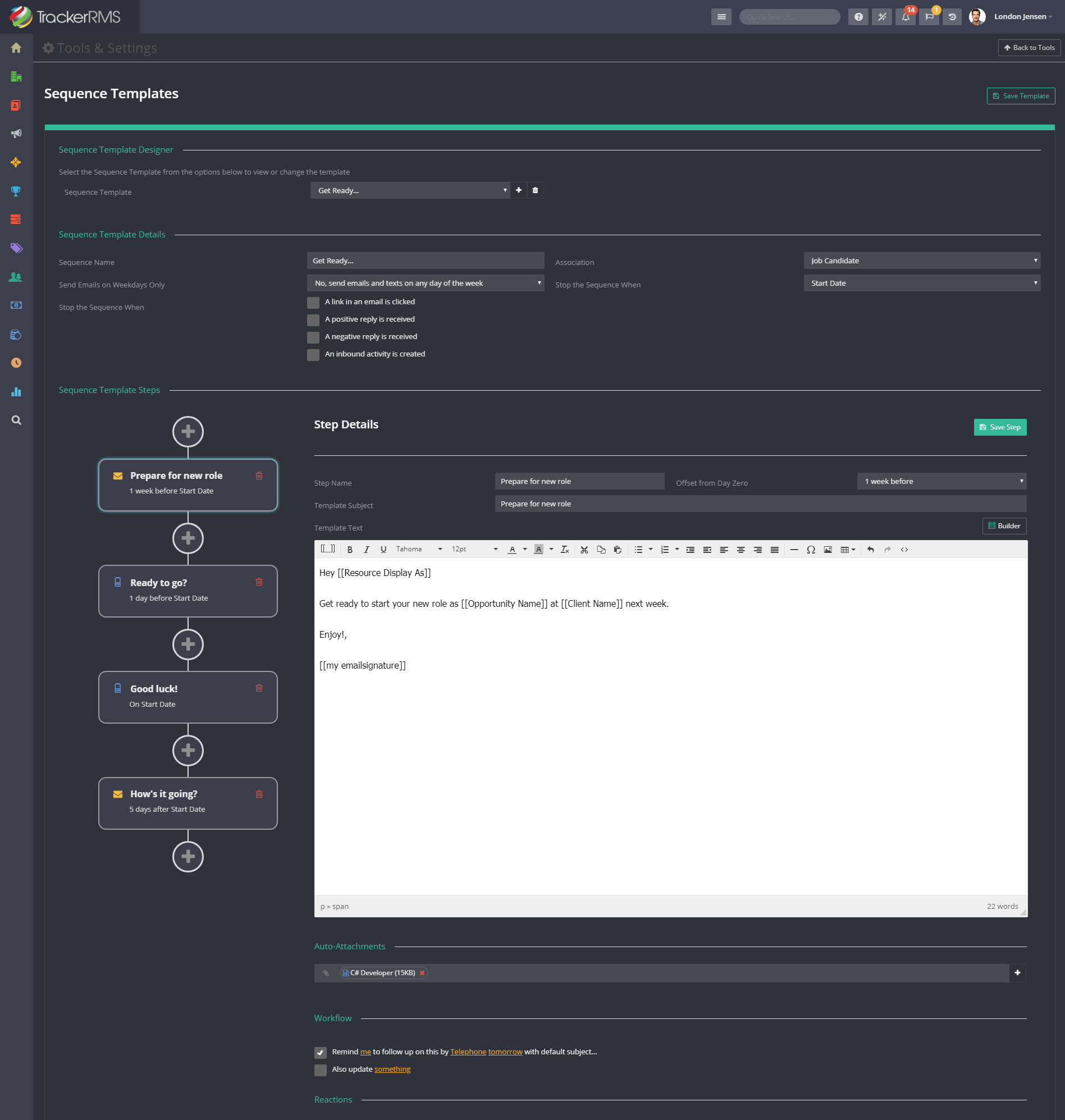
Tracker’s sequences let you map a workflow the way your agency actually runs it, not a template someone else designed. Auto-match and watchdogs can be configured and piloted on a single role type or process before anyone flips the switch agency-wide, so Stage 1 and Stage 2 aren’t separate purchases, they’re the same platform turned on gradually.
Recruiters keep ownership of the moments that need a human touch: final interviews, offers, anything relationship-driven. Tracker’s automation stays on the logistics side, things like scheduling, reminders, and status updates. Once a workflow is live, reporting dashboards show what’s actually happening inside it, not just what got configured at launch.
Tracker’s automation features and TrackerAI capabilities are built to work together rather than as separate tools bolted onto an ATS, so agencies aren’t left managing a fragmented stack of their own.
Conclusion: Fix the fundamentals at every stage
Automation fails and succeeds based on the same thing: whether an agency treats it as a process discipline problem or a technology purchase. The stages matter more than the software. Mapping the workflow, managing the change, protecting the human moments, and staying accountable after launch are what separate the agencies still waiting on results from the ones seeing them.
If your agency is ready to fix the fundamentals instead of adding another tool to the pile, get a demo of Tracker and see what a rollout built around your actual workflow looks like.
Frequently Asked Questions
Why does recruitment automation fail even with the right software?
Most failures trace back to rollout, not the tool. Automating an unmapped workflow, skipping change management, or leaving no one accountable after launch will undercut even a well-built platform.
How long should a recruitment automation pilot run before expanding?
Long enough to confirm adoption is real, not just tolerated. Watch for workarounds, spreadsheets or side processes recruiters build instead of using the new system, since that’s the clearest early sign a rollout needs to slow down before scaling.
What’s the biggest risk as agentic automation handles more steps?
Compounding errors across handoffs. A mistake at step two can quietly shape decisions by step five before anyone notices, so audits need to check the full chain, not just the point where something eventually broke.