
Remote hiring started as a quick fix but became essential for recruitment agencies everywhere. Video interview platforms are now central to how staffing teams work, letting recruiters assess candidates faster without sacrificing quality.
According to Gartner, video recruiting typically reduces both time-to-hire and recruitment costs. That’s exactly the kind of speed and quality balance that staffing professionals are looking for in today’s tough talent market.
What are video interview platforms?
Video interview platforms are tools that let companies evaluate candidates remotely using video technology. They eliminate location barriers and make hiring processes smoother. These platforms come in three main types, each tackling different recruiting needs.
Live Video Interviews
Think of these as your standard video calls, except they’re designed with recruiters in mind:
- Record sessions for team review later
- Built-in scorecards help everyone evaluate candidates consistently
- Automatic scheduling eliminates email coordination
- Ask follow-up questions in real-time
Asynchronous video interview platforms
These platforms let candidates record their responses at their preferred time:
- Candidates receive email links to access the interview platform
- Questions are presented as text or video prompts from recruiters
- A pre-recorded interview can be done using webcam or mobile device with flexible timing
- Recruiters review submissions when convenient, eliminating scheduling coordination
Primary advantages include:
- Enhanced efficiency and cost reduction: Eliminates scheduling coordination and travel expenses
- High scalability and fair evaluation: Structured questions enable large-scale candidate screening while reducing unconscious bias
- Objective assessment: Multiple reviews provide balanced evaluation
One way video interview platforms
These blend the best of both worlds:
- Recruiters ask questions live while candidates can see them in real-time
- Candidates record their answers for teams to review later
- You get some personal interaction but still have scheduling flexibility
- Works well for mid-level roles that need both efficiency and personal connection
Key features
Modern platforms make things easier for both recruiters and candidates. Key capabilities include:
- Automated scheduling systems that eliminate coordination delays
- AI-powered candidate matching and automated transcription services
- Seamless ATS integration that connects with existing hiring workflows
- Mobile apps optimization provides flexibility and convenience for candidates
| Platform | Best use case | Recruiter time investment | Candidate experience | Advantages |
|---|---|---|---|---|
| Synchronous (Live) | Executive/senior roles requiring in-depth discussion | High (real-time required) | Traditional interview feel with immediate interaction | Real-time rapport building, immediate clarification, dynamic conversation flow |
| Asynchronous (One-way) | High-volume positions and initial screening rounds | Low (review when convenient) | Self-paced flexibility with preparation time | Scalable screening, consistent evaluation, timezone independence |
| Hybrid (Mixed) | Mid-level specialized roles needing both efficiency and interaction | Medium (some real-time coordination) | Balanced interaction with structured format | Combines spontaneity with efficiency, moderate time investment |
Who needs it and why agencies rely on It
Staffing agencies use video interview software to fix three major hiring problems and improve recruitment strategies.
Faster time-to-interview and time-to-hire
Traditional interview coordination creates serious delays between the first contact and candidate screening. Video tools get rid of location problems and make it much easier to coordinate schedules when you have multiple people involved.

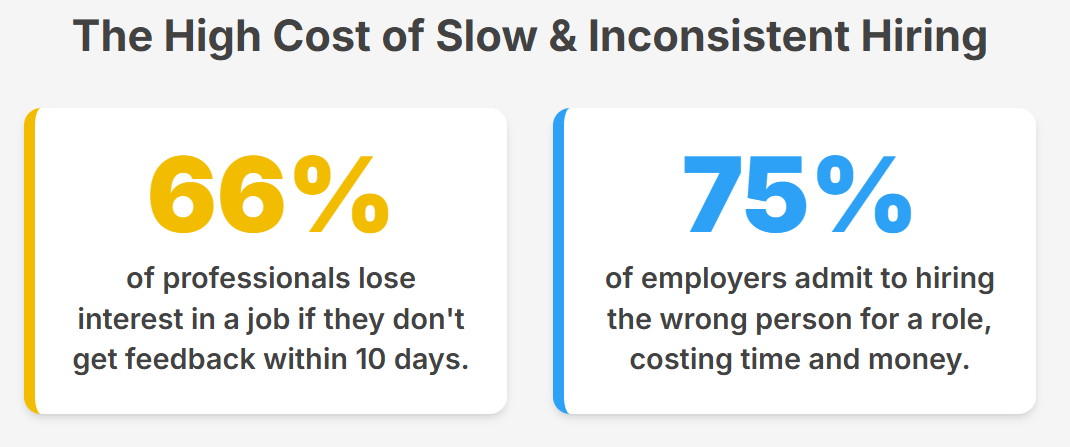
Research shows 66% of professionals lose interest in a position if they don’t hear back within 10 days of applying. Video platforms cut this timeline way down. When you can screen people faster, good candidates stay interested instead of taking other jobs while they wait for you to get back to them.
This speed boost helps agencies make their recruitment processes work harder, better, and faster without cutting corners on quality. Speed matters when you’re dealing with competitive markets where the best candidates get multiple job offers at the same time.
Consistent candidate evaluation
Video platforms give you structured ways to evaluate candidates that cut down on hiring bias and help different recruiters make more consistent decisions. The built-in scorecards and standard interview question sets make it easier to compare candidates fairly.
SHRM found that 75% of employers admit they’ve hired the wrong person for a job, which shows how much inconsistent evaluation methods can cost companies. When you use structured interviews, hiring accuracy goes up by 26% compared to unstructured approaches. Video platforms make it possible for agencies to use this method when they’re dealing with hundreds of candidate interactions weekly.
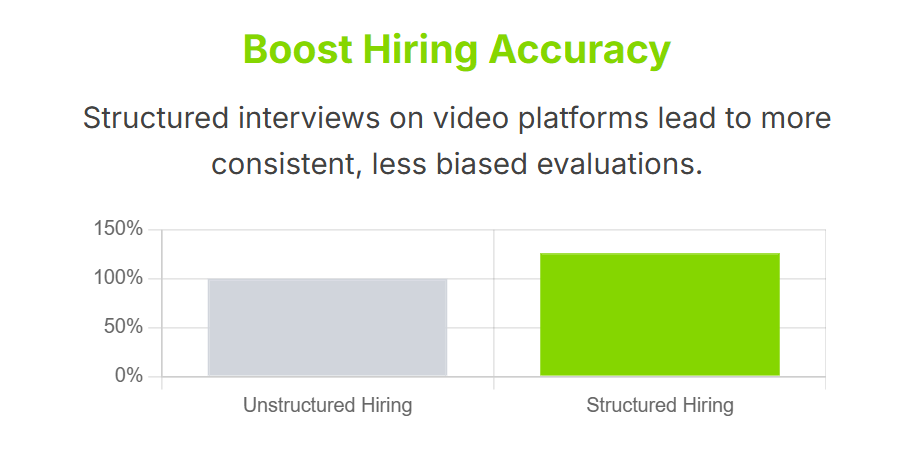
Video recording capabilities enable collaborative hiring decisions based on comprehensive feedback rather than individual impressions.
Better candidate reach
Geographic restrictions used to limit recruitment to local talent pools, but video technology opens up national and international markets while cutting travel costs and time constraints. This broader reach really helps with specialized roles where you can’t find enough local talent. The World Economic Forum’s 2025 outlook predicts that two-thirds of employers will actively hire for AI-specific skills, making video-based skills demonstration more important for evaluating candidates across different locations.
What to look for in the best video interview platforms
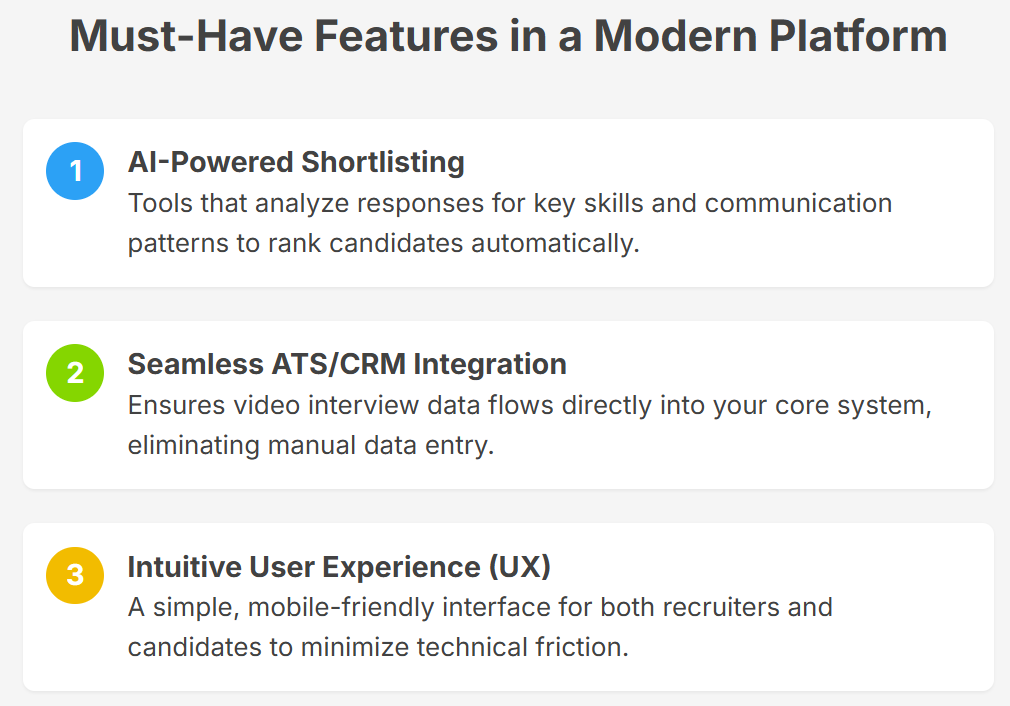
When you’re shopping for video recruiting software, you need to think about three things: how well they work, how they connect with your existing systems, and whether they’re easy to use. Getting this choice right affects how productive your recruiters are and how candidates feel about your company.
AI-powered shortlisting features
Advanced platforms include artificial intelligence tools used in talent acquisition that examine candidate responses for relevant skills, communication patterns, and role fit indicators.
Here’s what smart platforms do differently:
- Automatic candidate scoring and ranking based on customizable criteria
- Communication pattern evaluation and skill assessments, including tone and presentation quality
Current projections show 86% of employers expect AI and information processing to be important by 2030. You want platforms that let you adjust the AI evaluation settings to match what you’re looking for in different roles.
Integrations with ATS and CRM systems
Video interview data must flow seamlessly into existing recruitment workflows. Effective platforms integrate automatically to create candidate records, schedule follow-up tasks, and update hiring pipeline status.
The most valuable integration features work behind the scenes:
- Automatic candidate record creation and pipeline status updates
- Interview feedback transfer to CRM systems for sales team coordination
When systems don’t work together well, you end up copying information by hand between different programs, which defeats the whole purpose of trying to save time.
UX for recruiters and candidates
User experience matters for both your recruiters and the candidates going through the process. When interfaces are complicated, it takes forever to train people, and your team just won’t want to use them.
The platforms that win have these must-haves:
- Intuitive video review controls for recruiters with bulk management capabilities
- Simple candidate setup processes that minimize technical barriers
- Responsive mobile app experiences enabling interviews from any device
Smart use of technology helps rather than replaces human candidate engagement, so recruiters can have better conversations with the best candidates.
How tracker supports video interview workflows
Tracker puts video interview features right into their combined ATS and CRM system, which fixes the workflow problems you get when using multiple vendors that don’t integrate well. You can set up as many interview questions as you want for different campaigns and roles, and it only takes four clicks to get them out to candidates.
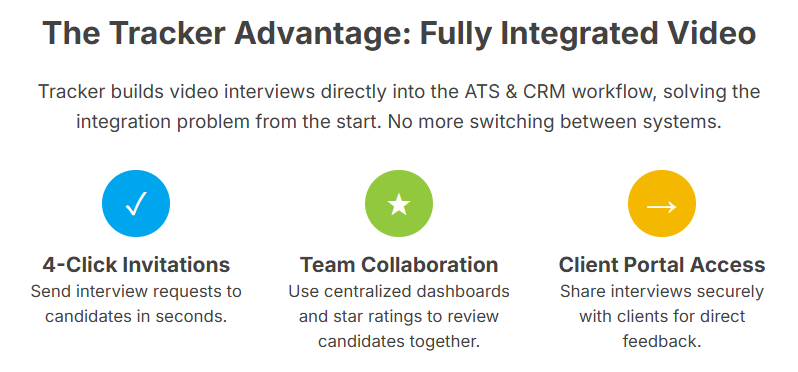
Key collaboration features include:
- Centralized dashboards with a star-rating system for team collaboration
- Automatic scoring and instant notifications when interviews are submitted
- Secure client portal access for direct feedback
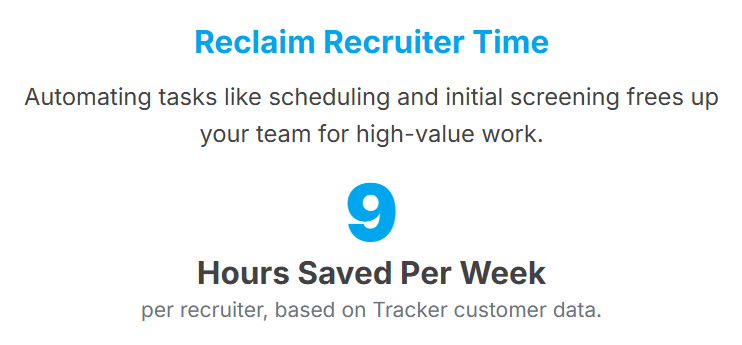
Tracker customers have seen this work in practice. Systematic Business Consulting got rid of their scheduling bottlenecks, while a professional services staffing company found out their recruiters were wasting 9 hours per week on repetitive tasks before switching.
Video Resume features let candidates record presentations showing personality and communication skills. Helpful for creative and customer-facing roles. If you want to improve your submission and interview processes, Tracker keeps building out their AI-powered recruitment tools with tons of feature sets that can completely change how you handle recruiting.
Conclusion
Video interview software solves the fundamental tension between speed and quality in candidate evaluation. The World Economic Forum projects that 39% of workers’ core skills will be disrupted by 2030, making skills-based assessment through video demonstrations increasingly valuable.
If you’re still on the fence about video interviews, you’re going to fall behind. Clients expect video screening ability and faster hiring now. It’s not about whether to use this technology – it’s about getting it set up before it becomes the standard.
Ready to reduce interview bottlenecks and increase placement speed?
Explore how Tracker’s video collaboration tools streamline the entire hiring process.