
You have 0 items in your cart
Key Takeaways
- Recruiters save time and improve quality of hire through automation and one searchable candidate database.
- Clients get clearer visibility into hiring progress and stronger compliance protection.
- Candidates get a faster, more mobile-friendly application process.
- Leadership sees a lower cost per hire and can scale without adding headcount.
- The right applicant tracking system connects these gains into one advantage for the whole agency.
If you’re reading this, there’s a good chance you’re weighing whether an applicant tracking system is worth the switching cost, the training time, and the case you’ll have to make to whoever signs off on new software.
Most conversations about the benefits of applicant tracking system adoption cover only half of what changes: they focus on recruiters and leave out clients, candidates, and the leadership team who has to approve the spend. Seeing all four groups together is what turns this from a feature list into a business case.
Benefits for recruiters
1. Time savings through automation
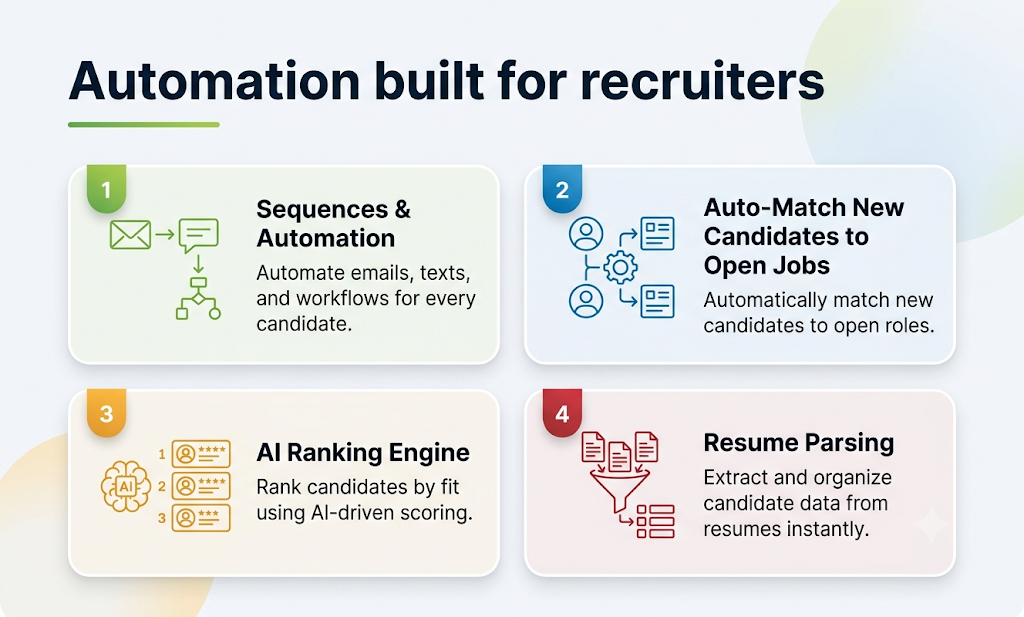
Picture a recruiter with 30 open job orders across eight clients, still manually screening resumes at seven at night. An applicant tracking system for recruiters changes that math by automating the work between candidate conversations:
- Resume screening against role requirements
- Interview scheduling and reminders
- Manual data entry across job orders
Recruiters build one hiring workflow instead of retyping the same information into three different tools. That time goes back into sourcing and closing, the parts of the job a machine can’t do.
2. Higher quality of hire
Speed isn’t the only thing that changes. When an ATS ranks candidates against a role’s actual requirements, recruiters focus on people who are genuinely qualified, not just the first resumes that arrived. Consider two versions of the same search: a recruiter submits five candidates who loosely fit the brief because they applied first, or the ATS surfaces three candidates who match the role’s real requirements. The second version means fewer interviews, a faster decision, and a placement less likely to fall through in the first ninety days. That’s why a stronger shortlist the first time is what keeps a client coming back.
3. Centralized, searchable candidate data
Every staffing agency has candidates worth remembering long after a search closes. A centralized database keeps that history searchable, so a strong candidate from six months ago can be found in seconds when a new, similar role opens. That’s a different benefit than the mechanics of how an applicant tracking system parses and stores information. What matters here is what a recruiter can do with it: pull up a name, confirm the details, and reach out, instead of digging through old email threads.
4. Redeployment and candidate reactivation
Placed candidates don’t disappear from the candidate pipeline. Contracts end, assignments wrap up, and people become available again, often exactly when a new job order needs someone with their exact background. An ATS flags these candidates automatically instead of relying on a recruiter’s memory, keeping the recruitment funnel filled with people who are already vetted and familiar with the agency. Reactivating a known candidate is almost always faster than starting a search from nothing.
5. Multi-client job and pipeline management
Staffing is built on juggling many clients at once. Staffing companies gave nearly 11 million people work in 2024, and every one of those placements sat inside its own job order, client relationship, and set of requirements. An ATS keeps those pipelines separate without separating the recruiter’s workload, so a candidate considered for three different clients doesn’t get mixed up, and one client’s job order doesn’t pull from a pool meant for another.
Benefits for clients
1. Better client visibility and reporting
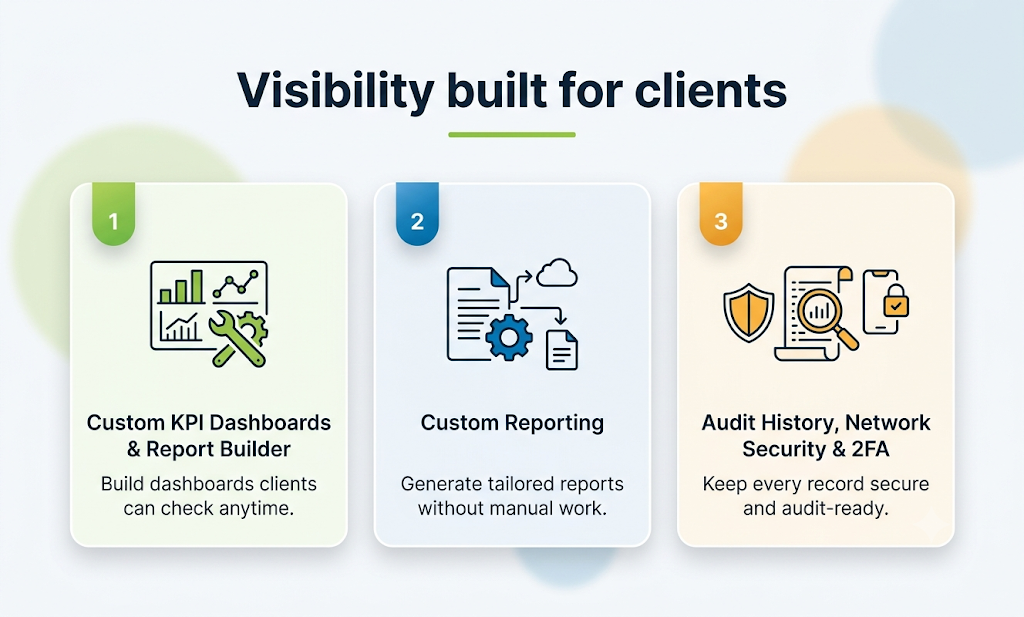
Clients stop calling twice a day for updates when they can see the pipeline themselves. Real-time dashboards show:
- How many candidates are in play
- Where each candidate sits in the recruitment process
- How long a job order has been open
That shift changes what the relationship is built on. Instead of trust based on reassurance over the phone, clients build trust on visible proof, which holds up better the next time a search gets difficult. That matters for renewal, since a five percent improvement in client retention can increase profits by 25 to 95 percent, and keeping an existing relationship healthy is almost always cheaper than winning a new client from scratch.
2. A portal that gives clients control, not just visibility
Tracker’s Client Portal gives your clients the visibility and control they’ve been asking for. The portal makes it easy for clients to:
- Stay in the loop with real-time job, placement, and PO visibility
- Take action on their own timeline — no email ping-pong required
- Submit jobs, review candidates, and manage placements
- Approve time and expenses without chasing paperwork
- Plug into your workflow without needing constant hand-holding
With Tracker’s Client Portal, your clients get more freedom, and your team gets more time back.
3. Stronger compliance and recordkeeping
Compliance is not a checkbox, it’s risk that sits quietly until an audit or a dispute forces the issue. Employers must keep personnel and employment records, including job applications, for at least a year, whether an agency works with one client or fifty. An ATS attaches that documentation to the record automatically: who applied, when, and what happened next. A missing document during a compliance review isn’t a paperwork problem, it’s exposure the agency and its clients both carry, and being able to produce it on demand is where most manual systems fail.
Benefits for candidates
1. Improved candidate experience
Candidates notice when an application process drags on with no word back, and the data backs that up: 57 percent of job seekers have abandoned an application mid-process due to overly complicated or time-consuming requirements. Timely status updates and clear next steps are what candidate engagement looks like in practice, and an ATS makes that consistent instead of dependent on whichever recruiter has time that day. A staffing agency’s reputation with talent affects who applies to the next role, and a candidate who drops out mid-process rarely comes back.
2. Mobile-first candidate engagement
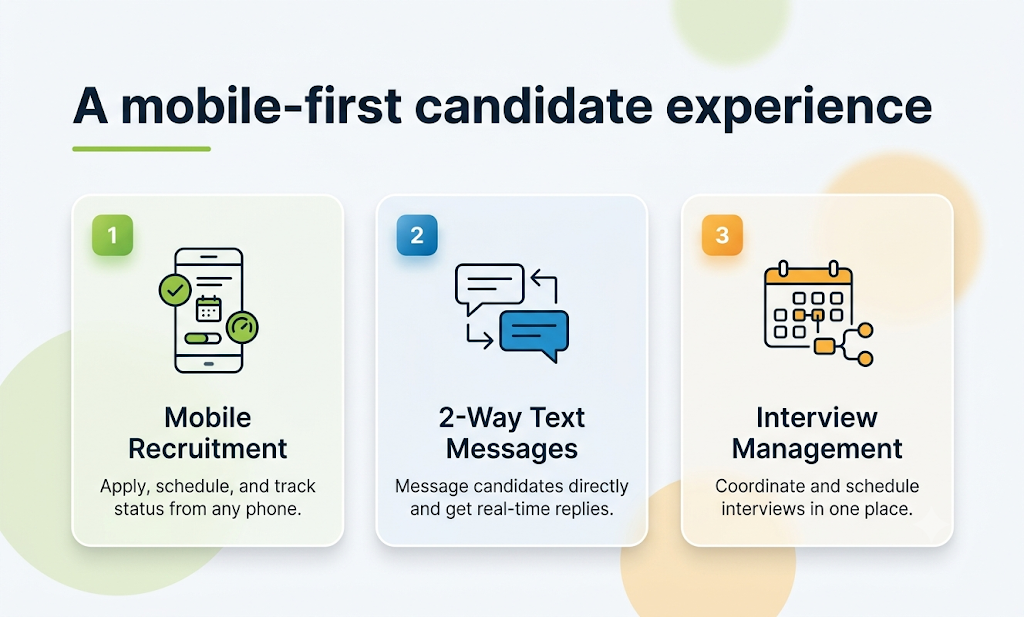
Most candidates apply, schedule, and check status from a phone, not a desktop. About 91 percent of U.S. adults now own a smartphone, up from about a third of the population back in 2011. Mobile access to the application itself, interview scheduling, and status updates isn’t a bonus feature anymore. It’s the baseline a staffing agency needs to meet to keep candidates from dropping out mid-process.
3. Automated and personal communication at every stage
Candidates drop out when they feel forgotten. Automated sequences keep every candidate moving through the process with timely, relevant touchpoints, without a recruiter having to remember to send each one manually. The key is that automation handles the consistency while the recruiter stays in control of the moments that need a human touch. See sequencer in action
Benefits for leadership
1. Reduced cost-per-hire
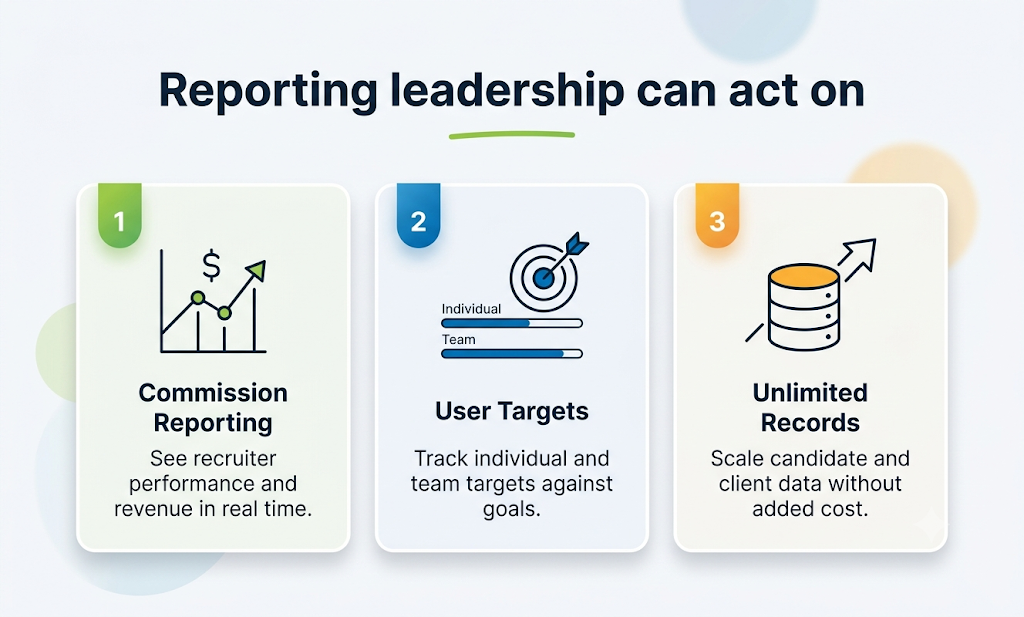
Hiring is getting more expensive, not less. Cost per hire and cost per application both rose sharply in 2025, even with a softer labor market, largely driven by rising job board and advertising costs. Automating the manual side of recruiting, resume screening, scheduling, and follow-up is one of the few levers an agency controls in that environment, turning cost per hire and applicant tracking system ROI into numbers leadership can act on instead of guessing at.
2. Scalability without added headcount
Growth usually means more job orders, more candidates, and more clients. The real question for leadership isn’t whether the agency will grow. It’s whether the current process can absorb that growth without adding headcount at the same rate. High-volume hiring is where automation earns its keep, since tasks like posting, screening, and scheduling don’t get harder just because there’s more of them.
How Tracker delivers these benefits for staffing agencies
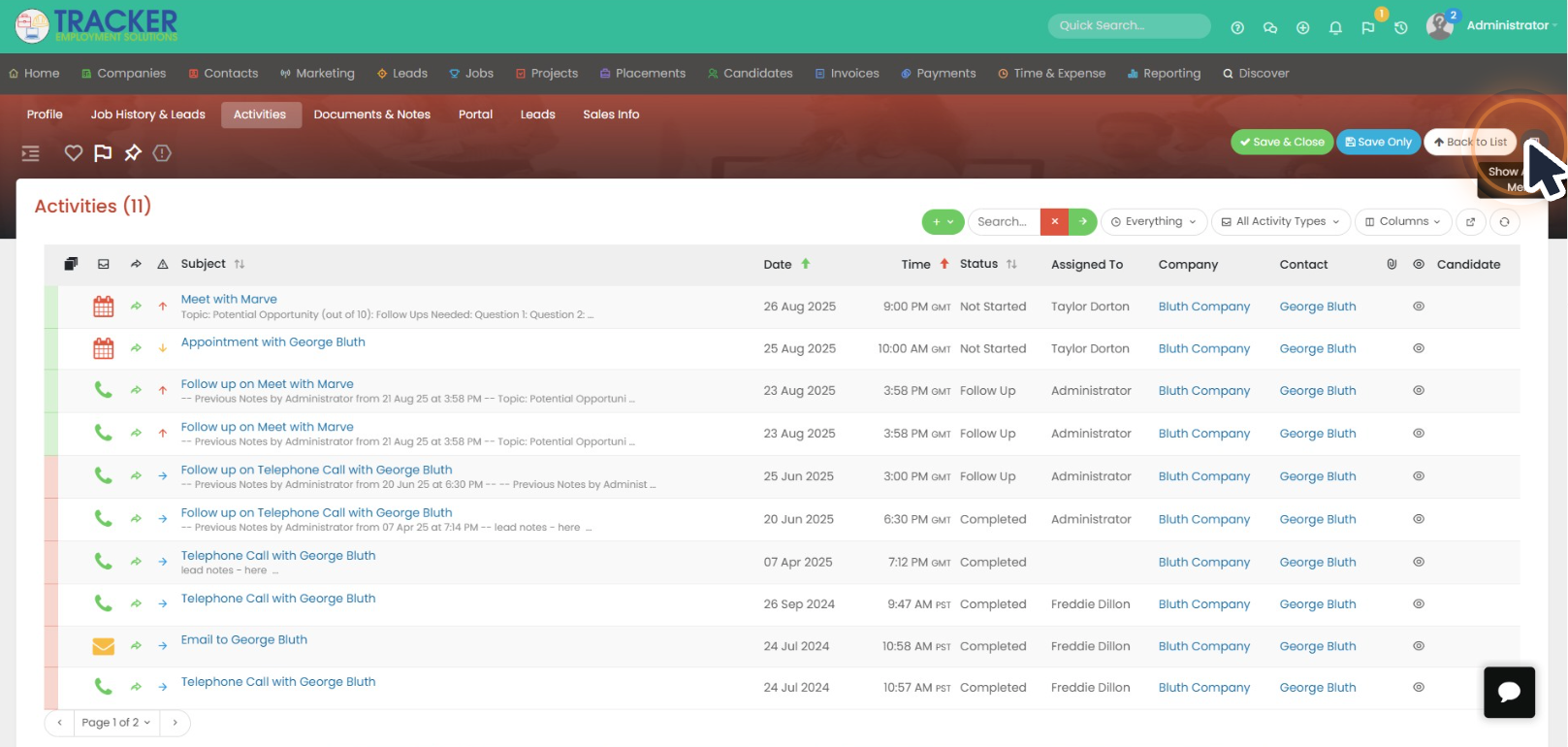
Tracker was built specifically for staffing agencies, which is why so many of these benefits show up together instead of requiring separate tools bolted onto each other. That connection is what turns the eleven benefits above into one system working together:
- Recruitment and applicant tracking features handle resume parsing, candidate ranking, and pipeline management in one place.
- Built-in automation covers the repetitive scheduling and follow-up work recruiters used to do by hand.
- AI-powered tools inside the platform help surface stronger matches faster. EVA, Tracker’s AI assistant, ranks candidates, generates job descriptions, summarizes resumes, and handles candidate FAQs and scheduling directly inside the platform.
See the full feature roundup for how candidate data, client reporting, and business development connect across the platform.
Conclusion: Choosing an applicant tracking system built for staffing
If you came into this piece weighing whether an applicant tracking system is worth the switching cost and the internal buy-in, the answer sits in how many parts of the business it touches at once. None of the eleven benefits above work by themselves. What makes this a sound investment is that it changes daily work for recruiters, clients, candidates, and leadership at the same time, not just one department. Book a demo to see how Tracker brings these benefits together for your agency.
FAQs
How soon does an ATS start showing results for a staffing agency?
Recruiters typically notice the time savings first, often within the first few weeks, since automation removes manual screening and scheduling almost immediately. Benefits tied to longer-term metrics, like cost per hire or client retention, usually take a full hiring cycle or two to show up clearly.
How much of a learning curve does an applicant tracking system for recruiters have for a recruiting team?
Most recruiters are comfortable with the core workflow, posting jobs, screening resumes, and moving candidates through a pipeline, within their first week or two of daily use. Advanced features like custom reporting usually take longer to adopt, but they aren’t required to get value from day one.
Does ATS software need to integrate with other tools, like payroll or a CRM, to be effective?
A standalone ATS system delivers most of the recruiter-facing benefits on its own. Integration with a CRM adds more value for staffing agencies specifically, since it connects candidate activity to client relationships and business development instead of keeping those records apart.
