
Most agencies start on a lean, single-purpose ATS. Then the job count climbs, clients start asking for different things, and the spreadsheets that used to hold it all together start to buckle.
That’s usually when enterprise applicant tracking systems come up. Not as an upgrade for its own sake, but because the agency’s recruitment technology now has more to carry. Choosing one at this stage means asking harder questions about scale, governance, and where the tech stack needs to go next.
What is an enterprise applicant tracking system?
An enterprise applicant tracking system is built for recruiting at a scale a standard ATS can’t keep up with. For a staffing agency, that means multiple recruiters running searches in parallel, multiple clients with different hiring requirements, and job volumes that would swamp a single-workflow tool.
“Enterprise” gets used in two ways. Some vendors attach it to a pricing plan. It also describes a category of capability: deeper permissions, higher data limits, and integrations a basic applicant tracking software package was never built for. This piece uses it in the second sense, because capability, not a plan name, is what decides whether a platform can grow with an agency.
Enterprise-grade applicant tracking isn’t only for large in-house teams. Recruitment agencies running complex, high-volume searches across industries and client contracts rely on the same category of technology, often for reasons that look nothing like a corporate rollout.
How enterprise ATS differs from standard ATS
The differences show up well before anyone talks price.
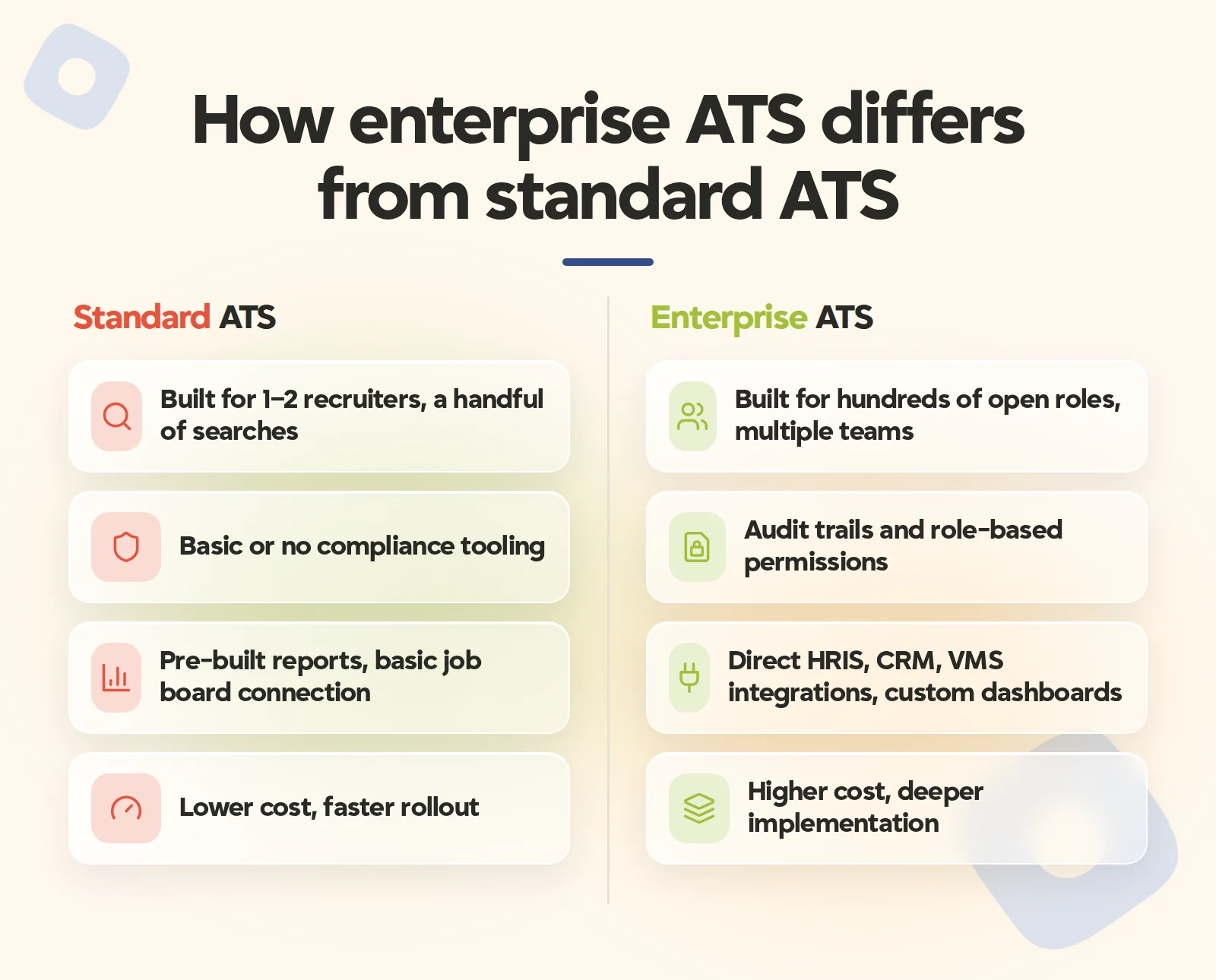
- Scale and hiring volume: enterprise platforms are built for hundreds or thousands of open roles across multiple teams. Standard tools are sized for one or two recruiters running a handful of searches.
- Compliance and governance: enterprise level applicant tracking systems come with audit trails, role-based permissions, and decision records that stand up to scrutiny. Standard platforms often have basic compliance tooling, or none.
- Integrations and reporting: enterprise platforms connect directly to HRIS, CRM, and VMS systems and produce custom, predictive dashboards. Most standard tools stop at a few pre-built reports and a basic job board connection.
- Cost and implementation: entry-level applicant tracking software starts around $70 per user per month, with enterprise solutions commonly above $335 per month, reflecting a longer, deeper rollout.
Benefits of enterprise ATS as agencies scale
As volume grows, the case for an enterprise level ATS for staffing firm operations stops being theoretical.
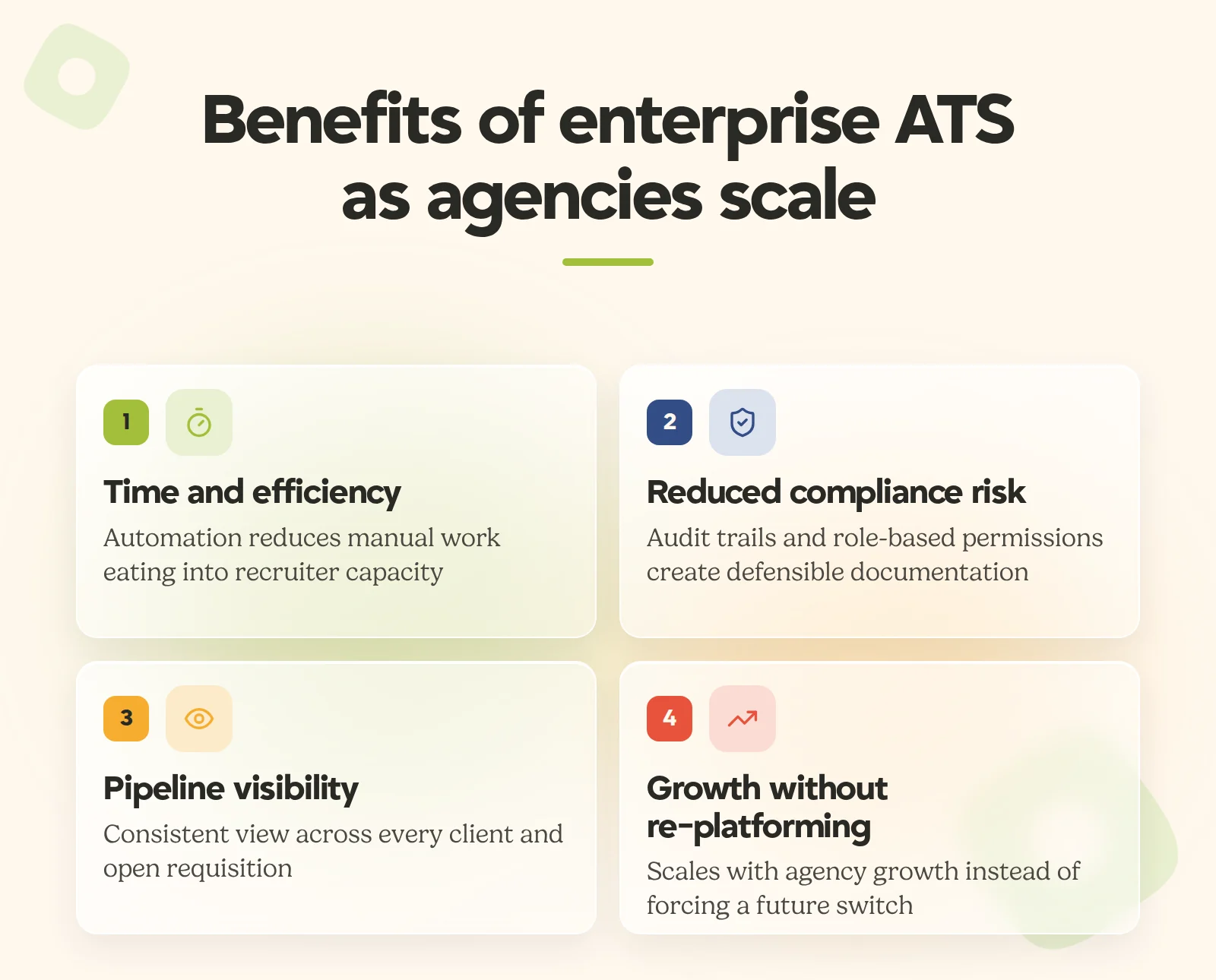
- Time back for recruiters: automation clears the manual work eating into recruiter capacity. High-volume roles are already being flagged as strong candidates for AI-first hiring, with the greatest cost savings, which is exactly where agency workloads sit.
- Less compliance risk: audit trails, role-based permissions, and structured decision records give agencies documentation a standard platform was never built to produce.
- A clear view of the pipeline: managers see every client and every open requisition in one place, instead of piecing it together from spreadsheets and inboxes.
- Growth without re-platforming: modern talent management solutions return $4.15 for every dollar spent, based on four years of case study data, and the global ATS market is projected to grow from $3.28 billion in 2025 to $4.88 billion by 2030. Agencies investing now are building for a market that keeps expanding.
Case study: how a lean startup gets enterprise-level results with Tracker
Pink Admin, a startup recruitment agency in New Zealand, moved invoicing, compliance, payroll, and candidate matching onto one platform after years of juggling disconnected tools. Automation now handles daily KPI reporting and the admin that used to eat hours every week, so a small team spends its time with clients and candidates instead of on data entry. Read the full case study
What to evaluate in enterprise ATS solutions
Once the differences and benefits point towards an enterprise platform, the job is weighing the best features of enterprise ATS options against how your agency actually works, not a generic checklist.
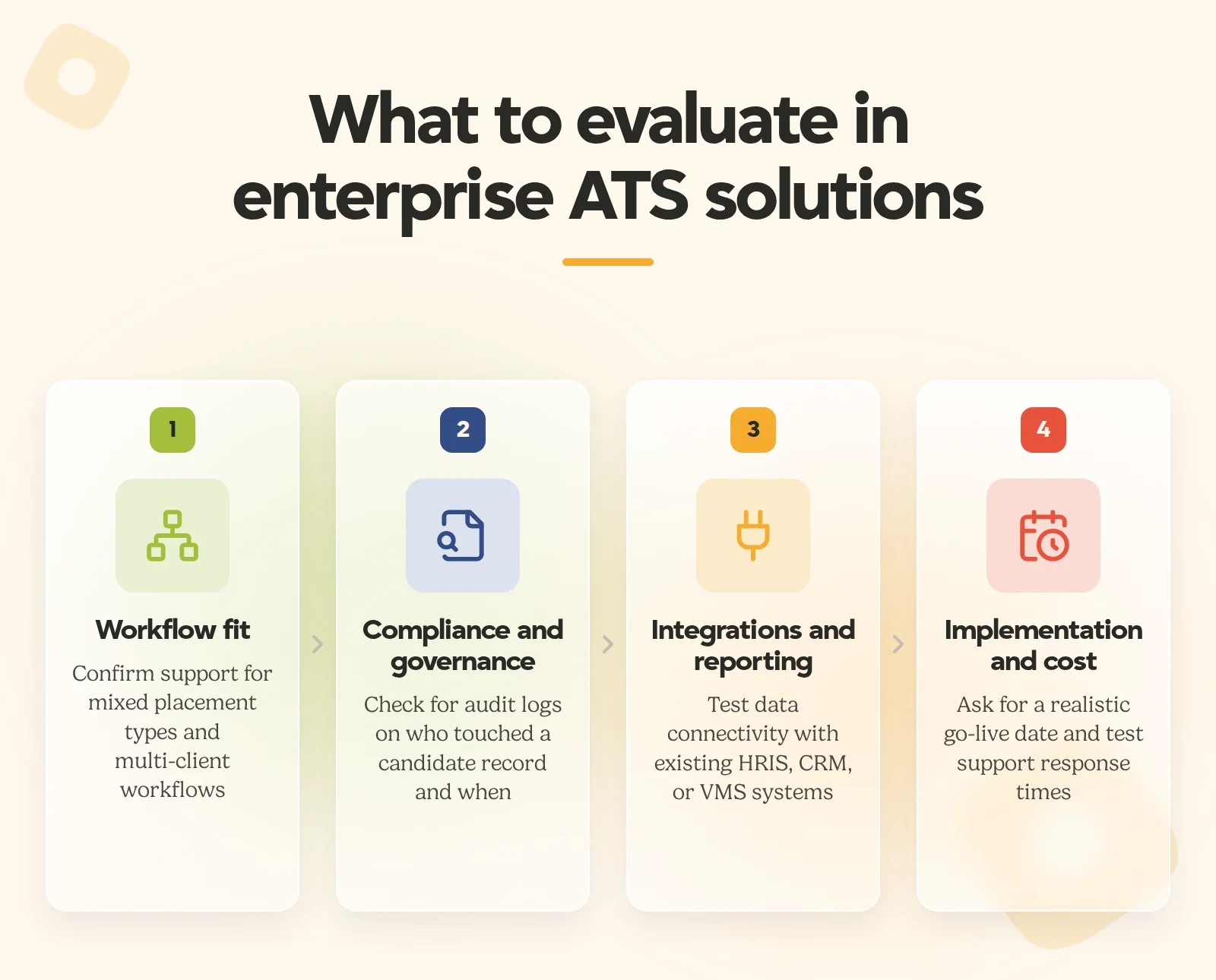
- Workflow fit. Check the platform handles mixed placement types (temp, contract, permanent, and executive search) and multi-client workflows, rather than forcing every search through one rigid process.
- Compliance and governance. Ask whether it logs who touched a candidate record and when. That history is what protects the agency if a client challenges a hiring decision months later.
- Integrations and reporting. Test whether it pulls data from your existing HRIS, CRM, or VMS without an export and reimport step, because that gap is usually where reporting delays begin.
- Implementation, support, and total cost. The number on the proposal rarely survives a slipping rollout and a growing support queue. Ask for a realistic go-live date and test response times before you sign.
These are the important factors in choosing an enterprise ATS: they decide whether a platform takes work off the desk or just adds another layer on top of the old one.
Tracker: an enterprise-level ATS built for staffing agencies
Tracker’s Enterprise plan answers each of those evaluation points directly. It pairs full back-office functionality, payroll, shift management, and unlimited API access with recruiting tools built for multi-consultant, multi-location agencies working at volume.
TrackerAI handles the work that eats into the day: drafting communications, ranking candidates with an engine that learns from ongoing engagement, writing job descriptions and candidate summaries, generating screening questions, and reformatting resumes to your branding. EVA, Tracker’s AI assistant, sits on top of all of it. Recruiters ask her questions in plain language, right on the record they’re already working.
Every Tracker plan runs on the same core recruitment and applicant tracking features that keep high-volume desks moving:
| Feature | What it does for the desk |
|---|---|
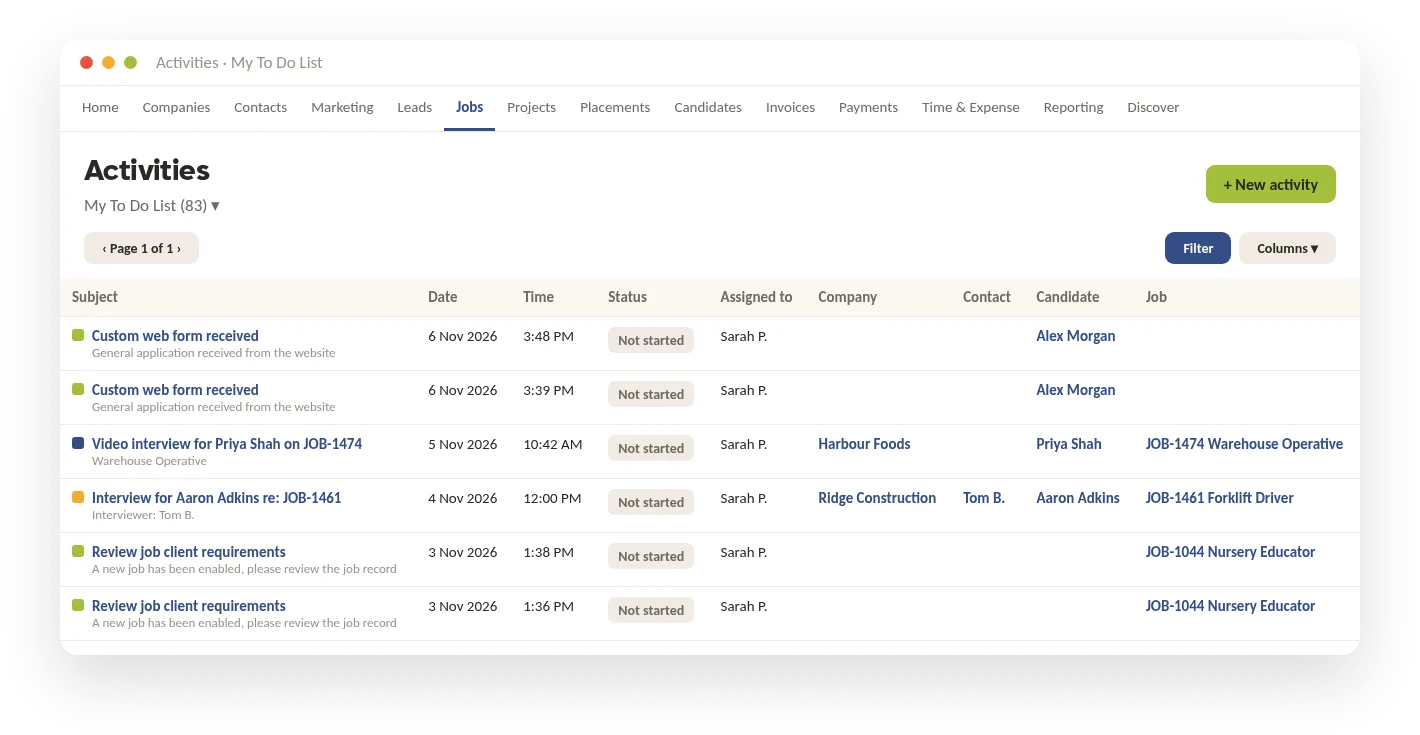
| Job pipeline views | Card and list views show every consultant and every live job at once |
| Candidate search | 80+ filterable fields, with Boolean, semantic, and radius-based search for large databases |
| Resume parsing | Pulls candidate details in automatically, so nobody’s retyping CVs at volume |
| Job board posting | One opening, sent to 1,000+ boards in one action |
| Long and shortlisting | Consultants and resourcers working from the same job record |
| Mobile app | The full platform for teams recruiting across sites |
| Reporting and dashboards | Team activity and candidate engagement, visible across the agency |
Choose the enterprise ATS that fits your agency
Enterprise applicant tracking systems aren’t defined by a price tag. They’re defined by whether the platform can carry the scale, compliance, and reporting your agency needs as it grows. Match the platform’s depth to your real requirements, rather than paying for capability you won’t use or settling for a tool that falls short.
If you’re ready to compare your current setup with an enterprise-grade platform, book a demo of Tracker’s plans.
Frequently asked questions
How long does it take to implement an enterprise ATS?
Most enterprise rollouts take three to six months from kick-off to go-live. Agencies with cleaner data and fewer integrations sometimes move faster. The timeline mostly comes down to how much historical data needs cleaning and migrating, and how many outside systems need connecting. Single-location agencies with a smaller candidate database tend to land at the shorter end.
Can an agency migrate existing candidate and client data to an enterprise ATS?
Yes. Moving candidate and client records across is one of the most common parts of switching platforms, and most vendors assign someone to manage it rather than leaving the agency to export and reimport on its own. What varies is the timeline: a decade of candidate history spread across spreadsheets and a legacy system takes longer to migrate cleanly than a smaller, well-organised database. Ask a vendor exactly how their migration works before you sign.
Does adopting an enterprise ATS mean extensive training for recruiters?
There’s a learning curve, simply because an enterprise platform does more than a basic tool. The agencies that settle in fastest treat onboarding as a scheduled part of the rollout, not something recruiters figure out between calls. A platform with this much depth rewards structured training over trial and error.