Staffing agencies see AI recruiting software pitched everywhere right now, but most of it is built for a single company hiring for itself, not an agency running dozens of open requisitions across multiple clients at once. That mismatch makes it hard to tell which capabilities actually apply to your business and which ones were designed for a different kind of buyer entirely.
This piece breaks down what AI recruiting software does, then walks through what to evaluate for your agency specifically, including how the right platform helps build a wider, more diverse candidate pool along the way.
What is AI recruiting software?
AI recruiting software is recruiting software that applies machine learning and natural language processing to automate sourcing, screening, scheduling, and candidate communication, the parts of hiring that used to eat up a recruiter’s day. For a staffing agency managing high-volume talent acquisition, that means running all of it across dozens of open requisitions and multiple clients at once, not one internal pipeline.
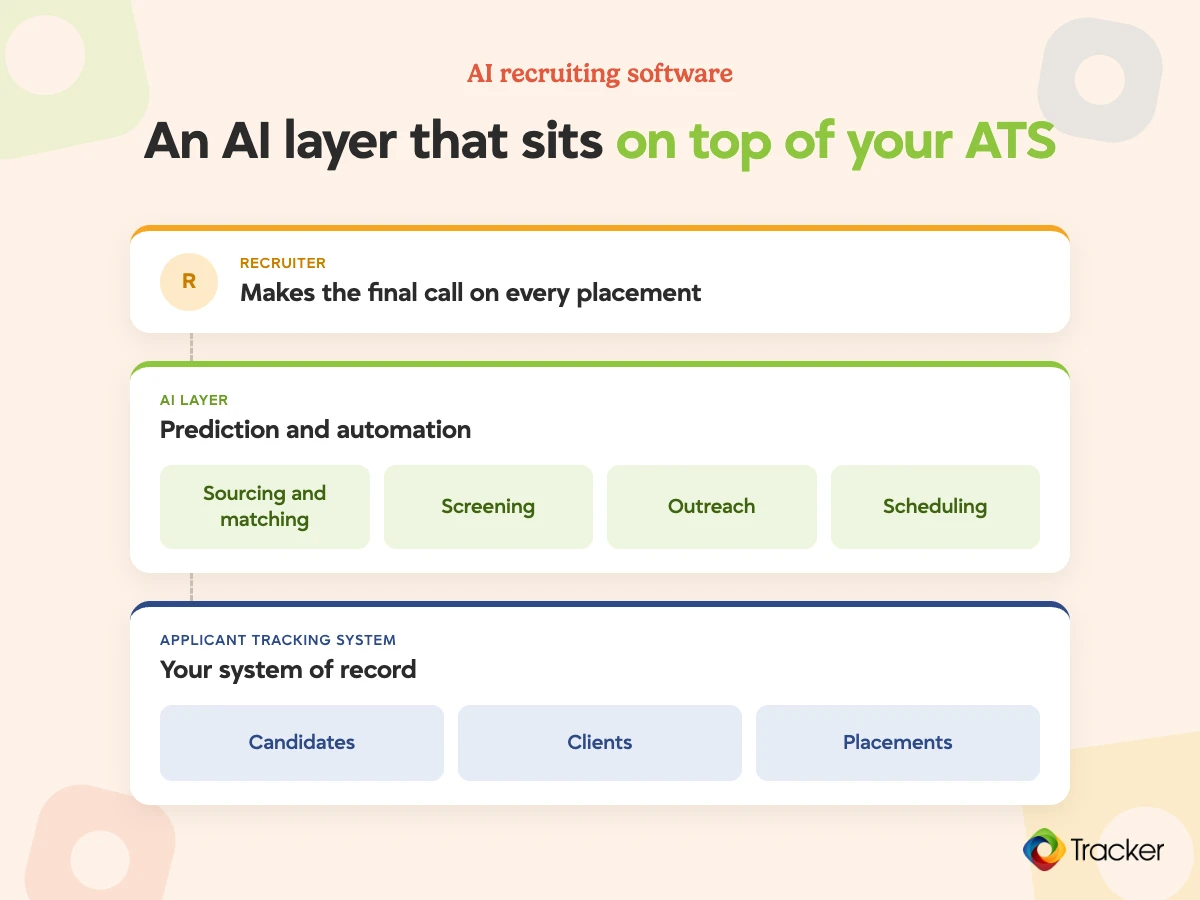
It sits alongside your applicant tracking system rather than replacing it. The ATS stays the system of record for candidates, clients, and placements. The AI layer adds pattern recognition on top, matching candidates faster and flagging who deserves a second look, while recruiters keep the final call on every placement.
Adoption is growing fast, though it’s still concentrated among a small number of large employers rather than spread evenly across the market. For agencies, that’s worth acting on. Getting in now puts you ahead of most of the market, not behind it, and it’s part of a broader shift across AI recruiting tools generally, not just software built for single-company hiring.
Core capabilities to expect from AI recruiting software
This is where AI for recruiters gets practical instead of theoretical. Not every AI recruiting tool includes every capability below, so treat this as a checklist for what full-featured looks like. Hiring managers already report using AI specifically for resume screening, skills-based candidate matching, and automated candidate outreach, which means none of this is speculative. It’s already standard practice.
| Capability | What it does |
|---|---|
| Candidate sourcing and matching | Pulls from databases, job boards, and networks, then ranks candidates by fit |
| Resume screening and candidate assessment | Parses applications against job requirements and surfaces the strongest matches |
| Candidate communication and outreach | Automates personalized outreach and status updates to candidates and clients |
| Job description generation | Drafts and refines postings, flagging language that discourages qualified applicants |
| Reporting, analytics, and candidate rediscovery | Provides talent analytics on pipeline health and resurfaces past candidates for new roles |
Candidate sourcing and matching
For an agency juggling multiple open requisitions, AI sourcing means faster access to a qualified candidate pool across every active client account, not just the one a recruiter happens to be focused on that day.
Strong sourcing tools also tend to expand a recruiter’s reach beyond their usual networks, surfacing a broader, more diverse set of qualified candidates who might otherwise get missed entirely.
Resume screening and candidate assessment
This matters most for high-volume roles, where a single client requisition can pull in hundreds of applicants. Structured interviews built around standardized questions by job level help recruiters compare candidates on the same basis instead of relying on gut feel alone.
Candidate communication and outreach
Done well, this strengthens candidate experience and candidate engagement rather than replacing the recruiter’s relationship with the candidate. Natural language tools handle routine updates so recruiters can focus on the conversations that actually move a placement forward.
Job description generation
The better tools flag language that quietly discourages qualified candidates from applying, gendered phrasing or unnecessarily narrow requirements lists included. Writing more inclusive job descriptions is one of the more overlooked ways AI recruiting software supports a broader candidate pipeline. It’s not an afterthought. It’s a direct result of the tool doing its job well.
Reporting, analytics, and candidate rediscovery
That visibility spans every open client account at once. Candidate rediscovery, resurfacing people who fit a new requisition even if they weren’t right for the last one, is especially valuable for agencies sitting on years of historical placement data, and the same capability supports internal mobility opportunities within a client’s own organization.
What to evaluate when choosing an AI recruiting platform
Once you understand what these recruitment platforms can do, the real work is figuring out whether a specific one is built for how your agency operates. The stakes are real: heavy AI adoption, alongside stronger operational discipline, cut staffing agencies’ revenue contraction rates roughly in half last year, from 56 percent down to 31 percent. Use the criteria below as a working checklist for vendor conversations and demos, not just a definition of features.
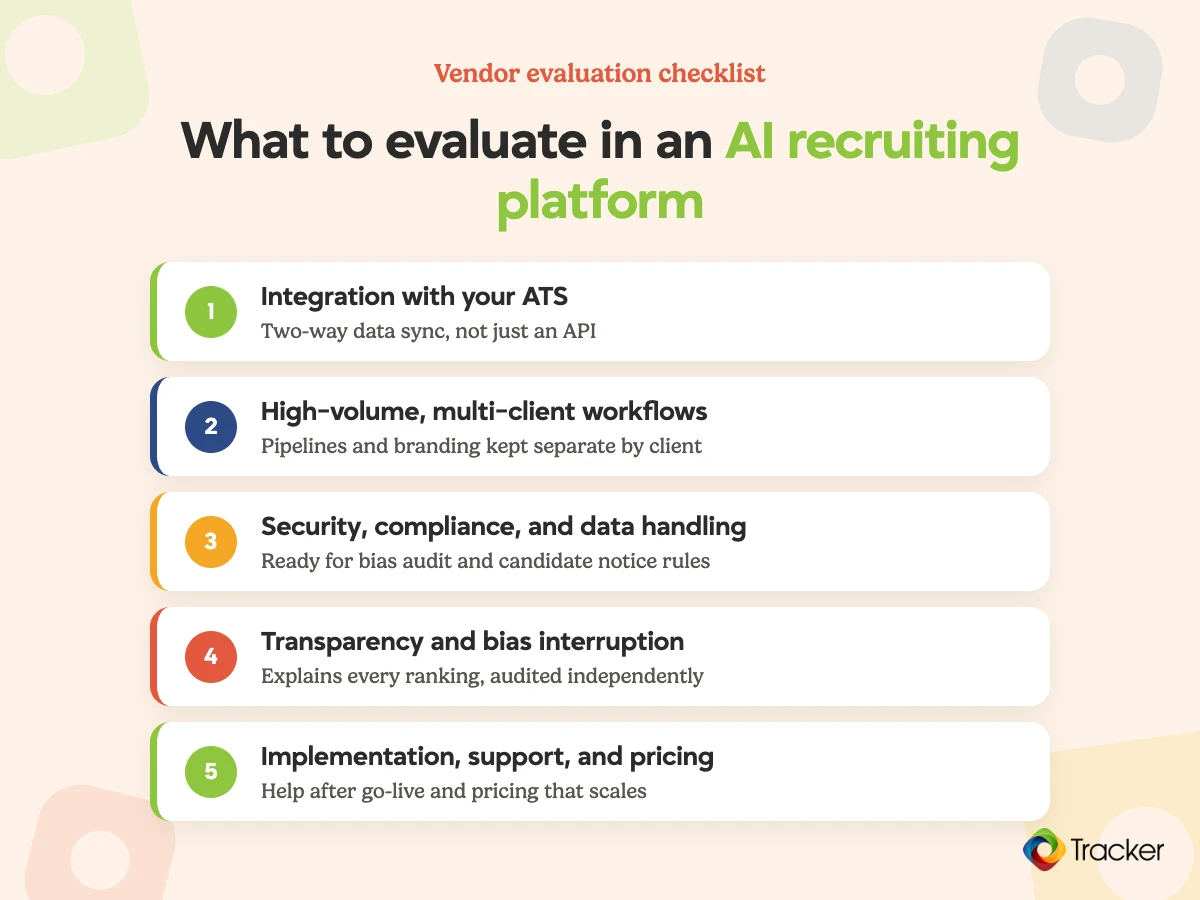
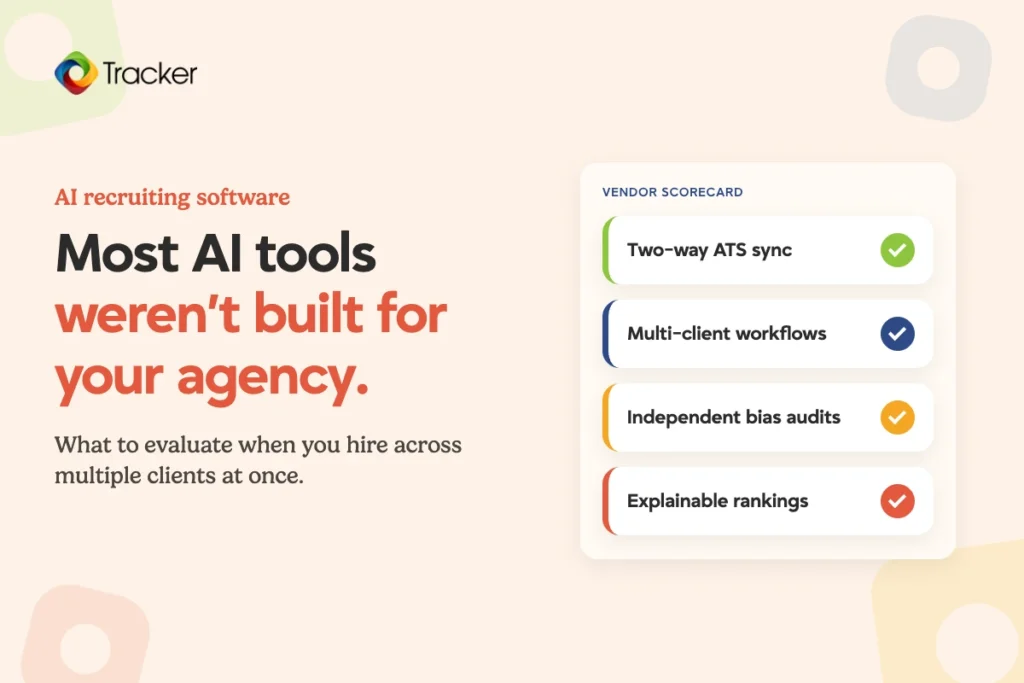
Integration with your existing applicant tracking system
AI capabilities only help if they connect cleanly to the ATS and CRM your team already relies on.
- Ask vendors for specific integration examples with agency-standard systems, not just confirmation that an API exists.
- Get clarity on whether data syncs both ways. If it doesn’t, recruiters end up re-entering the same candidate information twice, which defeats the point of adding AI in the first place.
Support for high-volume, multi-client workflows
A platform built for one company hiring for itself often breaks down once it has to keep client-specific branding, reporting, and candidate pipelines separate across a dozen open requisitions.
- Ask directly how the platform separates workflows by client.
- Confirm it prevents candidates from getting crossed between accounts.
Security, compliance, and data handling
Candidate data security matters more as AI tools take on a bigger role in candidate screening and ranking decisions. New York City’s Local Law 144 already requires an independent bias audit before an employer or employment agency can use an automated tool to screen candidates, along with advance notice to candidates.
- That’s not hypothetical. It’s a binding requirement in at least one major market already.
- A serious vendor should expect the question and have an answer ready.
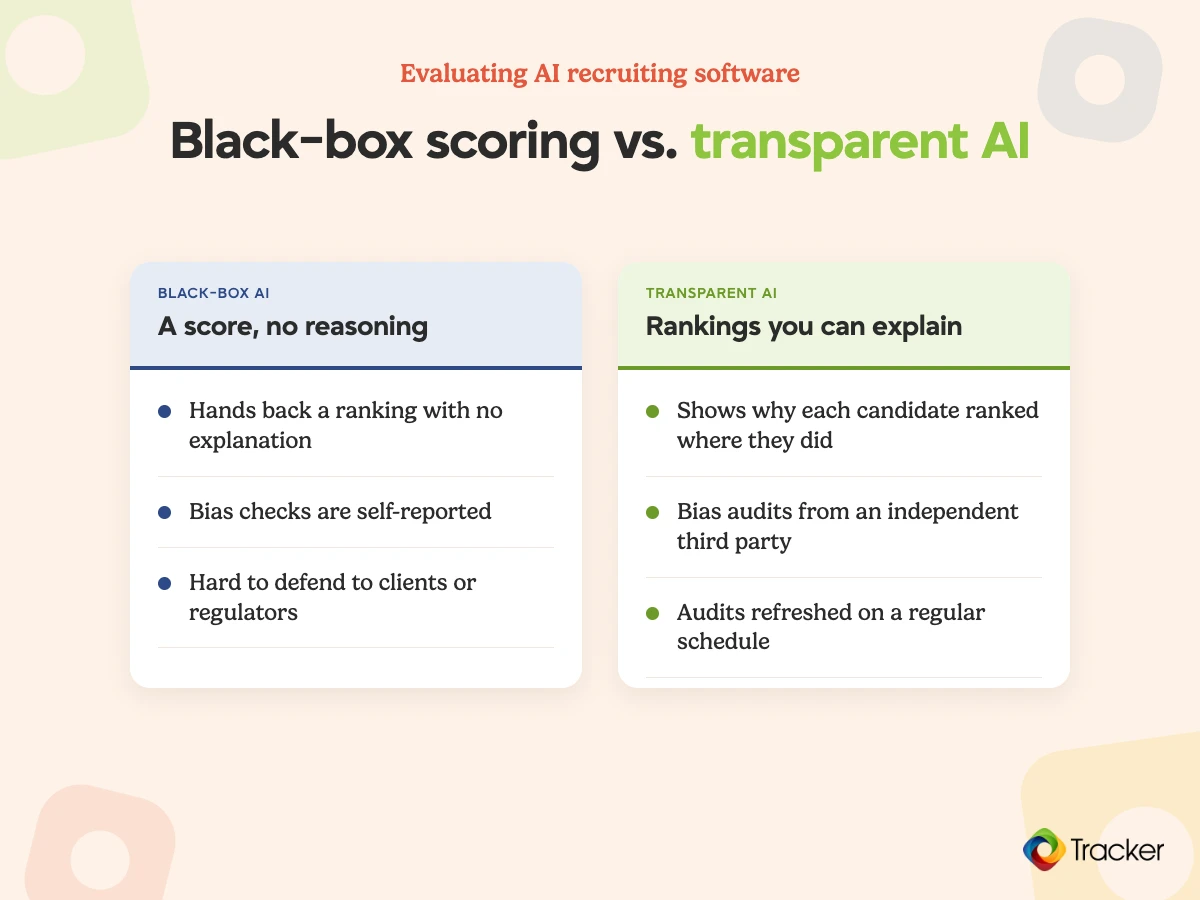
Transparency and bias interruption in AI-driven decisions
A platform should explain why it ranked or screened a candidate a certain way, not just hand back a score with no reasoning behind it. In a 2023 survey, most Americans said they remained uneasy about AI making hiring decisions without a person involved, and it’s still the most specific benchmark available on this exact question, which is exactly why transparent, auditable AI matters here.
- Ask whether bias audits come from an independent third party or are simply self-reported, and how often they get refreshed.
- This same transparency is what supports fairer, more diverse hiring rather than working against it.
Implementation, support, and pricing
Onboarding time, training quality, and support after go-live often matter more than the sales demo suggests.
- Ask what happens three months in, not just what happens during the pitch.
- Make sure pricing scales sensibly with your agency’s size and requisition volume rather than punishing growth.
TrackerAI features built for staffing agency hiring
The criteria above are not abstract. They are the specific list staffing agencies compile after getting burned by a platform built for someone else’s hiring process. TrackerAI exists because of that list, not despite it, built from the ground up for staffing agencies rather than adapted from a corporate in-house tool after the fact.
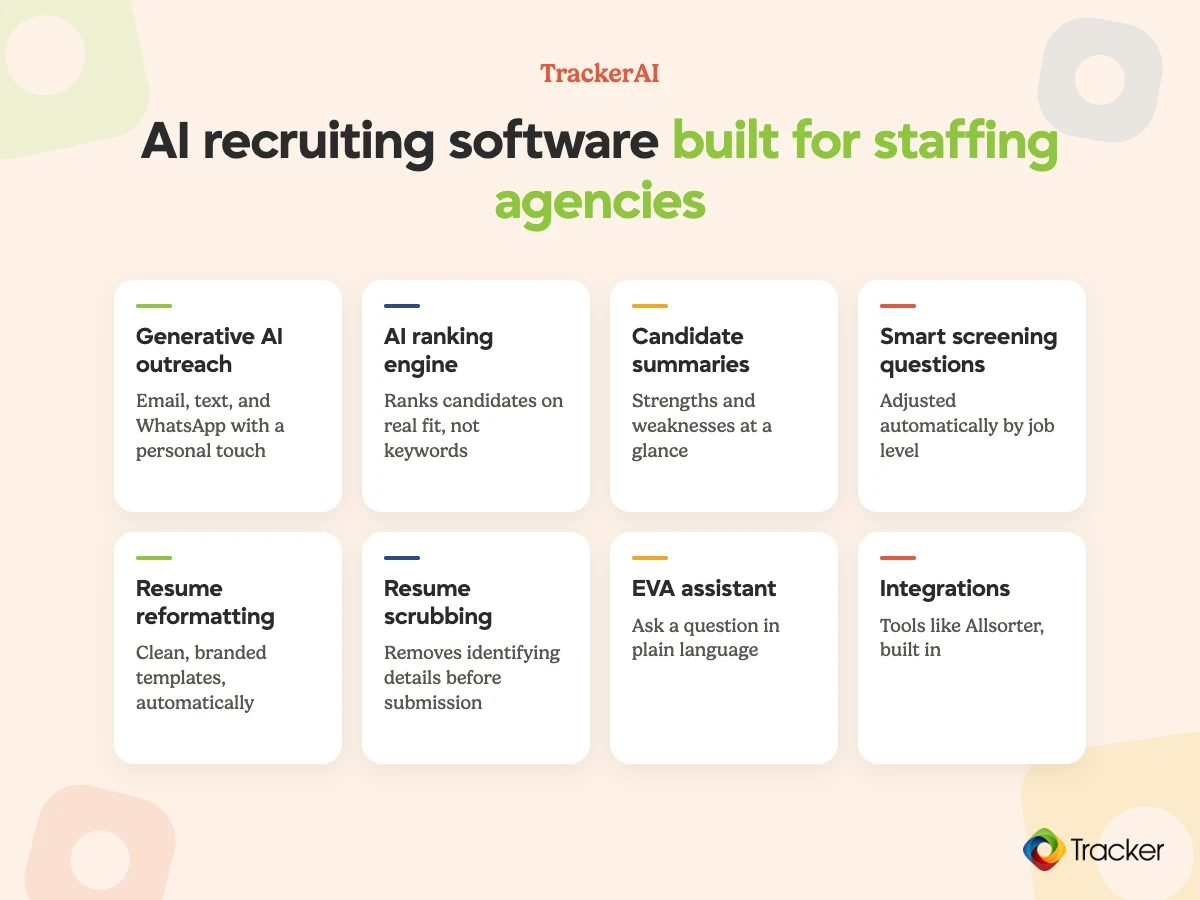
- Generative AI handles email, text, and WhatsApp outreach without losing the personal touch.
- The AI ranking engine surfaces the strongest candidates for a given requisition based on real fit, not just keyword overlap.
- Candidate summaries and strengths-and-weaknesses breakdowns give recruiters a faster read on each applicant.
- Screening questions adjust automatically by job level, so a request for a machine operator and a request for a plant manager don’t get the same generic list. That’s workflow automation built around how staffing actually runs.
- Resume reformatting strips out inconsistent formatting from incoming resumes and rebuilds them into a clean, branded template automatically, so nobody’s manually reformatting a PDF at 6pm before a submission deadline.
- Resume scrubbing removes identifying details (name, photo, age, school dates) before a resume goes to a client, cutting down on the unconscious bias conversation agencies keep having to have.
- Ask a question in plain language and get an answer, instead of digging through screens to find it. EVA, Tracker’s built-in assistant, sits in the sidebar so a recruiter can ask about a candidate, req, or account without breaking away from what they’re working on.
TrackerAI’s integration ecosystem extends further still, including tools like Allsorter for AI-powered resume formatting, part of a broader set of integrations built around how staffing agencies work day to day.
Conclusion: Choose the AI recruiting software that fits your agency’s needs
The right choice isn’t the platform with the longest feature list. It’s the one built for agencies running multiple clients and hundreds of requisitions at once, not the one built for a single company hiring for itself and stretched to look like it fits your world. Weigh every feature and every vendor claim against that distinction. It’s the one most demos won’t bring up on their own.
See how TrackerAI handles all of this in practice. Get a demo.