
Data entry. Status updates. Interview coordination. Job posting. Report pulling. By Thursday afternoon, most recruiters have spent more of the week on admin than on the people they’re placing.
Automation in recruitment takes those repetitive, rule-based tasks off the recruiter’s plate and runs them consistently in the background. The payoff is already showing up in the numbers: among agencies using no AI in any process, 56% contracted in 2025, compared with 31% of heavy AI users.
Automation and AI aren’t the same thing, even when they run inside the same platform. Automation follows rules you set. AI interprets data and makes judgement calls. This piece is about the automation side: where it fits across the staffing workflow, what it delivers, and what to weigh up before you adopt it.
What is automation in recruitment?
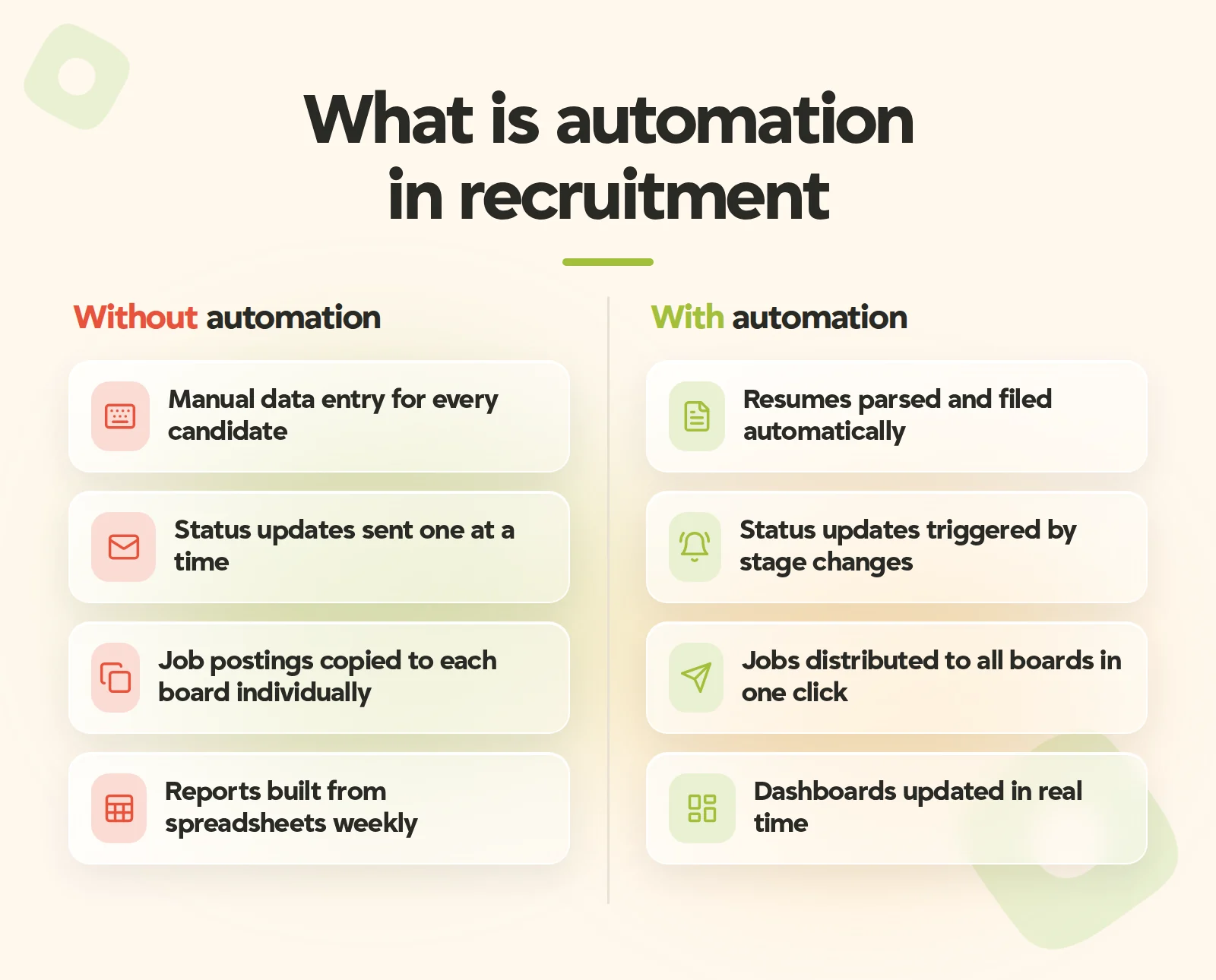
Recruitment automation is technology that handles repetitive hiring tasks by following predefined rules. When a candidate applies, automation can parse their resume, send a confirmation, add them to the right pipeline, and let the assigned recruiter know, without anyone clicking a button.
It doesn’t make judgement calls. It follows the same instructions every time, for every candidate. That predictability is exactly why it works so well in agencies, where recruiters are juggling multiple clients, high-volume requisitions, and contractors at every stage of their assignment.
These workflows run through the ATS and recruitment CRM that support the full recruiting lifecycle, from sourcing through to placement and redeployment.
Where automation fits in the staffing workflow
Automation touches every stage of the recruiting lifecycle. Here’s where it does the most work, stage by stage, so you can see where to start.
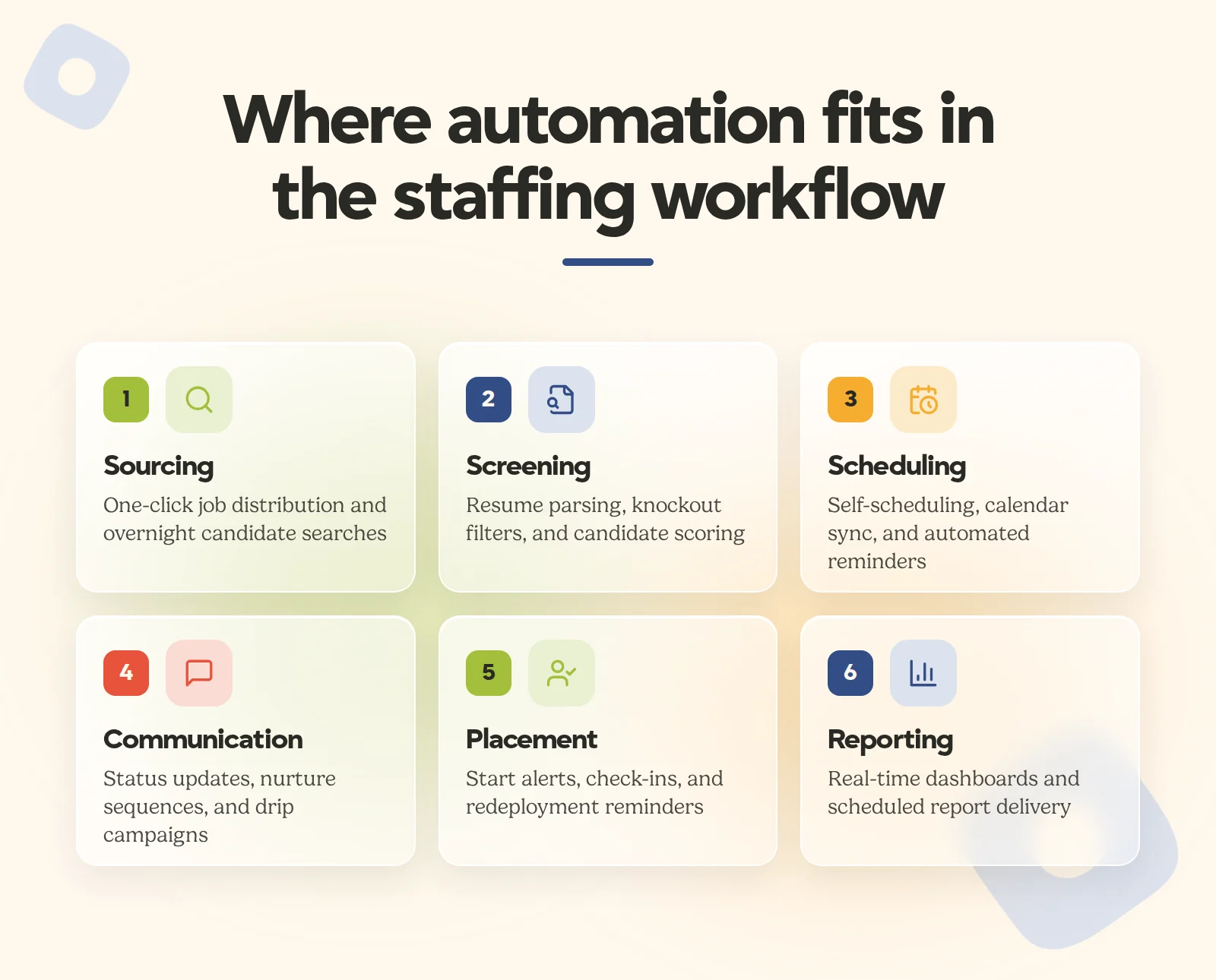
Sourcing and job distribution
Posting every opening to every board by hand is a time sink. Automation makes it one click. Agencies with automated sourcing workflows usually see the difference in three places:
- One-click job distribution to multiple job boards and social channels from one platform
- Overnight sourcing that searches job boards and parses new profiles into the system while recruiters are off the clock
- Candidate rediscovery that surfaces people already in your database who match a new opening, so you fill from your own pool before searching externally
Screening and candidate qualification
Screening is where automation shows up most clearly in shortlist quality. The right recruitment automation software connects it all into one pipeline:
- Resume parsing turns incoming applications into structured, searchable profiles, with no retyping of contact details, work history, or skills
- Pre-screening questions and knockout filters qualify or rule out candidates before a recruiter looks, based on certifications, location, or availability
- Matching and scoring rank applicants by skills, experience, and fit, so recruiters see the strongest candidates first
Interview scheduling and coordination
Scheduling is one of the most common bottlenecks in staffing, and one of the easiest to automate. Automation examples in HR keep showing measurable time savings here:
- Self-scheduling lets candidates pick a slot without a recruiter in the middle
- Calendar syncing across recruiters, candidates, and hiring managers stops double-bookings
- Automatic confirmations, reminders, and rescheduling cut the back-and-forth and the drop-off before interview
Candidate communication and engagement
Keeping every candidate updated across dozens of open roles is close to impossible by hand, and it’s one of the biggest drivers of how candidates feel about you. Agencies using recruitment marketing automation see fewer ghosted candidates and more coming back:
- Status updates at every stage change, from application received through screening, interview, offer, or rejection, so nobody’s left wondering
- Email and SMS sequences for candidates who aren’t ready yet, or who are between assignments
- Drip campaigns that keep your talent pool warm, so the next conversation starts from familiarity, not a cold call
Placement and post-hire follow-through
Most recruitment automation advice stops at the offer. Agencies don’t get to stop there, because the relationship carries on long after the candidate starts. This is where most firms have the most room to grow:
- Start date alerts let recruiters and clients know when a placement begins
- Scheduled check-ins at one week, three months, and six months keep the relationship warm without anyone tracking it in a calendar
- Finance notifications fire as soon as a placement is confirmed
- Contract end-date reminders flag redeployment opportunities before the assignment wraps up
- Onboarding automation sends the right documents and compliance steps based on location, job type, or client
Recruitment automation for reporting and analytics
Automated reporting takes the spreadsheet-building off everyone’s plate, and it’s where recruitment workflow automation pays back more over time:
- Real-time dashboards show pipeline health at a glance, with nobody pulling numbers by hand
- Scheduled reports land with leadership daily, weekly, or monthly
- Pipeline analytics show time in stage, conversion rates, and source effectiveness, so bottlenecks get caught early
Benefits of automating the recruitment process
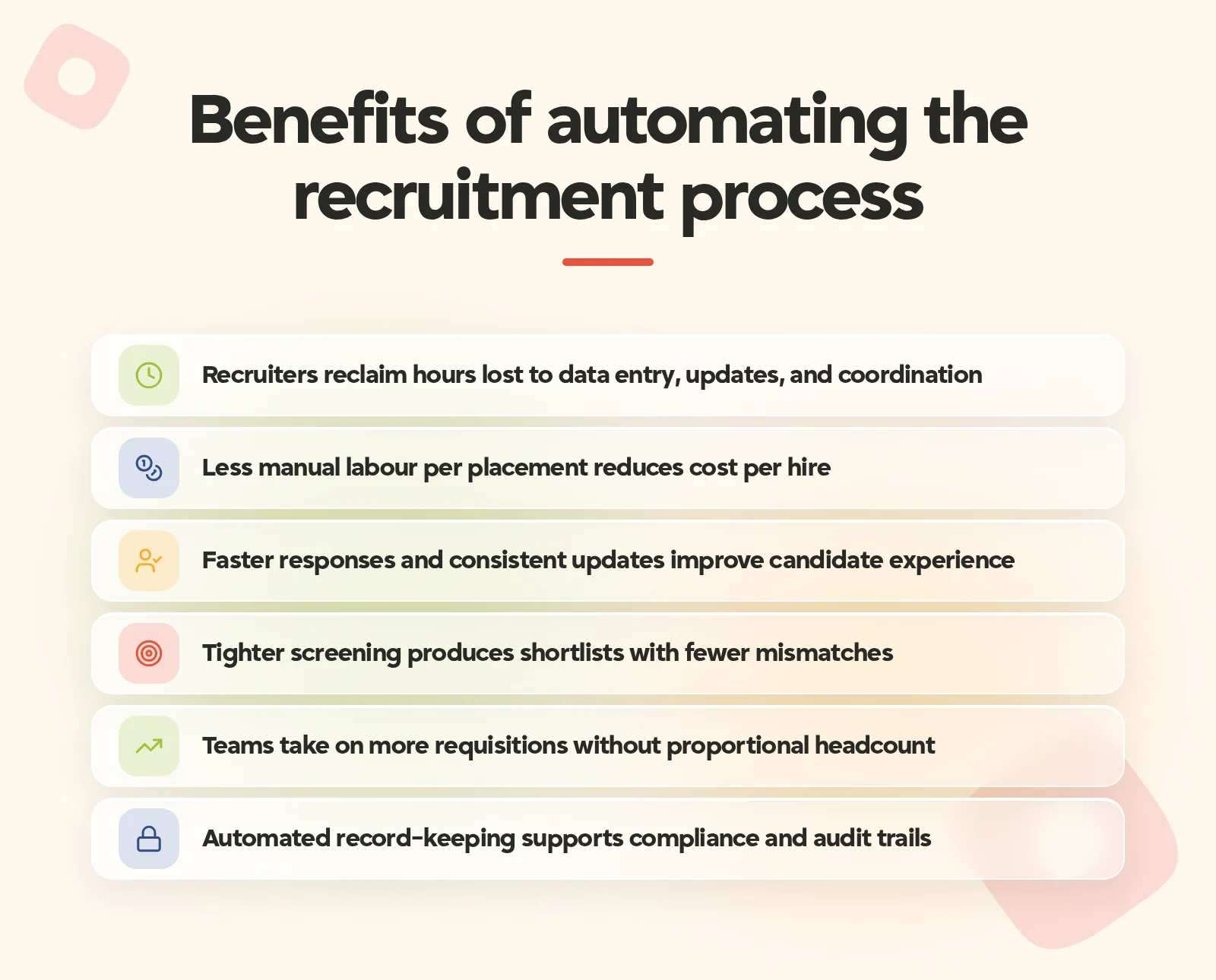
The benefits of automating the recruitment process are practical, not theoretical. For staffing agencies, these are the ones that matter most:
- Time back for the whole team. This is how automation saves time in recruitment: the hours that went on data entry, status updates, and coordination go back into candidate conversations and client work.
- Lower cost per hire. Less manual effort per placement, fewer candidates lost to slow follow-up, and fewer expensive re-sourcing cycles.
- A better candidate experience. Fast responses and consistent updates mean candidates always know where they stand, and that’s a real edge when you’re competing for the best people.
- Better placements. Tighter screening and matching mean fewer mismatches on the shortlist, fewer fall-offs, and clients who come back.
- Room to scale. The team can take on more requisitions across more clients without hiring at the same rate.
- Compliance on solid ground. Automated record-keeping cuts manual errors and keeps an audit trail of every candidate interaction.
Agencies that start with one or two automated workflows and build from there see these gains add up. This roundup of recruitment automation tools has plenty of starting points.
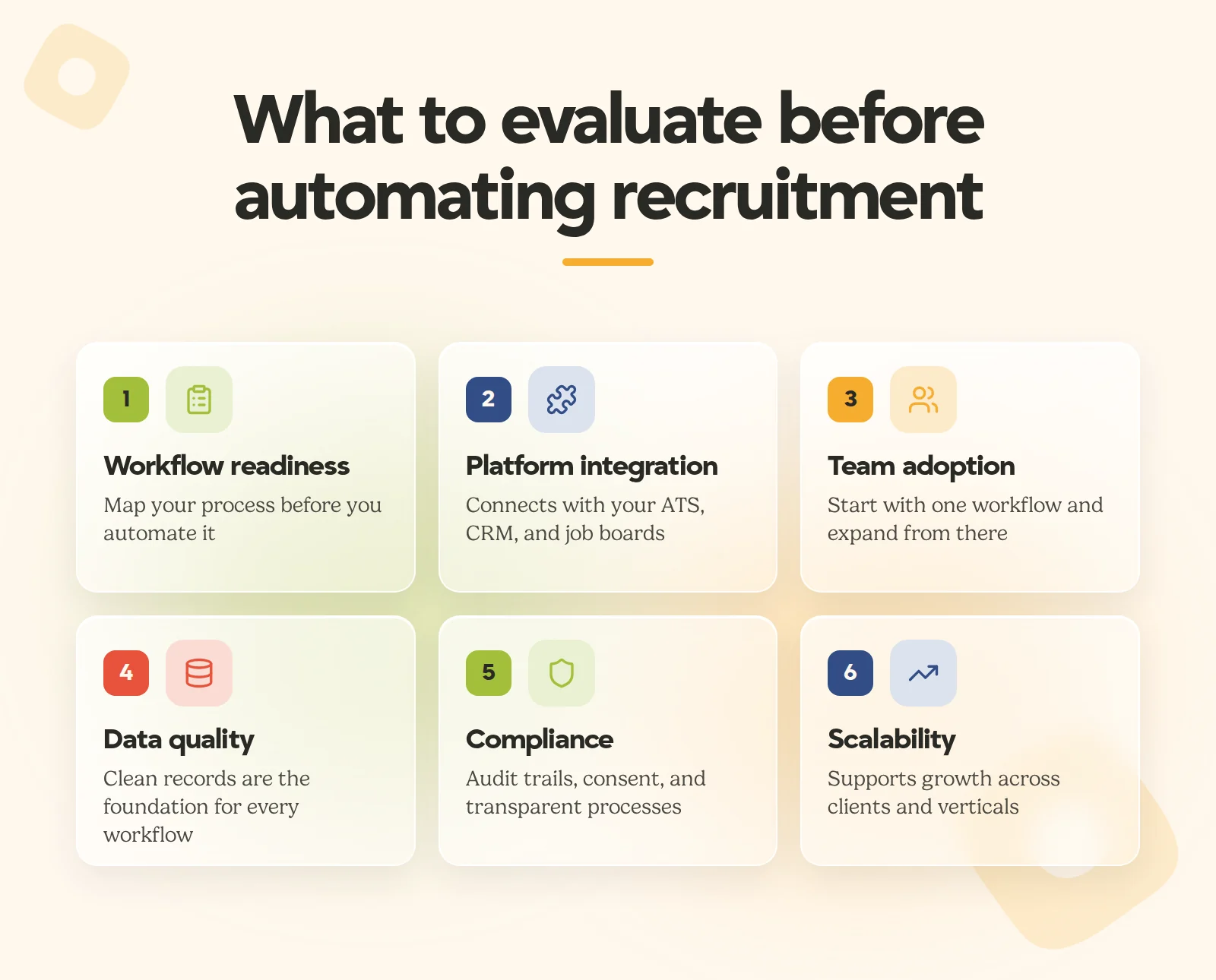
What to evaluate before adopting recruitment automation
Before choosing a platform or expanding what you already have, a few things are worth working through.
Workflow readiness comes first. Map your process before you automate it, because automating a broken workflow just runs the broken version at higher volume. Agencies that document intake to placement before they automate recruiting process steps report smoother rollouts.
Integration matters more than feature count. If the tool doesn’t connect to your ATS, CRM, and job boards, it’s just another silo.
Team adoption is the one most agencies underestimate. Start with one high-impact workflow, show the result, and build from there. Recruiting process automation stalls most often when agencies try to automate everything at once.
Data quality sits under everything. Incomplete or duplicate records will break every workflow you build on top of them.
Compliance and data privacy need the same attention. Audit trails, candidate consent, and transparent processes matter in every market, and even more where regulatory scrutiny of hiring is increasing.
Finally, think about scale. Will this still work as you add clients, enter new verticals, or take on different work types? Staffing analysts looking at 2026 trends say the same: the agencies pulling ahead chose their automation with a clear operational plan behind it.
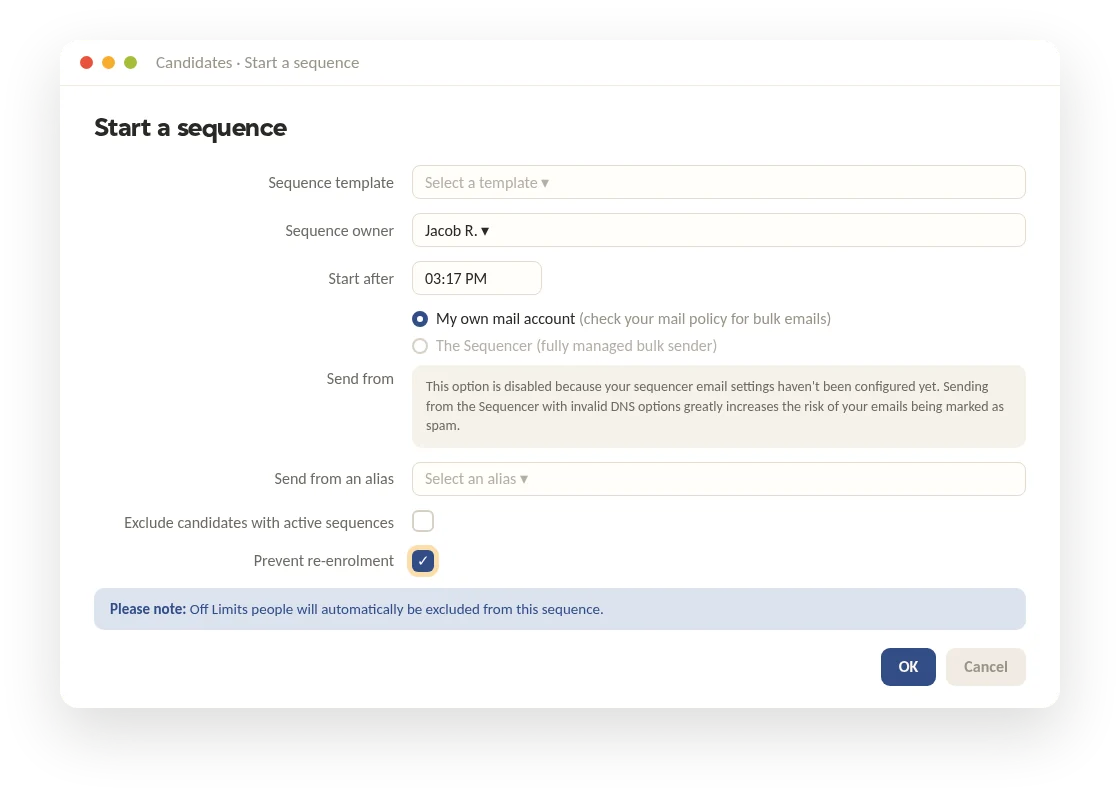
Tracker’s built-in automation for every hiring stage
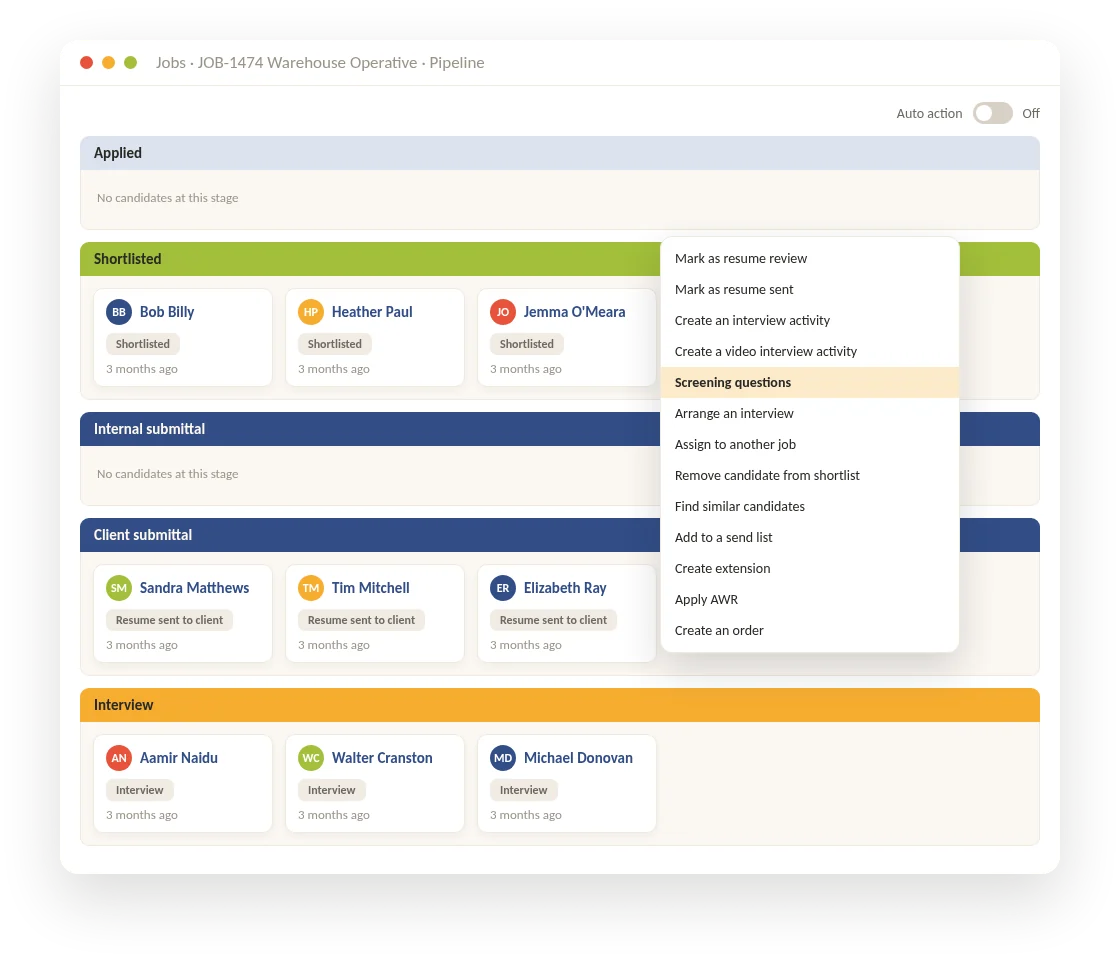
Tracker is one ATS and CRM platform where automation is built in, not bolted on. Every workflow above runs inside the platform recruiters already use.
Jobs go out to every board in one click. Watchdogs source overnight, so the morning starts with a list waiting. Auto-matching, resume parsing, interview scheduling, and calendar coordination take care of the legwork. The built-in sequencer keeps candidates in the loop by email and SMS, start date alerts and check-ins go out on time, and redeployment reminders land before the assignment ends. Leadership gets real-time dashboards and scheduled reports without pulling anyone off a call.
TrackerAI adds a separate AI layer for the tasks that need judgement: candidate ranking, screening questions, and job descriptions. The two work together, each on a different part of the process.
One multi-discipline agency with 80+ recruiters found that 40% of its revenue was coming from candidates already in its Tracker database, surfaced through automatic source tracking and candidate rediscovery. When automation is built in, gains like that become part of the everyday, not a special project.
Build your automation around the right workflow
Automation in recruitment delivers most when it sits on top of a well-mapped, consistent process. The point is to get recruiters out of admin and back into the candidate and client conversations that close placements. As recruitment automation trends keep moving, agencies with their workflow fundamentals in place will be ready for whatever comes next.
The automation handles the admin. Your recruiters handle the people.
If you’re working out where to start, book a demo to see how Tracker’s automation fits your agency’s workflow.