
In the early years, an applicant tracking system (ATS) usually just works. Recruiters know the candidate database by heart, there are few enough clients to track from memory, and reporting is simple because there isn’t much to report on yet.
Growth changes all of that, quietly. An ATS for staffing agencies that once felt effortless starts to strain under more candidates, more clients, and more recruiters leaning on it every day.
It never shows up as one breaking point. It shows up as patterns that repeat often enough to feel familiar, and frustrating, long before anyone calls it a technology problem. Here are five of the clearest signs.
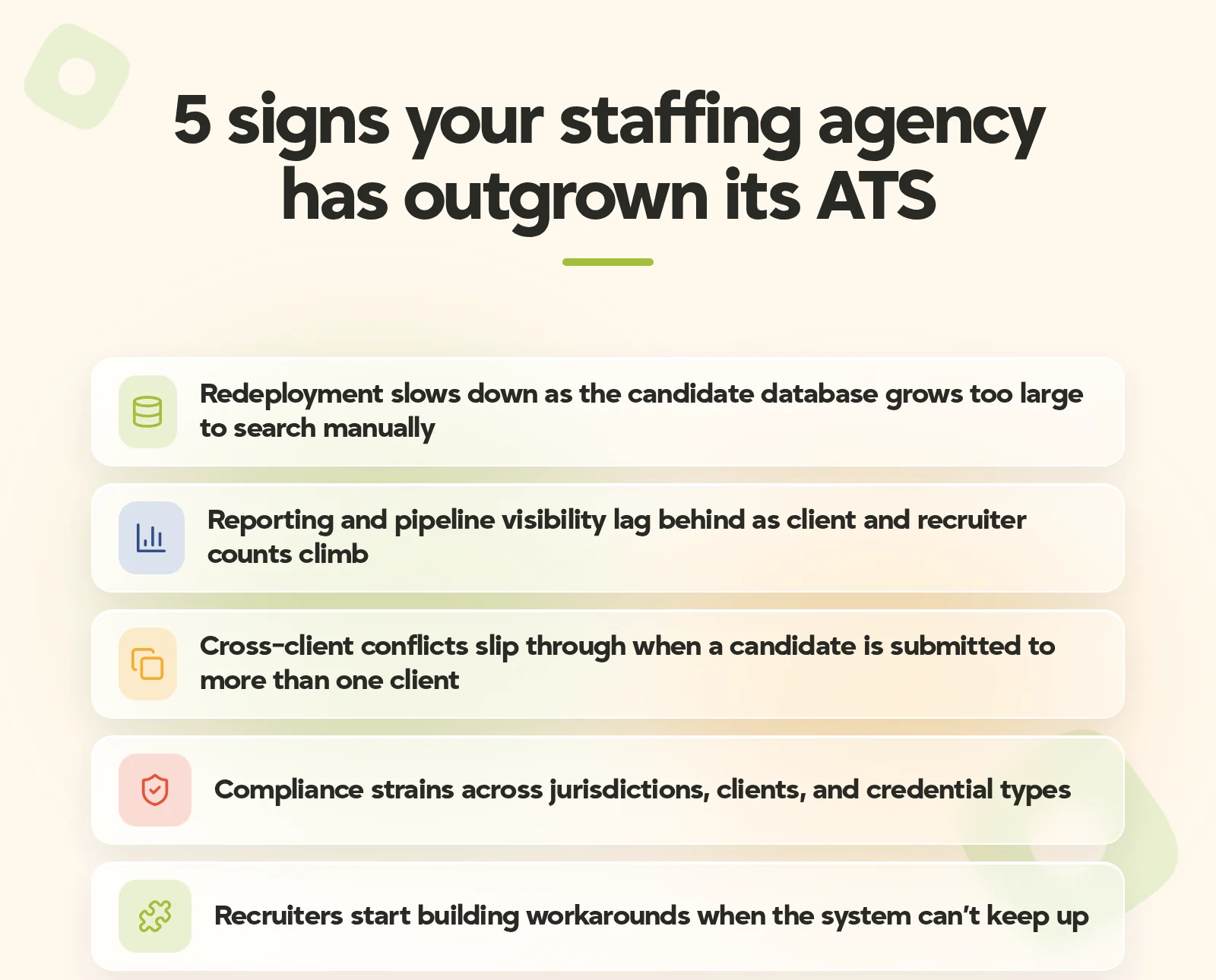
Redeployment can’t keep up
Redeployment, placing someone already in your database into a new role, should be the fastest and cheapest way to fill a job. But once the database runs into the thousands, manual searching stops surfacing the right people. Recruiters end up re-sourcing candidates they’ve placed before, and paying to find talent the agency already had.
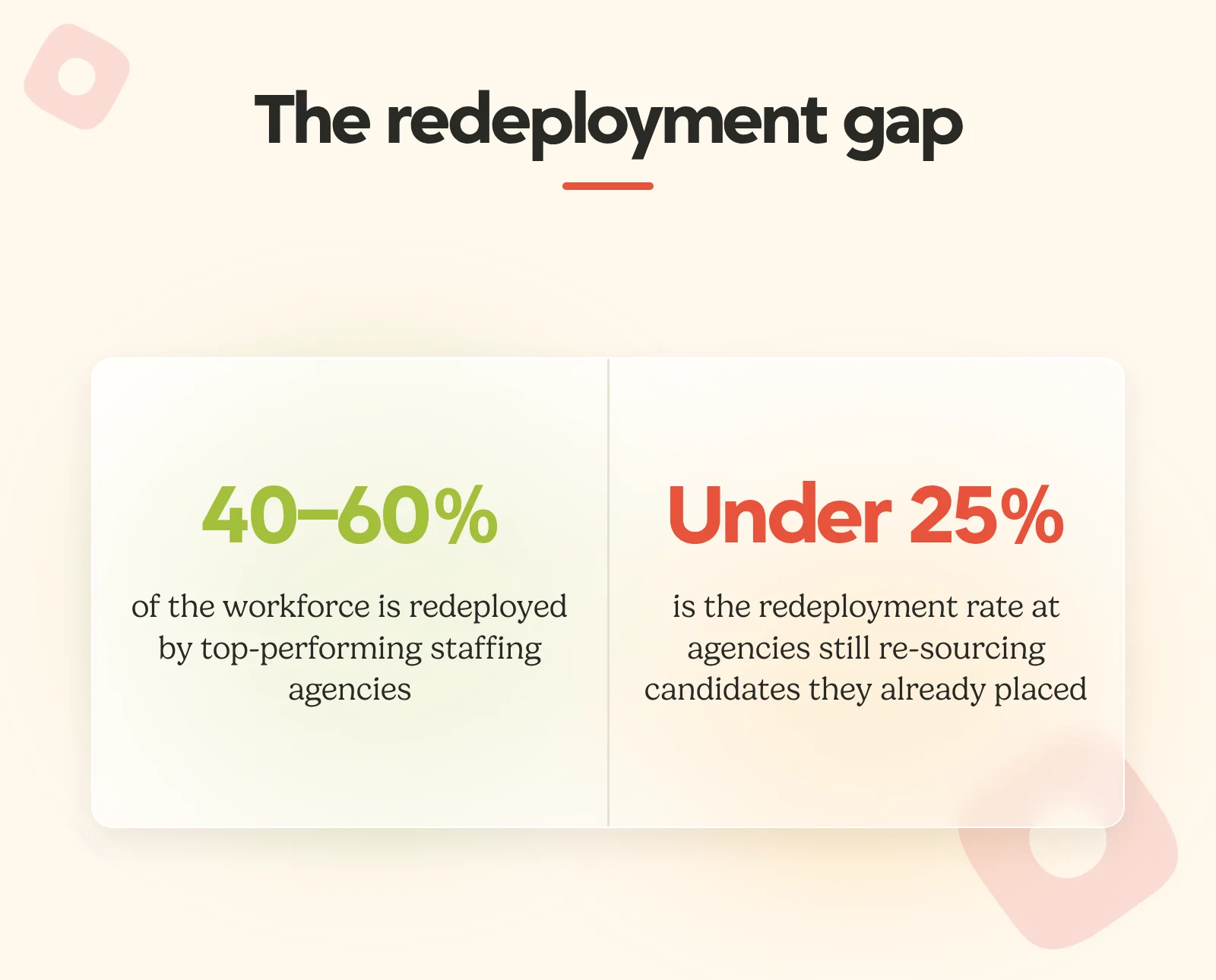
What gets missed is bigger than most agencies assume. Top-performing agencies redeploy 40 to 60% of their workforce, while agencies stuck below 25% are quietly paying to replace people they already had.
One multi-discipline recruitment agency had no systematic way to reconnect with past candidates. Once it added source tracking, it found that 40% of its revenue was already coming from people in its own database. That revenue had been there all along. Nobody could see it.
If redeployment feels harder than it should, the candidate pipeline has probably outgrown what manual search can manage.
Reporting and visibility lag behind
Client and recruiter numbers rarely grow in a straight line, and reporting is usually the first thing to fall behind. A quick look at a shared spreadsheet becomes a scramble to pull numbers from three or four places before a client call. Nothing breaks outright, which is why this one is easy to miss. It shows up as:
- Reports built by hand from exports right before a client call, instead of pulled on demand
- Leadership unable to see recruiter productivity, job order status, or pipeline health in real time
- Coaching conversations that stay reactive, because the numbers aren’t there when they’re needed
Once client rosters grow past what one person can hold in their head, agencies start losing confidence in their own applicant tracking system statistics and reporting. One growing agency running high-volume labour hire across several branches found that reporting for its biggest clients meant pulling data by hand from disconnected sources. Another had almost no visibility of recruiter metrics until it brought its data into one system.
Cross-client conflicts slip through
Multi-client recruiting carries a risk in-house hiring never has to think about: the same candidate in two client pipelines at once. Without a system built to flag it, a recruiter can submit someone who’s already under consideration elsewhere in the agency. That’s a conflict of interest, and sometimes a dispute over placement credit and fees.
It isn’t hypothetical. One managed service provider for automotive dealerships found that duplicate candidate records were wasting recruiters’ time long before the volume made the problem obvious. Resume parsing that keeps records structured from the moment a candidate enters the system is what stops those duplicates forming. At scale, unresolved duplicates stop being a cleanup job and start being a trust problem with clients.
Case study: how one agency fixed this by switching to Tracker
The Mason Group, a 40-person accounting, finance, and IT staffing firm with around 100 active contractors across four Canadian offices, had outgrown its old ATS. Recruiters avoided it because it was clunky, contractor availability was hard to track, and payroll ran on manual workarounds. After evaluating 16 platforms, the firm moved to Tracker. Four months later:
- Back office and payroll: all 100 contractors submit time through Tracker every two weeks, clients approve hours in one click, and invoicing follows automatically, replacing a login-heavy process that generated constant payment questions
- Candidate presentations: building one dropped from about 30 minutes to around 10, giving recruiters that time back for outreach
- Reporting: leadership built custom reports showing team activity, pipeline, and contractor status, something the old system couldn’t reliably do
Go-live took a single weekend, and the contract division was fully off the old system within two weeks.
Compliance can’t scale across jurisdictions
Credential tracking gets harder every time an agency adds a state, a client with its own requirements, or a new type of certification. What starts as a manageable checklist for one office turns into a growing set of moving parts:
- Expiring certifications tracked by individual recruiters instead of one central system
- Documentation that varies by state, county, or client
- Client-specific compliance requirements layered on top of standard credentialing
The risk grows with volume. One high-volume labour hire operation found compliance gaps creating real placement risk across its largest clients, until it standardised its compliance rules by client and region. The fix wasn’t more diligence from recruiters. It was software built for compliance tracking that enforced the rules automatically, so nobody could be placed until every requirement was met.
Recruiters start working around the system
This is the sign leadership can see for themselves: recruiters quietly building their own workarounds because the system isn’t giving them what they need fast enough.
- Shadow spreadsheets for candidates the ATS makes hard to find
- Sticky notes and personal to-do lists standing in for follow-up reminders
- Side trackers kept outside the system for priority job orders
None of that reflects badly on the team. It’s what capable people do when a tool stops keeping up. One staffing firm running on Excel found each recruiter losing around nine hours a week to manual, repetitive tasks: nearly 468 hours a year each, on work the system should have been doing.
A system that brings fragmented recruitment processes into one place is what closes that gap. If the team isn’t fully trusting or using the ATS, that gap usually shows up first, often well before a report or a client says so.
Tracker: an ATS for staffing agencies outgrowing the basics
All five signs share a thread. Each one is a symptom of a system that was never designed for the scale, complexity, and multi-client demands the agency has grown into. Tracker’s applicant tracking features are built around exactly these growth points.
| Sign | How Tracker’s ATS handles it |
|---|---|
| Redeployment can’t keep up | Full text, Boolean, profile, and semantic search; an AI ranking engine and skills profiling; auto-match to every open job; candidate prospecting to reconnect with past talent |
| Reporting and visibility lag behind | Job management with real-time role status; interview management tied to job orders; sendouts and submittals logged by job and client |
| Cross-client conflicts slip through | Resume parsing that keeps candidate records structured instead of duplicated across desks; sendouts and submittals tracked at job level, so a candidate already active with another client gets flagged |
| Compliance can’t scale across jurisdictions | Customisable workflows that build client- and location-specific requirements into each stage; VMS integration for the credential rules enterprise clients require before placement |
| Recruiters start working around the system | Long listing and shortlisting built into candidate search, replacing side spreadsheets; website and mobile recruitment tools that keep sourcing inside the system |
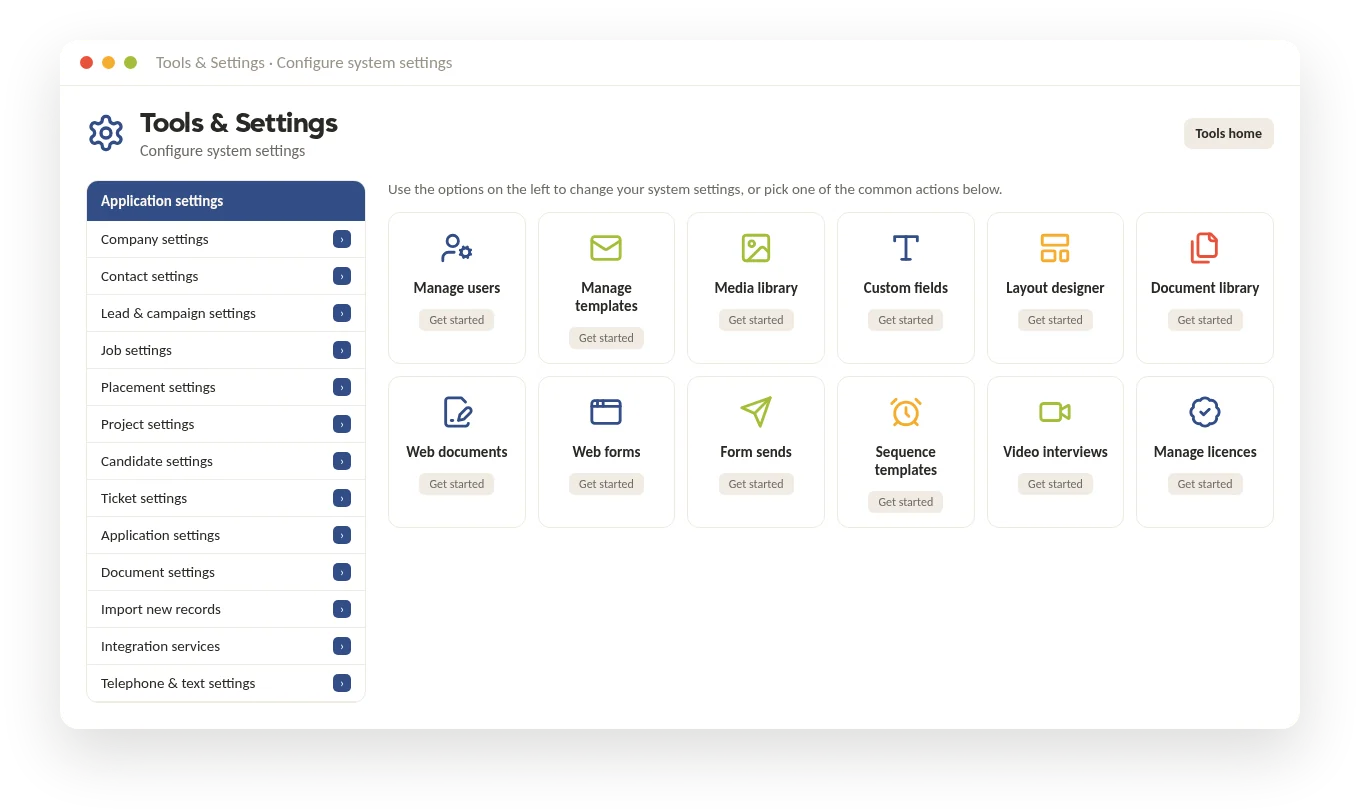
Agencies noticing several of these signs at once are often already comparing options, including what the best ATS systems for staffing agencies offer beyond the basics. That comparison is worth doing carefully, and it starts with knowing exactly which gaps need closing.
Spotting the signs is only the first step
These signs rarely arrive together. They surface one at a time, each easy to explain away, and much harder to ignore once two or three are happening at once. Each one means the applicant tracking system has become a brake on growth instead of a tool behind it.
Recognising the signs isn’t the same as deciding what to do next. The more useful move is a structured evaluation of what an applicant tracking system for staffing agencies actually needs to deliver, rather than reacting to the latest frustration. Agencies that treat it as a deliberate decision end up with a system built for where the business is going, not just where it started.
See what an ATS built for growing agencies looks like. Get a demo of Tracker.