
Recruiting has hit a turning point. Staffing agencies are discovering that the old ways of finding and vetting candidates simply can’t keep pace with today’s market demands. AI recruiting tools have stepped in to fill this gap, transforming how agencies identify, screen, and place candidates by simplifying and accelerating hiring workflows from initial sourcing through final placement.
Twenty-two percent of today’s jobs will be disrupted within the next five years, creating massive structural changes that require sophisticated technology solutions to manage effectively.
What are AI recruiting tools and how do they work?
AI recruiting tools represent software applications that apply artificial intelligence and machine learning to improve how recruiters manage hiring. These platforms go beyond traditional keyword matching to analyze candidate data, predict job fit, and automate recruitment processes.”
Core capabilities of AI tools in recruitment
The technology operates across four primary areas of recruitment:
- Sourcing and screening: Most recruiters have wasted countless hours manually browsing profiles, only to discover candidates whose job titles don’t reflect their real abilities. AI search tools change this approach by reviewing multiple platforms at once, zeroing in on actual skills and experience patterns instead of confusing job titles. The screening work now happens behind the scenes, with algorithms sorting applications according to job needs and previous hiring wins. It can also happen with AI agents or chat tools that have actual conversations with candidates to score them and only pass qualified candidates over.
- Candidate engagement: AI-generated outreach handles personalized one-to-one communications with candidates and clients or creates reusable sequences that can be deployed repeatedly. More advanced engagement uses recruitment chatbots and agents to manage initial candidate conversations, responding to frequently asked questions and coordinating interview schedules without requiring staff involvement. These tools customize messaging based on candidate backgrounds and interests, keeping people engaged throughout the hiring process.
- Interview management: Automated scheduling manages calendar coordination across all participants, while video interviewing platforms review candidate answers and gauge competencies. Automated evaluations measure cognitive skills and personality characteristics to build detailed candidate profiles.
- Predictive analytics: 39% of worker skills are set to evolve by 2030, which makes skills-based matching increasingly important. This move toward AI-powered recruiting allows teams to anticipate hiring needs and spot promising candidates before they start looking for new positions.
AI recruiting tools vs. traditional hiring methods
The evidence is compelling. Agencies that have made the switch to AI see substantial improvements in how quickly they hire, how much it costs, and how efficiently their teams operate:

Source: Data from SHRM
Best AI tools for recruiting
The AI recruiting market has matured rapidly, with several platforms demonstrating proven results for staffing agencies. Each addresses specific workflow challenges while offering integration capabilities that complement existing systems.
| Tool | Primary function | Key capabilities | Best use case |
|---|---|---|---|
| Tracker | Integrated ATS + CRM with AI automation | Unified candidate and client management with EVA AI suite for workflow automation, relationship tracking, and placement optimization | End-to-end recruitment management, agency operations, AI integration foundation |
| HireVue | Video interviewing and assessment | Analyzes candidate responses, facial expressions, and language patterns to evaluate technical skills and emotional intelligence | High-volume screening, remote hiring, structured assessments |
| SeekOut | Advanced talent sourcing | Aggregate profiles across platforms with sophisticated filtering for tech roles and diversity initiatives | Executive search, specialized technical positions, and diversity hiring |
| Paradox (Olivia) | Conversational AI assistant | Automates candidate screening, interview scheduling, and application status updates through chat interface | High-volume recruitment, candidate engagement, administrative automation |
| Textio | Job posting optimization | Uses predictive analytics to create bias-free, engaging job descriptions that attract diverse talent pools | Improving job ad performance, reducing bias, and enhancing employer brand |
| Eightfold AI | Talent lifecycle management | Machine learning platform that manages sourcing through development with a focus on diversity and bias reduction | Enterprise-level talent management, skills-based hiring, and long-term talent planning |
| hireEZ | AI-powered sourcing and engagement | Combines sourcing capabilities with DEI filters and CRM functionality for candidate relationship management | Outbound recruiting, diversity initiatives, and candidate pipeline development |
| Asendia | AI agent powered interviews and smart candidate scoring | Self-learning interview platform with dynamic question adaptation and seamless ATS integration | When you have more candidates than recruiters can handle, but need quality first interactions |
| Glyde | AI chatbot to pre-screen candidates | Autonomous AI agents that automates job posting to candidate shortlisting to pre-screening via chatbot | Mid-sized firms needing to prove ROI and optimize recruiting spend |
| Alex (formerly Apriora) | AI recruiter | AI recruiter that automates candidate screening through live conversations and personalized interviews | Mid-size+ staffing firm that needs to screen more candidates than your recruiters can handle, but candidate conversations still matter for placement success |
These platforms address core operational challenges by automating resource-intensive tasks while providing data-driven insights that improve hiring decisions. Staffing teams see the best results when they select tools that complement their existing technology infrastructure rather than creating additional complexity.
What to look for in an AI tool for recruitment
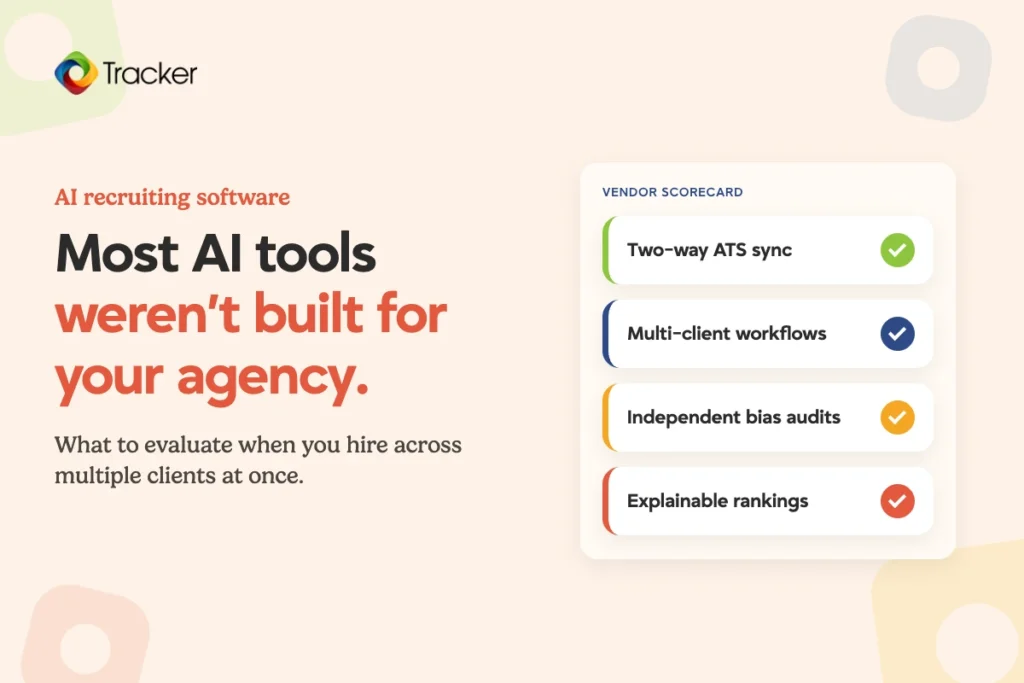
When choosing AI solutions, staffing agencies should focus on platforms that work smoothly with current processes while offering clarity and real value. Important features to review include:

Integration and workflow management:
- Seamless ATS and CRM integration to prevent data silos and workflow fragmentation
- API access for custom integrations and data synchronization across enterprise systems
- Unified candidate and client management within a single platform
- Built-in AI capabilities that remove complex third-party integrations
Transparency and decision support:
- Clear explanations for AI-generated candidate rankings and recommendations
- Customizable AI ranking engines that allow you to understand and adjust scoring criteria
- Audit trails and reporting capabilities to track AI performance and outcomes
- Full visibility into how candidates are scored and prioritized
Diversity and compliance features:
- Built-in DEI analytics and bias detection capabilities
- GDPR/CCPA compliance tools with automated preference management
- Customizable workflows that support fair hiring practices
- Comprehensive compliance frameworks with preference indicators
Automation and efficiency:
- Workflow automation for screening, scheduling, follow-ups, and candidate communications
- Generative AI for job descriptions, candidate summaries, and personalized outreach
- Auto-matching capabilities with unlimited workflow sequences
Scalability and customization:
- Unlimited records and users to support enterprise growth
- Custom fields, workflows, and reporting to match specific operational requirements
- Multiple user roles and access controls for complex organizational structures
- Clear pricing without hidden AI-related charges or integration costs

Pros, cons, and considerations for staffing leaders
Getting a clear picture of both the benefits and drawbacks of AI recruiting tools helps staffing leaders make smart implementation choices. 38% of HR leaders are already testing or rolling out AI solutions to boost efficiency and tackle talent shortages. Companies looking at AI implementation for HR functions need to weigh technology advantages against possible downsides.
Advantages of using AI recruiting tools
- Speed: Recruitment workflow automation allows staffing agencies to respond faster to client needs and capture opportunities that slower competitors miss.
- Quality: Candidate scoring tools review far more data points than human recruiters can handle, spotting successful hiring patterns that boost match quality. Research shows that job seekers using AI assistance to improve their resumes are 8% more likely to be hired, demonstrating improved application quality.
- Scalability: Established agencies see the biggest impact in this area. Companies can manage far more candidates without bringing on additional recruiters. Cost savings can reach 30% once AI starts handling the routine paperwork and admin tasks that usually eat up so much time.
Limitations and ethical considerations
- Bias risk: AI systems learn from past hiring decisions, which means they can accidentally bake in the same biases that already exist. This might cause qualified candidates from underrepresented backgrounds to get overlooked. Organizations must regularly audit AI tools to prevent unfair hiring outcomes.
- Human element: Building relationships, figuring out cultural fit, and handling tricky negotiations still need the human touch and emotional intelligence that only people can provide. AI works best as a support tool for recruiters, not a replacement for them.

How AI recruiting tools integrate with Tracker
Modern AI recruiting tools work best when paired with comprehensive ATS and CRM platforms like Tracker. Advanced AI technologies, including voice agents, are transforming recruitment SaaS platforms by building more seamless, automated workflows.
Enhancing CRM and ATS workflows with AI
TrackerAI’s embedded approach removes integration complexity by providing built-in AI capabilities across the platform. The system’s AI ranking engine offers full visibility into how candidates are scored and prioritized, helping recruiters focus energy on the most promising opportunities.
Key automation features:
- Automated candidate-to-job matching based on skills and requirements
- Generative AI for creating job descriptions and candidate summaries
- Unlimited workflow sequences for personalized communication
- Real-time pipeline updates and automated client notifications
Compliance and scalability: Tracker’s comprehensive compliance framework includes GDPR/CCPA tools and preference indicators, making certain all AI-driven processes maintain regulatory compliance. The platform provides unlimited customization with no additional AI fees or integration costs.
Advanced reporting: Reporting capabilities expand significantly when AI insights combine with traditional ATS data. Recruiters gain visibility into which AI-generated leads convert to placements, allowing continuous optimization of sourcing strategies through customizable dashboards and analytics.
Example workflow: From sourcing to placement with AI
When a client sends over a job requirement, TrackerAI’s generative AI writes optimized job descriptions while automated matching finds and ranks qualified candidates from multiple sources based on fit. Personalized outreach sequences start right away, with all interactions and status changes updating instantly within the unified system.
The platform’s multiple user roles and access controls support organizational collaboration throughout the process, while hiring managers receive automated progress reports with candidate status and next steps. This integrated approach removes the typical fragmentation between sourcing, screening, and client communication phases that occurs with standalone AI tools.
Conclusion
AI recruiting tools represent a valuable complement, not a replacement, to human recruiting expertise. The most successful staffing agencies use technology to remove repetitive tasks, freeing recruiters to focus on relationship building and strategic placement decisions.
The industry keeps changing, and the real question isn’t whether recruitment is ready for AI, but how fast agencies can adapt to use these tools well. AI takes care of data processing and initial screening, while humans focus on building relationships, negotiating placements, and making tough hiring calls.
Ready to explore how AI can transform your recruiting efficiency?