Recruitment agencies in 2025 are discovering something important about their technology choices. Running separate systems for different tasks creates bottlenecks that hurt your bottom line. Meanwhile, agencies using integrated hiring platforms are placing candidates faster and building stronger client relationships. The current talent market makes this technology decision even more significant. When good candidates are scarce and client expectations keep rising, your platform choice directly impacts whether you can compete or get left behind.
Recruiting topped HR priorities in 2024, driven by ongoing difficulty attracting top talent in a market where job openings consistently outnumber active job seekers. This climate forces agencies to compete more aggressively and develop stronger methods for attracting candidates.
What is a recruitment platform?
A recruitment platform is a software application that helps organizations find, attract, and hire new employees through integrated tools for job posting, candidate sourcing, applicant tracking, and communication. The market spans everything from basic job boards to full-scale recruitment software systems that include AI automation and video interviewing tools.
Modern recruitment platforms combine multiple core functions within a unified interface. The foundational component remains the applicant tracking system, which manages the complete application process from initial submission to hiring decision. CRM functionality tracks every conversation and builds ongoing connections with candidates, whether they’re actively job hunting or not.

Current platforms incorporate AI-powered tools that automate candidate screening, matching, and communication sequences. Mobile accessibility ensures recruiters can manage their pipeline anywhere, while social media integration enables easy job sharing and candidate engagement across platforms.
Traditional applicant tracking systems focus on moving candidates through hiring stages for specific roles. Recruitment CRM platforms add client management and sales pipeline functionality. AI recruitment platforms incorporate machine learning for predictive analytics. Modern talent acquisition has moved from reactive job filling to proactive pipeline building, where agencies anticipate future workforce needs and maintain warm candidate relationships.
Key features to look for in a recruitment platform

The right recruitment platform combines four critical capabilities that separate high-performing agencies from their competitors.
CRM and relationship management
Strong recruitment platforms keep detailed records of every candidate conversation, track what clients prefer, and spot chances for additional business. The best systems create a complete relationship timeline, showing communication history, job preferences, and placement outcomes.
Key CRM capabilities that drive agency success include:
- Comprehensive contact tracking – Complete interaction history across email, phone, and text communications
- Intelligent candidate segmentation – Automatic tagging and grouping based on skills, experience, and placement history
- Client opportunity identification – Alerts for repeat business potential and relationship expansion opportunities
- Talent pool management – Organized candidate databases with comprehensive candidate profiles for quick access to pre-vetted talent
Building talent pipelines enables agencies to shift from reactive job posting to proactive relationship building. Agencies without the right systems end up missing candidate connections that could lead to future placements.
Automation and AI capabilities
The shift toward AI is happening fast. SHRM found that 92% of HR leaders now rely on AI to handle resume screening and interview scheduling.

AI recruitment platforms boost productivity in several key ways:
- Automated resume parsing – Pulls candidate information from any resume format and organizes it properly
- Intelligent candidate ranking – AI sourcing technology scores and ranks applicants based on how well they match the job, reducing time to hire
- Personalized communication sequences – Sends automated follow-ups that adapt to how candidates respond
- Smart interview scheduling – Connects with calendars to find the best meeting times without back-and-forth emails
Start small if you’re new to automation. Look for recruiting tasks to automate this week and you’ll see quick wins in productivity.
Marketing tools and sourcing reach
Today’s recruitment marketing platforms extend far beyond posting jobs. They create branded email campaigns, nurture passive candidates, and maintain talent pools for future opportunities. This recruitment marketing approach improves the candidate experience while building stronger talent acquisition capabilities.
Important marketing and sourcing features include:
- Multi-channel job distribution – Post jobs to multiple boards and social platforms with one click
- Branded email campaigns – Professional templates plus automated sequences that keep candidates interested over time
- Social media integration – Post directly to LinkedIn, Twitter, and Facebook while engaging candidates where they spend time
- Talent pool nurturing – Build relationships with passive candidates by sending them relevant content and opportunities
Reporting, dashboards, and usability
Quality recruitment platforms give you dashboards that track the metrics that matter most, without burying you in useless data.
Important reporting capabilities include:
- Performance metrics tracking – Time-to-fill, candidate-to-placement ratios, and revenue per recruiter
- Pipeline visibility – Real-time status updates across all active job orders and candidate relationships
- Source effectiveness analysis – ROI tracking for different sourcing channels and marketing campaigns
- Forecasting tools – Predictive analytics for placement trends and revenue projections
Platforms with intuitive interfaces reduce training time and increase recruiter productivity.
Choosing the best recruitment platform for your agency
The right platform comes down to three things: how big your agency is, what types of clients you serve, and where you want to grow. Each agency model needs a different technology approach.
For growing or boutique agencies
Growing agencies face a tricky balance. They need platforms that work well from day one but won’t become a limitation when business takes off. The smart move is finding systems that bring together solid ATS capabilities with strong relationship management tools. Enterprise-level security is non-negotiable, but implementation should move at your pace.
What matters most for these agencies? Tools that help them build relationships with more people without adding extra work. When you can automate follow-ups, schedule interviews seamlessly, and track every client conversation, your team gets more done while looking professional.
For high-volume staffing firms
Large staffing operations deal with complex workflows and thousands of candidates every day. You need hiring platforms that can handle bulk resume parsing, candidate sourcing, and automated recruitment workflows. At this level, connecting with payroll and timekeeping systems isn’t optional anymore.
The World Economic Forum projects 78 million net new jobs globally by 2030

, with 170 million new roles emerging while 92 million are displaced. Enterprise agencies need robust compliance features that track certifications, manage background checks, and maintain audit trails.
For specialized or niche recruiters
Professional agencies need platforms that understand their unique requirements. Healthcare staffing requires credential tracking and compliance management. IT staffing benefits from skill-based matching and technical assessment integration.
Nearly 40% of a worker’s core skills are expected to change by 2030, making traditional keyword-based matching insufficient. Platforms that work well for specialized agencies give you the specific tools you need without forcing you into a one-size-fits-all approach.
For firms with mixed or multiple agency models
Multi-division agencies face the challenge of serving different markets with unified systems. The smartest approach is finding platforms that let each division work the way they need to, while keeping all your reporting and candidate data in one place.
How Tracker supports staffing agencies
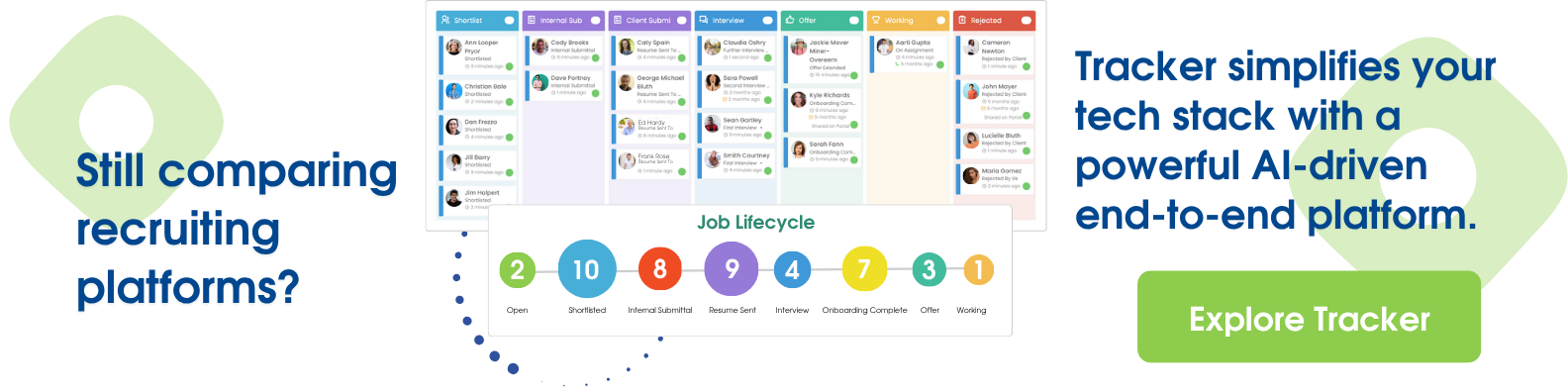
Tracker combines integrated ATS and CRM functionality with marketing automation in a single platform designed specifically for staffing agencies. This system eliminates the need for multiple separate tools while delivering everything needed for professional recruitment operations.
The platform’s automation capabilities reduce recruiter workload through intelligent candidate matching, automated interview scheduling, and personalized communication sequences. Built-in compliance tools help agencies meet regulatory requirements without manual oversight.
The onboarding process integrates with existing workflows through pre-built connectors for major job boards, accounting systems, and communication platforms. This integration approach minimizes disruption while maximizing immediate productivity gains.
If your agency still uses separate tools for CRM, ATS, and marketing, you’re working harder than necessary. Integration helps agencies get time back, cut down on errors, and focus on building relationships that generate revenue.
Ready to upgrade your staffing tech stack? Tracker’s recruitment platform brings CRM, ATS, and marketing together in one system designed for staffing agency success.