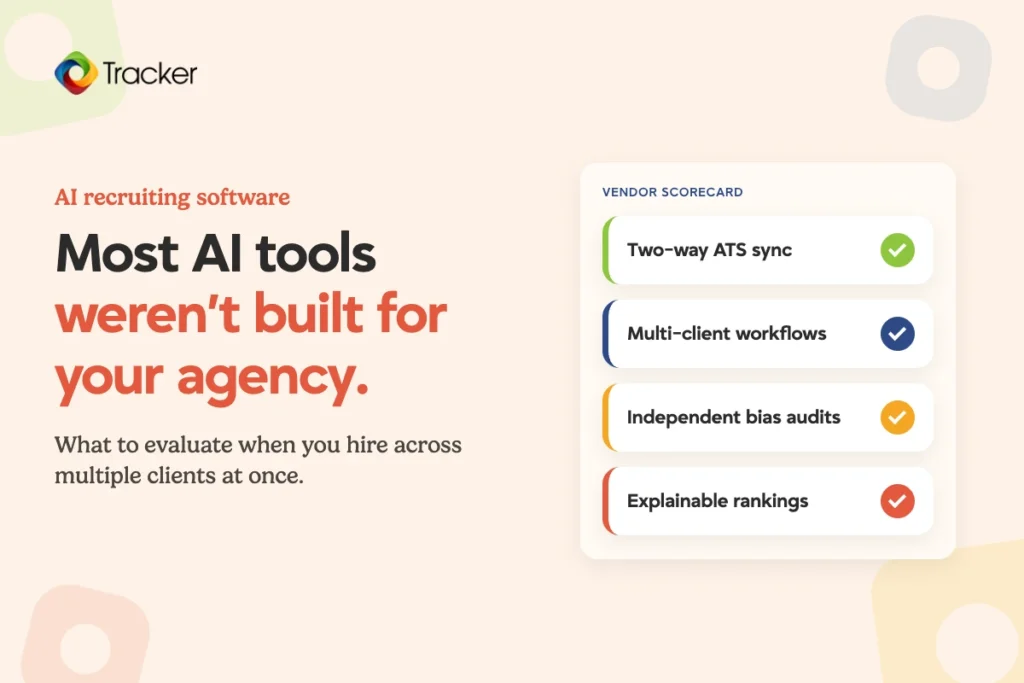

Most “best ATS for staffing agencies” articles follow the same formula. Rank ten platforms, crown a winner, move on. What they rarely do is help you work out which kind of applicant tracking system actually fits the way your agency runs.
That gap matters. Nearly 98% of Fortune 500 companies already use an ATS, and staffing agencies are no different. In 2026 the question isn’t whether to use one. It’s which type belongs in your tech stack.
So this piece does it differently. Instead of picking favourites, it explains how applicant tracking systems are classified, maps those types onto real platforms, and gives you a simple framework for matching the right category to your agency.
Types of applicant tracking systems
Before comparing platforms, it helps to know how applicant tracking systems break down. Three lenses matter most for anyone buying staffing agency software: size, functional scope, and who the platform is built for. Each one narrows the field in a different way.
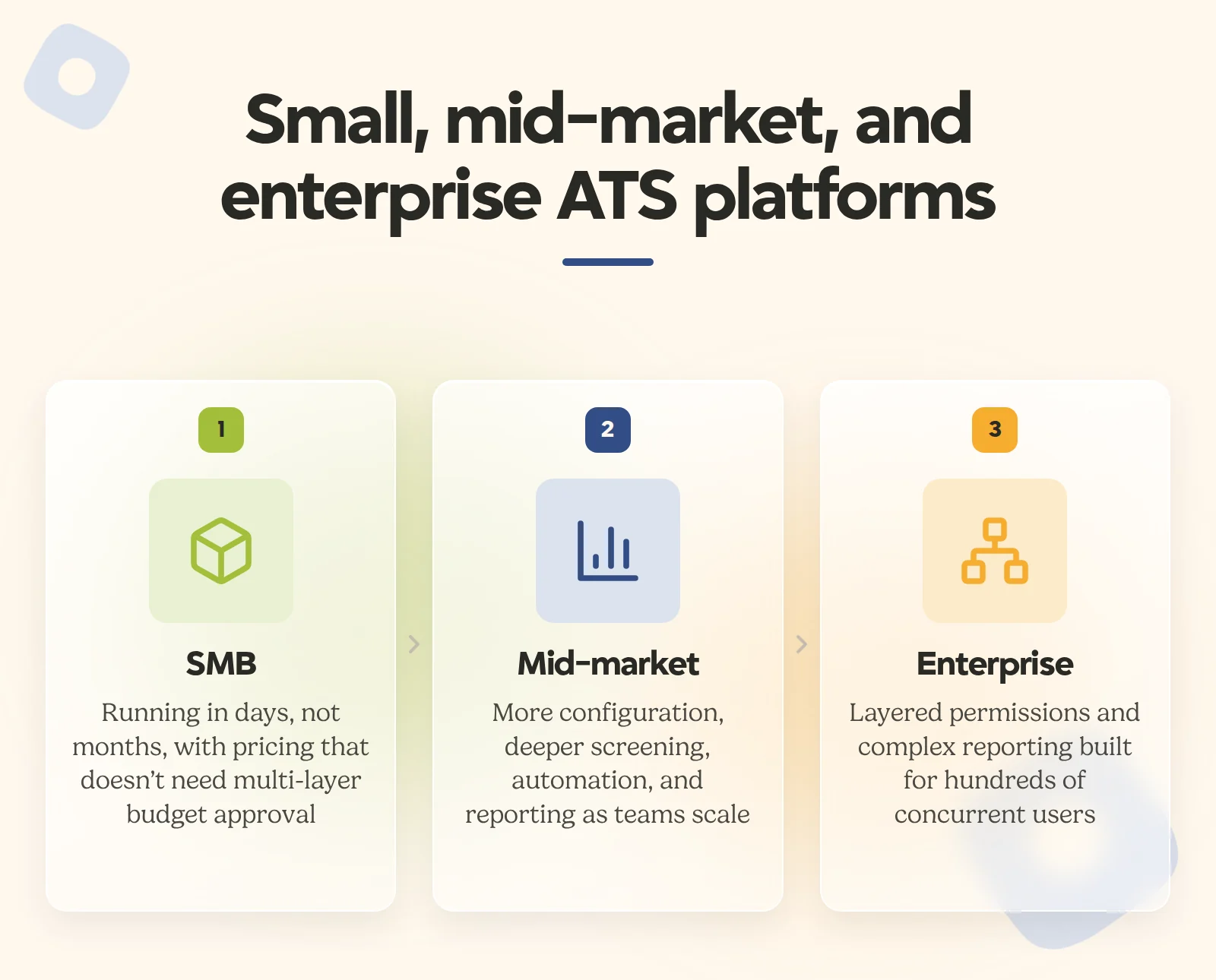
Small, mid-market, and enterprise ATS platforms
- SMB platforms get a small team up and running in days, at a price that doesn’t need three layers of budget sign-off, and help smaller agencies cut recruitment costs from day one.
- Mid-market platforms handle more users and more configuration. Screening, workflow automation, and reporting all go deeper, for agencies that have outgrown a bare-bones setup.
- Enterprise ATS platforms support large teams with layered permissions and complex reporting across hundreds of users at once. The trade-off is the rollout, which usually takes months, not weeks.
Standalone, integrated, and AI-driven ATS platforms
- Standalone ATS platforms do applicant tracking and nothing else. No CRM, no sales tools, just the candidate pipeline.
- Integrated ATS and CRM platforms keep candidate data and client records in one system, so recruiting and business development work from the same picture. This is the distinction people mean when they compare an ATS and CRM against separate point solutions, or weigh up ATS vs CRM as a buying decision.
- ATS modules inside HR suites package applicant tracking as one feature of a broader HR platform, often without being built for recruiting.
- AI-powered applicant tracking systems lead with candidate matching, resume parsing, Boolean search, and AI-powered sourcing. For more on how modern ATS recruiting software handles these, that breakdown covers the detail.
Staffing ATS vs corporate ATS platforms
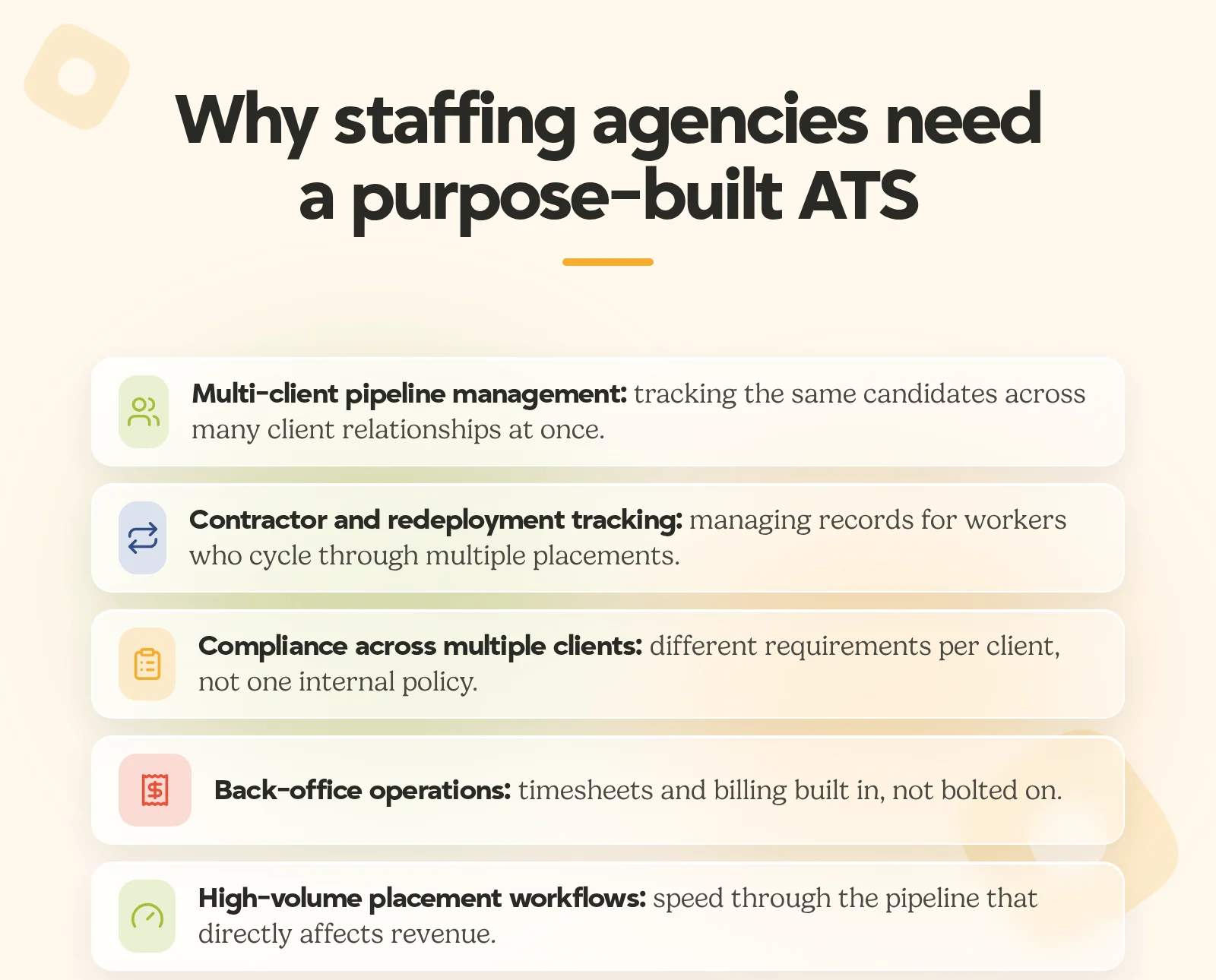
US staffing companies employed an average of two million temporary and contract workers a week in Q4 2025. At that scale, what an agency needs from its ATS looks nothing like an in-house team’s needs. Staffing ATS software has to handle:
- Multi-client pipelines, tracking the same candidates across many client relationships at once
- Contractor and redeployment tracking, keeping one central record for workers who move through placement after placement
- Compliance across multiple clients, where every client brings different requirements instead of one internal policy
- Back-office work like timesheets and billing, which corporate platforms don’t need
- High-volume placement, where speed through the funnel affects revenue directly. 66% of candidates accepted an offer because of a positive hiring experience, and 36% withdrew after a bad interview, so communication and engagement aren’t nice-to-haves
Agencies without strong applicant tracking system integration between recruiting and the back office feel these gaps every day, as a disconnected tech stack slows placements down. An ATS for recruiters placing across multiple clients has to be built for that reality from the start.
How leading staffing ATS platforms compare
The applicant tracking system market is projected to grow from $3.28 billion in 2025 to $4.88 billion by 2030, an 8.2% CAGR. That means more platforms to choose from, and more noise. The table maps the categories above onto real platforms, so you can see where each one sits.
| Platform | Type | Core positioning |
|---|---|---|
| Bullhorn | Enterprise, staffing-specific | Built for large staffing operations, with deep workflow customisation, high user volumes, and a broad integration ecosystem |
| Avionté | Staffing-specific with back office | Combines applicant tracking with payroll, billing, and back office for temp and light industrial staffing |
| Vincere | Mid-market, staffing-specific | Designed for staffing and search firms, with ATS, CRM, and analytics in one platform |
| Tracker | Staffing-specific, integrated ATS and CRM | A full operational platform combining applicant tracking, CRM, automation, and back-office tools built for staffing agency workflows |
| Zoho Recruit | Standalone to mid-market, broad audience | Part of the wider Zoho ecosystem, serving both staffing agencies and corporate HR teams with modular pricing |
| Recruiterflow | SMB to mid-market, integrated ATS and CRM | Built for boutique and mid-size agencies, combining applicant tracking with candidate relationship management |
| Ceipal | AI-driven, staffing-focused | AI-first, with candidate scoring, job distribution, and VMS integration for staffing firms |
| Loxo | AI-driven, integrated ATS and CRM | Centred on AI-powered sourcing and outreach, with a built-in CRM for smaller to mid-market recruiting teams |
| Manatal | SMB, AI-driven | A lightweight AI-powered platform with candidate sourcing and a simple interface, for small teams and agencies |
Each one sits somewhere different in the categories above. For real-world stories of how they perform, these applicant tracking system examples are worth a look.
Matching the best ATS for staffing agencies to your team
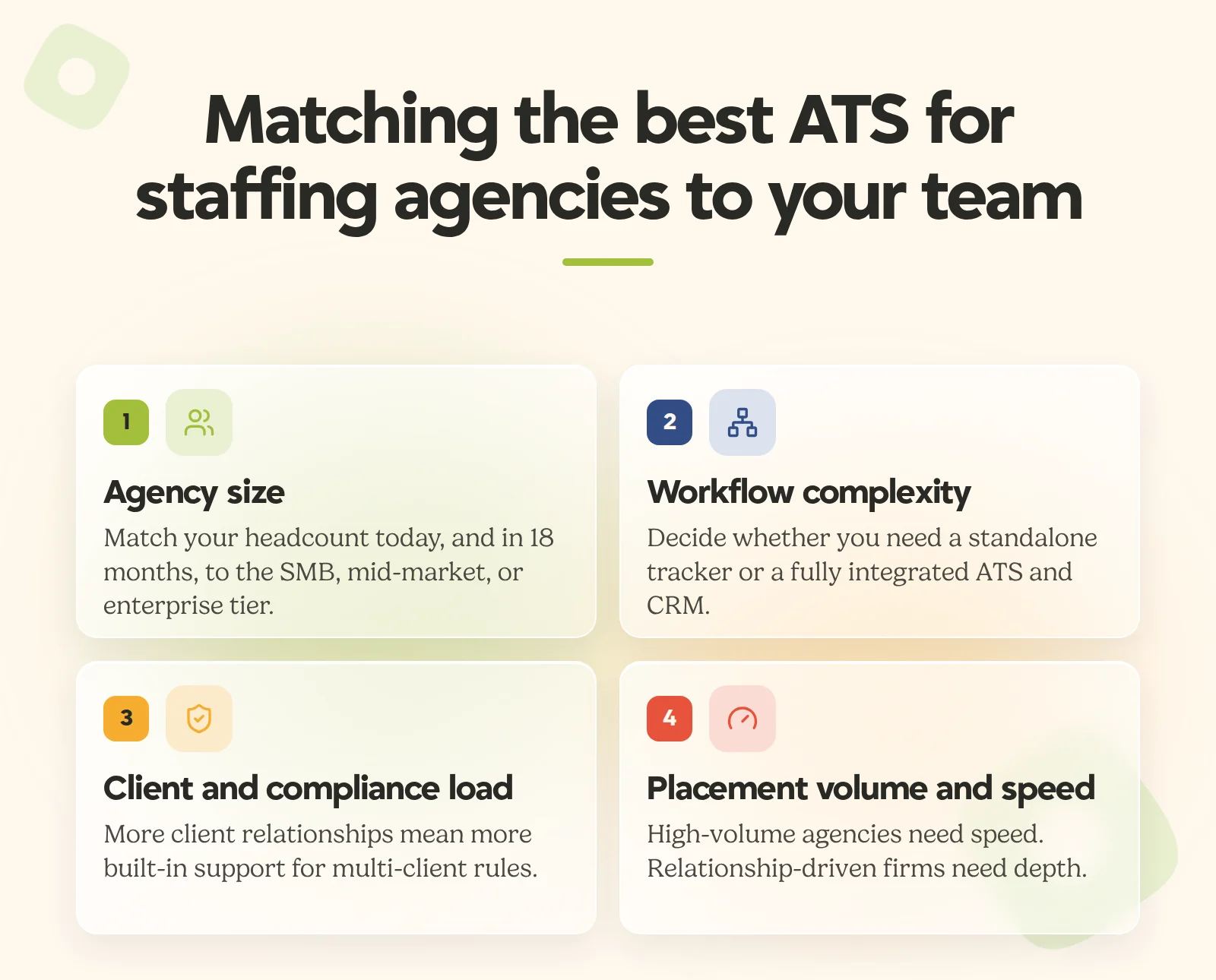
Finding the best ATS for staffing agencies starts with four questions, tied to the categories above:
- Agency size and growth stage. A five-person shop placing into two verticals needs something different from a 200-recruiter firm across six states. Match your headcount today, and where you expect to be in 18 months, to the SMB, mid-market, or enterprise tier.
- Workflow complexity. Does your team need a standalone tracker, or an integrated ATS and CRM that connects candidate data to client records and sales activity? An applicant tracking system workflow that mirrors how your recruiters already work gets adopted faster.
- Client and compliance load. The more clients and compliance layers you manage, the more your ATS needs built-in support for multi-client rules, not one-size-fits-all settings.
- Placement volume and speed. High-volume agencies working a large talent pool need speed. Relationship-driven search firms need depth in candidate profiles and structured hiring workflows.
If you’re already weighing a switch, these essentials to consider when transitioning to a new ATS will help you map your criteria. And if your answer is “staffing-specific, integrated ATS and CRM”, here’s what that looks like in practice.
Tracker: a staffing-specific ATS and CRM for the whole agency
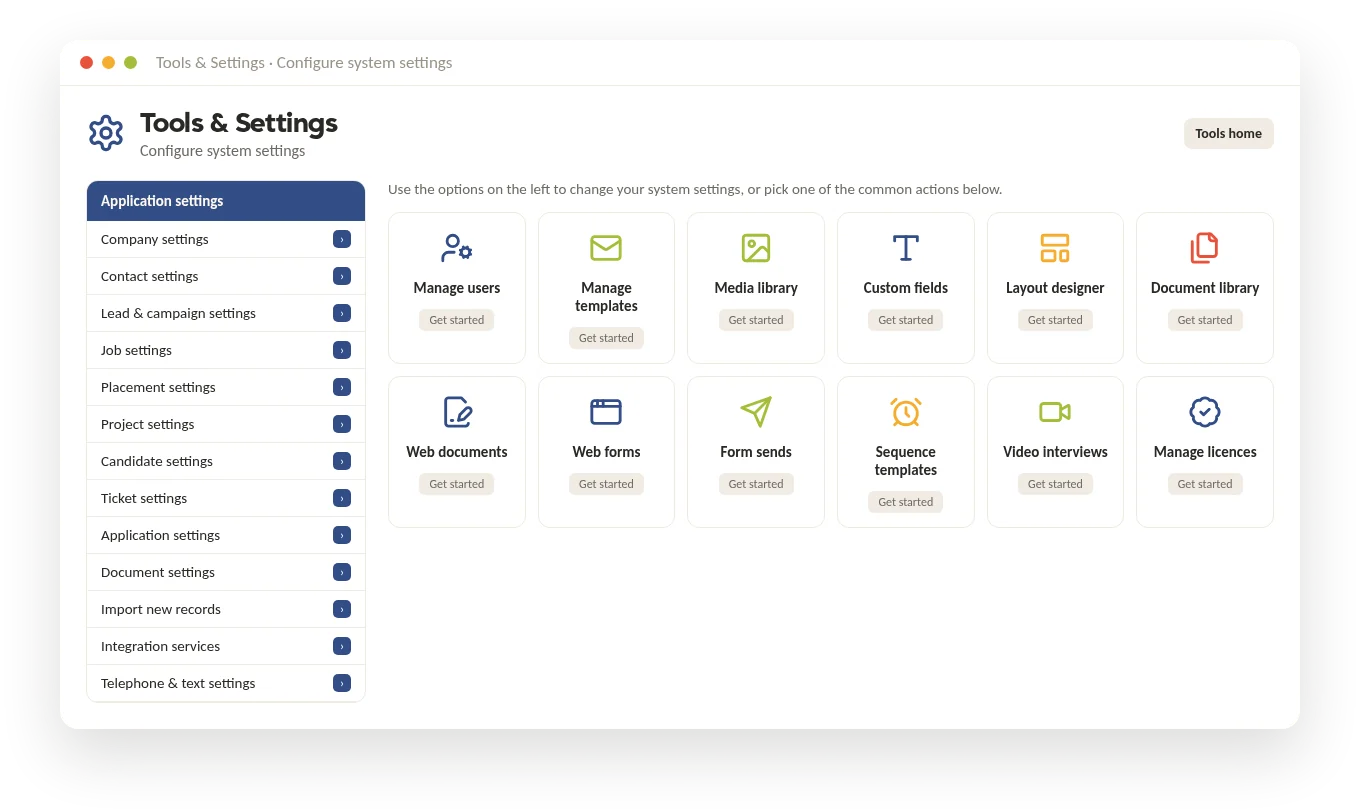
Tracker’s recruitment and applicant tracking features cover recruiting, sales, automation, and the back office in one platform. For staffing teams, that means:
- Resume parsing that pulls in a candidate’s full history (employment, education, and skills) automatically, so nobody’s retyping at volume
- Candidate search across 80+ filterable fields, with Boolean and semantic search for fast, precise queries across the whole database
- AI ranking that weighs resume match alongside engagement history, so the strongest candidates surface first without anyone sorting by hand
- One-click job posting to 1,000+ job boards, instead of publishing the same role site by site
- A fully featured mobile app, so recruiters can work candidate and client records away from the office without losing anything
Choose the ATS that fits how your agency works
The best applicant tracking system for staffing agencies isn’t one product. It’s the type that matches your size, workflow, client load, and placement speed. Use the framework above to narrow the field, then test your shortlist against how your team actually works.
The platform handles the process. Your recruiters handle the people.
Request a demo to see how Tracker’s integrated ATS and CRM supports the whole agency.